By 2026, more than half of IT spending, 51 percent, will be in the public cloud solutions. However, security is the most referred concern by 83 percent of organizations that implement hybrid cloud architectures. The dilemma is evident: how do organizations secure data and apps in an increasingly complicated environment that encompasses on-premises data centers, private clouds and public clouds?
Perimeter-based security is no longer adequate. Contemporary threats use inter-environmental gaps, inconsistent policies, and the challenge of using a variety of security tools across platforms.
Regardless of whether you are a CISO crafting a strategy, an IT architect building infrastructure, or a business leader considering cloud investments, it is essential to understand hybrid cloud security. This guide offers a practical framework, tools, and insights to ensure your hybrid cloud is secure.
What Is Hybrid Cloud Security?
Hybrid cloud security refers to the strategies, technologies, and processes used to protect data, applications, and infrastructure across public clouds, private clouds, and on-premises environments.
It addresses the unique challenges of assets moving dynamically between environments with different security models, compliance requirements, and operational processes. Unlike traditional security that relies on fixed perimeters, hybrid cloud security assumes threats can come from anywhere, requiring consistent controls across all platforms.
Effective hybrid cloud security includes:
- Identity and access management to control who can access what
- Data protection across all environments
- Network security for safe connectivity
- Compliance monitoring to meet regulatory requirements
- Threat detection and response for rapid mitigation
At the same time, it must preserve the flexibility and scalability that make hybrid cloud attractive to organizations.
Why Hybrid Cloud Security Matters for Modern Organizations
1. The Business Case for Security Investment
Breach of cloud data is costly. It reached an average cost of $4.88 million in 2024. This is exacerbated in hybrid cloud environments where breaches require 27% more time to detect and contain.
But here’s the good news. Organizations that have good hybrid cloud security reap actual rewards:
- 23% faster threat detection
- 31% reduced cost of incident response.
- 65% fewer business disruptions
- 14 percent increase in the growth of revenue in the industries that depend on clouds.
The math is simple. The security investment in most companies pays back in 18 months. The reduced incidences, improved efficiency, and compliance are savings.
In the case of IT teams, security is not a matter of preventing bad guys. It’s about moving faster. Effective security systems reduce the deployment time by 40 percent. New applications are introduced in the market 3-4 weeks earlier.
2. Compliance and Regulatory Requirements
The issue of compliance is becoming complex. There are several regulations that organizations have to address simultaneously:
- GDPR for European customers
- HIPAA for healthcare data
- SOC 2 of service organizations.
- Payment processing PCI DSS.
- NIS2 Critical infrastructure Directive.
This is more difficult with hybrid cloud. One set of rules may have your data residing in an on-premises server. It is however processed in a shared cloud with varying requirements.
Select a hospital to analyze data on AWS. HIPAA regulations keep patient records on-site. However, the analytics are occurring in AWS through their shared responsibility model. Protection of both environments is required, but the regulations are varied.
The price of making this error is higher than penalties. Businesses are penalized with contracts, increase in insurance premiums, and business opportunities.
You May Also Like: Discord Data Breach Explained: What Every User Must Know
Types of Hybrid Cloud Security Models
Not every hybrid cloud security strategy is similar. It will depend on your data, applications, and business requirements. These are the three primary models.
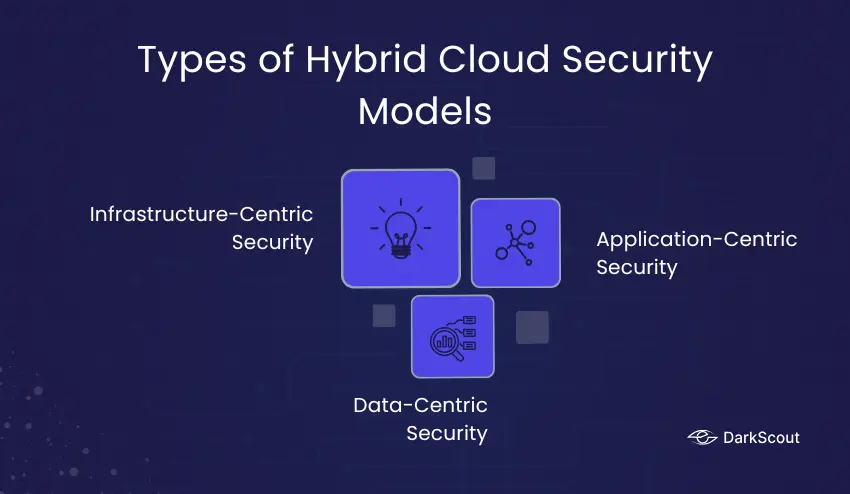
1. Infrastructure-Centric Security
This model is aimed at safeguarding the underlying systems and networks. Imagine firewalls, intrusion detection and network monitoring.
Infrastructure-based security is effective in:
- Companies that have intensive on-premises investments.
- Strict data residency industries.
- The slow migration of legacy applications.
The strategy views security as putting walls around your castle. There are tough walls that cover the interiors. However, it has the potential to slow down cloud adoption and impose bottlenecks on the development teams.
Example: An organization that provides financial services stores the information about customers on-site and behind several firewalls. They rely on the cloud services to perform non-sensitive analytics and all the data movement is tightly controlled by network.
2. Application-Centric Security
This model implements security right into applications and workloads. Your apps are secure wherever they go.
Application-centric security includes:
- Runtime application self-protection (RASP).
- Container security measures.
- API security gateways
- Code level scanning of vulnerabilities.
This is suitable to cloud-native organizations and DevOps teams. Security does not enter the development process as an additional layer.
Example: A SaaS firm incorporates security checks in each microservice. The security controls are automatically transferred with the application when they are deployed to other cloud regions.
3. Data-Centric Security
No matter where the information resides or how it is processed, this model guards information itself.
Key components include:
- At rest and in transit encryption.
- Data loss prevention (DLP) applications.
- Rights management and classification.
- Tokenization and masking
Organizations that deal with sensitive information such as healthcare records, financial information or intellectual property need data-centric security.
Example: A medical practitioner secures patient information using keys that remain on-site. The information may be processed in public clouds to conduct research, however, the real information can be accessed by authorized users with the help of proper keys.
7 Critical Hybrid Cloud Security Challenges
There are distinct security challenges encountered by each organization in the management of hybrid environments. These are the most prevalent problems and their effect on the business.
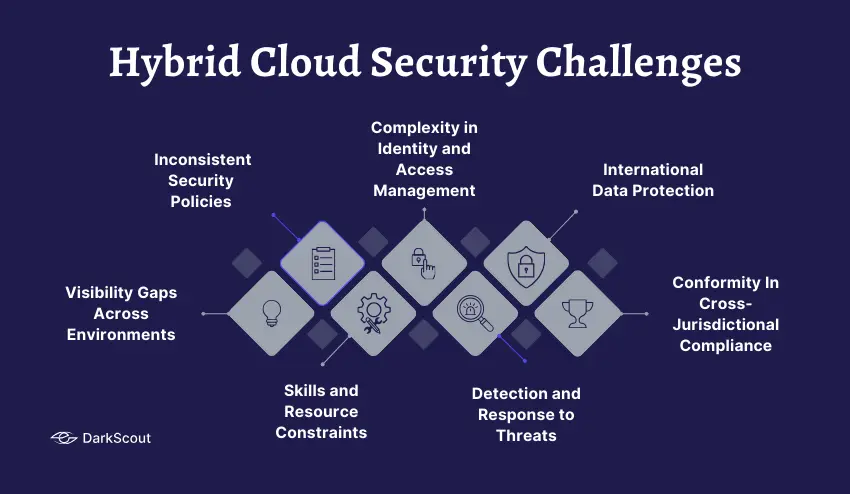
1. Visibility Gaps Across Environments
It is impossible to safeguard what is not visible. This is the greatest issue with hybrid cloud security.
The various monitoring tools employed by most organizations in each environment are:
- On-premises SIEM systems
- Cloud-native security dashboard.
- Third-party monitoring solutions.
The result? Security teams are wasting 40 percent of their time trying to even understand what is going on in their infrastructure. Blind spots provide attackers with the chance to operate without being detected.
Impact: 73 % of security incidents are on assets that were not duly inventoried or monitored.
2. Inconsistent Security Policies
Security rules are usually different in different environments. What is blocked on-premise may be permitted in the cloud.
This happens because:
- Old systems have obsolete policy models.
- There are various control mechanisms of cloud platforms.
- Policies are dealt with by teams independently.
Impact: 58% of security incidents and a 34 percent higher rate of compliance audit failures are due to policy inconsistencies.
3. Complexity in Identity and Access Management
Controlling user access in any of the multiple environments is a nightmare. Different systems require different credentials to be used by the users. Permission is not automatically synchronized.
Common problems include:
- Orphaned accounts that are not deactivated.
- Users who have too much access rights.
- Shadow IT establishes openings that are not managed.
- Unclear access requirements by contractors and vendors.
Impact: 80 percent of data breaches are related to compromised credentials or too many user privileges.
4. International Data Protection
Your data is transferred between environments at all times. Every transfer poses a security gap.
Key risks include:
- Unencrypted data in transit
- Uncoordinated backup and recovery processes.
- Sovereignty and data residency breaches.
- Platform incompatibility in encryption standards.
Impact: 1.76 million dollars per incident on average and frequently provoke regulatory fines.
5. Conformity In Cross-Jurisdictional Compliance.
Various industries and nations have varying regulations. Your hybrid cloud may cut across different regulatory areas.
This brings some problems such as:
- Competing data residency requirements.
- Varied audit and reporting criteria.
- Different breach notification dates.
- Compliance systems in the industry.
Impact: The average fines and legal costs of multi-jurisdictional compliance violations are 5.4 million.
6. Detection and Response to Threats.
Attackers are not concerned with your environment boundaries. However, your security tools may not be conversant.
Detection problems include:
- Multiple security systems fatigue.
- Delayed reaction to incidents in environments.
- Weak forensic capabilities on clouds.
- Challenges in cross-platform threat correlation.
Impact: Fragmented threat detection is associated with 287 days of additional time to detect and contain breaches in organizations.
7. Skills and Resource Constraints
Hybrid cloud security involves skills in various fields. The majority of organizations lack the adequate professionals.
The skills gap includes:
- Cloud security architecture.
- Multi-platform incident response.
- Governance and compliance systems.
- Orchestration and automation software.
Impact: 67 percent of organizations postpone cloud projects because of lack of skills in security, which costs them an average of 2.1 million dollars per year in lost opportunities.
9-Step Hybrid Cloud Security Implementation Framework
Secure hybrid cloud architecture does not occur in a day. This framework divides the process into manageable stages having distinct timelines and success indicators.
Phase 1: Assessment and Planning (Steps 1-3)
Timeline: 4-6 weeks
Important stakeholders: IT architects, compliance teams, security leaders.
Step 1: Complete Security Inventory and Risk Assessment
Begin by knowing what you are, and what you are not.
Create an inventory of:
- Types of all data and the level of sensitivity.
- Dependencies and current applications.
- Available security tools and security gaps.
- Network connections, data flows.
- Patterns of user access and degree of privilege.
Rank your most vital assets using a risk scoring matrix. Target those systems that process sensitive information or those that facilitate business-critical processes.
Success measure: Have a full asset inventory with risk scores on 95 percent of your infrastructure in 2 weeks.
Step 2: State Your Architectural Vision of Security.
Draw your target state security architecture. This forms your north star on all decisions to be implemented.
Your architecture should address:
- Identity and access control in any environment.
- Information security measures on various types of data.
- Segmentation and network security controls.
- Incident response and monitoring capabilities.
- Jurisdiction requirements on compliance.
Success metric: Approved architecture, signed by security, IT and business stakeholders.
Step 3: Develop Implementation Roadmap and Budget
Divide your vision into projects that have timelines, resources and dependencies.
Prioritize based on:
- Risk reduction impact
- Compliance requirements
- Business enablement value
- Resource availability
Success measure: Board-approved roadmap with budget and success measures.
Phase 2: Architecture and Deployment (Steps 4-6)
Timeline: 12-18 weeks
Noteworthy stakeholders: IT architects, DevOps teams, security engineers.
Step 4: Develop Identity and Access Management Foundation.
Hybrid cloud security relies on IAM. Get this right first.
Deploy solutions for:
- Single sign-on (SSO) all over.
- The authentication of each person by using multi-factors.
- PAM Administrator privileged access management (PAM).
- Temporary permissions on demand basis.
Start with the weakest systems and users. Expand gradually not to disrupt business.
Success measure: 90 percent user access in case of IAM centralization within 8 weeks.\
Step 5: Protection and Encryption of Data.
It is also confidential that your data is regardless of the point of delivery or storage.
Implement:
- Any sensitive information should be encrypted when it is not in use.
- Security of transport layer in-flight.
- The management systems that have been well rotated.
- Data loss prevention policies.
- Recovery and backup processes.
Success measures: 100 percent encryption of sensitive information with centrally managed keys in 6 weeks.
Step 6: Network Security and Surveillance.
Offer equal security in all places.
Deploy:
- Next-generation firewalls (NGFWs).
- Segmentation of the network (Zero trust based).
- Intrusion detection systems and intrusion prevention systems.
- Security information and event management (SIEM).
- Cloud security posture management (CSPM).
Success measure: 360 degree security monitoring, inbuilt security monitoring in 10 weeks.
Phase 3: Operations and Optimization (Steps 7-9)
Timeline: 8-12 weeks
The most important stakeholders: Security operations, DevOps, business units.
Step 7: Automation of Security Operations.
Automation of manual work and response time.
Automate:
- Detection of threats and correlation of alerts.
- Playbooks on incident response.
- Compliance reporting and auditing.
- Enforcement of security policy.
- Workflows of vulnerability management.
Success measure: 75 percent of regular security activities automated in 6 weeks.
Step 8: Train Teams and set up Governance.
People and processes are the only things that make you secure.
Establish:
- Different position security training.
- Response procedures and communication plans.
- Security update change management.
- Periodic security testing and intrusion testing.
- Vendor risk management initiatives.
Measuring success: Within 4 weeks, all the team members have been trained on documented procedures.
Step 9: Continuous Monitoring and Improvement.
Security is never complete. Constant improvement of construction.
Implement:
- Security posture testing periodically.
- Assimilation of threat intelligence.
- KPI control and performance indicators.
- Improve the process by feedback loops.
- Technology refresh and upgrade.
Measure of success: Security review monthly with a document of improvements and measures of success.
Hybrid Cloud Security Architecture
A hybrid cloud security architecture is a type of security framework that offers one comprehensive security system in on-premises, private cloud and public cloud systems. It does not treat the environments as isolated systems, but instead, it implements uniform policies with security controls being applied where workloads are actually executed.
On a high-level, the hybrid cloud security architecture is constructed on the following basic components:
- Centralized IAM, MFA, and least-privilege access. Identity-first access control.
- Segmentation, secure connectivity, and traffic inspection of a Zero Trust network design.
- Encryption of data at rest and in transit, key management, and data loss prevention.
- Logging, SIEM, and cloud security posture management are used to monitor and have centralized visibility.
- Policy enforcement is automated to minimize misconfigurations and maintain constant compliance.
With identity, data, network, and monitoring layers aligned into one architecture, organizations can minimize security gaps, enhance visibility, and ensure high protection as workloads traverse across hybrid environments.ganizations can reduce security gaps, improve visibility, and maintain strong protection as workloads move across hybrid environments.
Hybrid Cloud Security Solutions & Tools
To achieve a hybrid cloud environment, it is necessary to have special platforms and tools that are capable of delivering visibility, control, and threat protection to both the public and the private cloud. The following are some of the best solutions:
| Tool / Platform | Best Use Case | Key Features | Pricing Range |
| Palo Alto Prisma Cloud | Comprehensive hybrid and multi-cloud security | Cloud workload protection, vulnerability scanning, compliance monitoring, network security | Custom pricing based on resources |
| Microsoft Defender for Cloud | Integration with Azure and hybrid workloads | Threat detection, continuous security assessment, automated remediation | Free tier + pay-as-you-go plans |
| Check Point CloudGuard | Large enterprise hybrid deployments | Cloud posture management, threat prevention, identity security, policy enforcement | Custom enterprise pricing |
| Trend Micro Hybrid Cloud Security | Protecting workloads across AWS, Azure, and on-prem | Automated workload security, container security, intrusion detection | Subscription-based; contact sales |
| McAfee MVISION Cloud | Governance and data protection in hybrid environments | CASB functionality, DLP, threat intelligence integration | Contact vendor for pricing |
How to Choose the Right Tool:
- Assess your current cloud architecture and workloads.
- Decide on whether workload protection, compliance monitoring or threat detection is required.
- Take into account the ability to integrate with the current security and DevOps tools.
- Test usability and coverage using trial programs or pilot programs.
Best Practices of Hybrid Cloud Security by Role.
Various roles have different security roles. This is what the teams should concentrate on.
For CISOs and Security Leaders
Top priorities:
- Develop single security policies in all environments.
- Measure security ROI using business relevant measures.
- Invest in cloud security skills team training.
- Periodically test incident response procedures.
Action point: Construct governance structures that are effective regardless of data being on-premise or in the cloud.
For IT Architects and Engineers.
Top priorities:
- Architecture that is built on zero trust.
- Install identity and access management centralization.
- Encrypt all data and have a key management center.
- Enforce security policies automatically.
Action point: Auto deploy uniform security controls across all environments using infrastructure as code.
Devops and Development Teams.
Top priorities:
- Add security testing to the pipelines.
- Use ready base images and templates.
- Apply authenticated and rate limited API security.
- Monitor security issues in manufacturing.
Action key: Take security into consideration by discovering and fixing vulnerabilities during the early development stages, instead of fixing the vulnerabilities after the system has been implemented.
For Business Leaders
Top priorities:
- Aware of business impact security threats.
- Money to computerize compliance.
- Education on support security to every employee.
- Establish crisis management and incident response plans.
Action point: Pay attention to security practices and business KPIs to demonstrate value and maintain executive sponsorship.
Conclusion
Hybrid cloud security is no longer an option. As 51% of IT spending will be in clouds by 2026, organizations that will master hybrid security will have competitive advantages as other organizations continue to face more risks.
The point is to make security a facilitator rather than a hindrance. A properly designed hybrid cloud security lowers the friction of deploying it and allows quicker innovation. Begin with centralized identity control, uniform encryption, and centralized surveillance.
Make use of the 9 step model and checklist here to create momentum. It should be kept in mind that security is a process that needs constant enhancement and adjustment to emerging threats.
Waiting costs more than the cost of acting does. Each month of delay exposes you to greater risks and complicates and makes the implementation more costly.