Running a business today means handling data. Customer details, payment records, employee information, it all lives somewhere on your systems.
And with that data comes responsibility.
Governments and regulatory bodies around the world have created rules about how businesses must protect that data. Follow the rules, and you’re compliant. Ignore them, even accidentally, and the consequences can be devastating.
That’s what cybersecurity compliance is about. And in 2025, it matters more than ever.
What Is Cybersecurity Compliance?
Cybersecurity compliance means following the security standards, laws, and regulations that apply to your industry and the type of data you handle.
It’s not just about having a firewall or a strong password policy. It means proving, through documented controls, processes, and audits, that you’re actively protecting the data in your care.
Think of it as aligning your internal security practices with legal, regulatory, and industry-specific standards. Whether you’re handling personal information, financial records, or healthcare data, compliance requirements exist to protect both your customers and your business.
A business that is compliant isn’t just ticking boxes. It’s demonstrating to customers, partners, and regulators that it takes data protection seriously.
Why Does It Matter?
A lot of businesses treat compliance as something to deal with once a year before an audit. That’s a dangerous mindset.
Global non-compliance fines reached approximately $14 billion in 2024. Regulators are not slowing down. They’re getting faster, bolder, and more aggressive with enforcement.
The global economic impact of cybercrime is estimated to rise from $9.22 trillion in 2024 to $13.82 trillion by 2028. Compliance isn’t just a legal obligation; it’s one of the most important lines of defence a business can maintain.
And it’s not only the fines you need to worry about. The reputational damage from a publicised breach can take years to recover from. Some businesses never do.
The Regulations You Need to Know
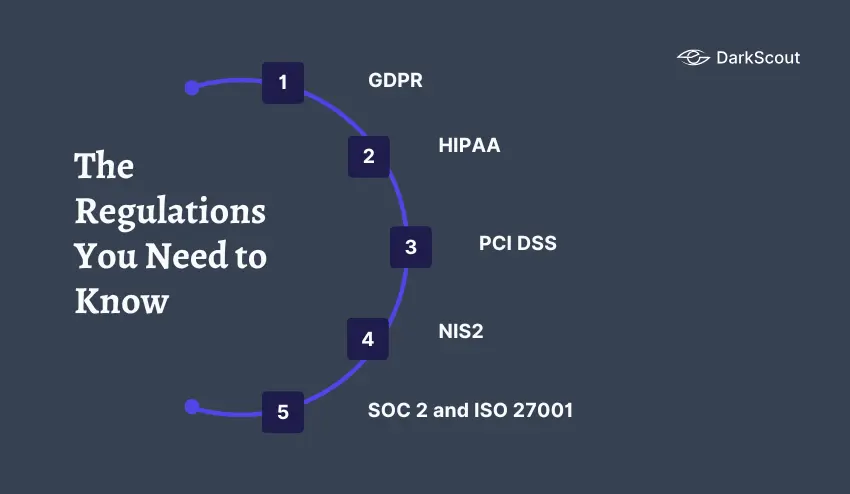
Different industries are governed by different frameworks. Here are the most important ones in 2025.
1. GDPR
The General Data Protection Regulation applies to any organisation that handles the personal data of people in the European Union — regardless of where your business is based.
Under GDPR, businesses must have clear consent for data collection, follow strict protocols for storing data, notify authorities of breaches within 72 hours, and give individuals the right to access, correct, and delete their personal data.
Fines for non-compliance can reach up to €20 million or 4% of annual global turnover, whichever is higher.
The enforcement is real. In October 2024, LinkedIn was fined €310 million for processing user data without proper consent. In May 2025, TikTok was fined €530 million for unlawfully transferring data. These aren’t small companies. No one is too big — or too small — to be exempt.
2. HIPAA
If your business operates in healthcare in the United States, HIPAA governs how you handle patient information.
Non-compliance fines range from $100 to $50,000 per violation, with a maximum annual penalty of $1.5 million.
In January 2025, Solara agreed to pay $3 million to settle HIPAA violations after a breach exposed the records of over 114,000 individuals. The breach happened. Then they sent notifications to the wrong addresses. Both mistakes carried consequences.
3. PCI DSS
If your business accepts card payments, you fall under the Payment Card Industry Data Security Standard.
Non-compliance can result in fines of between $5,000 and $100,000 per month. Updated PCI DSS 4.0 guidelines now emphasise real-time threat monitoring and secure software development, raising the bar for what “compliant” actually means.
4. NIS2
The NIS2 Directive is an update to the original NIS published in 2016. It aims to strengthen cybersecurity resilience across critical infrastructure in the EU — and it holds top management directly accountable for compliance failures.
Penalties for non-compliance can reach up to €10 million or 2% of global turnover.
What makes NIS2 different is the personal accountability angle. It’s not just the company that faces consequences — executives and senior managers can be held personally liable.
5. SOC 2 and ISO 27001
These are more like frameworks than laws, but they are quite influential, especially for tech companies or those who provide services to other companies.
SOC 2 is based on the five Trust Services Criteria of Security, Availability, Processing Integrity, Confidentiality, and Privacy. It is more about proving you are achieving certain criteria, which can be more flexible but more challenging to prove.
ISO 27001 is the global standard for information security management, and getting the certification tells clients you are serious about your information security.
What Happens When You Don’t Comply?
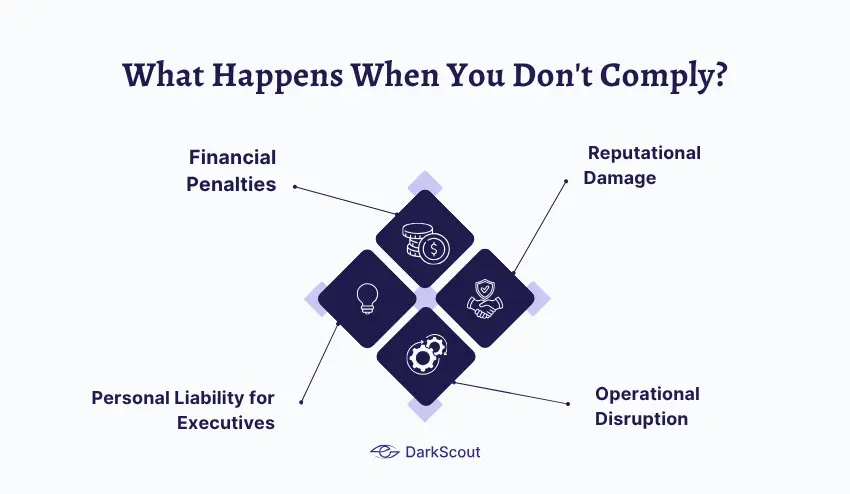
Let’s be direct about what non-compliance actually costs.
1. Financial Penalties
The fines are large and getting larger. In 2025, AML fines increased by approximately 417% in the first half of the year compared to the same period in 2024.
According to IBM’s 2024 report, the average total cost of a data breach is $4.88 million, and that’s before regulatory fines are added on top.
2. Reputational Damage
The financial hit is only part of the story.
When you search for SolarWinds online, a mention of their cyberattack appears in the first results. Their stock price dropped from $24.83 in December 2020 and has still not recovered, hovering around $11 in 2024.
Customers remember. Partners remember. Investors remember.
3. Personal Liability for Executives
This is where it gets personal.
Regulations, including NIS2, hold senior leaders directly accountable for ensuring compliance, with personal fines and legal consequences possible in cases of negligence.
It’s no longer just the company on the hook. CEOs, CISOs, and board members are increasingly being held responsible when security failures happen on their watch.
4. Operational Disruption
It takes an average of 194 days to detect a breach, giving attackers more time to steal data and embed ransomware before anyone notices.
During that time, and in the recovery period that follows, operations are disrupted. Systems go offline. Staff scramble. Revenue stops. Unplanned downtime alone can cost industrial firms as much as $125,000 per hour.
The Dark Web Connection Most Businesses Miss
Here’s something most compliance guides don’t mention.
A lot of compliance violations don’t start with a sophisticated attack. They start with a leaked credential, an employee’s username and password sitting on a dark web forum, waiting to be used.
Gartner predicts that 75% of businesses will face fines for non-compliance by 2025. DarkScout Many of those incidents trace back to exposed data that was never detected in time.
This is where DarkScout’s Dark Web Compliance Monitoring comes in. It continuously monitors dark web sources for any exposure of your organisation’s data — identifying breaches that could put you in violation of GDPR, HIPAA, or any other framework before regulators do.
Knowing about a breach before it becomes a reportable incident gives you the window to act, remediate, and stay on the right side of compliance.
How to Build a Compliance Programme That Actually Works
Compliance isn’t a one-time project. It’s an ongoing process. Here’s how to approach it properly.
- Be aware of the regulations that affect you– Begin with knowing your industry, the kind of data you deal with, and the areas where your customers are located. A healthcare business in the US has various responsibilities compared to a retail company that deals with customers in the EU.
- Conduct a risk assessment– Begin by having a clear image of your weaknesses. Test network setups, user access controls, third-party connections, and endpoints. Such audits must be done at least once a year.
- Document everything– It is important to keep a thorough documentation of your cybersecurity policies, response plans, and training programs. Documentation assists in proving compliance in case of audit and provides uniformity in the implementation of the same across departments.
- Train your people– A majority of the breaches are human. It can be ensured through regular training of your team to know their role in data protection, and what to do when something appears amiss.
- Monitor continuously– Obedience is not a position that one attains and leaves. New violations, new rules, and new threats are being created continuously. Constant monitoring – such as dark web monitoring – keeps you informed of threats on a real-time basis.
Common Compliance Mistakes Businesses Make
Treating compliance as a once-a-year exercise. Regulations change. Threats evolve. A compliance posture that was solid in January may have gaps by June. Continuous review is essential.
Underestimating third-party risk. Your compliance is only as strong as the vendors and partners who have access to your data. If they’re not compliant, your risk exposure grows, even if your own systems are secure.
Assuming small businesses aren’t targeted. Regulators don’t make exemptions based on company size. Many organisations struggle to stay fully compliant due to limited in-house expertise, budget constraints, and the complexity of overlapping global regulations, but that doesn’t reduce the penalties for failure.
Ignoring the dark web. Leaked credentials and exposed data often surface on dark web forums weeks or months before a formal breach is detected. Without monitoring, you’re operating blind.
The Bottom Line
Cybersecurity compliance isn’t optional anymore. It’s a core part of running a responsible, resilient business.
The regulations are getting stricter. The fines are getting larger. And the threat landscape is getting more complex every year.
But compliance isn’t just about avoiding penalties. It’s about protecting the people who trust you with their data, and building a business that can weather whatever comes next.
If you want to make sure your organisation isn’t unknowingly sitting on a ticking compliance time bomb, DarkScout’s Dark Web Compliance Monitoring gives you the visibility you need, continuously watching for exposed data before it becomes a regulatory problem.