Most people use the terms “dark web” and “deep web” as if they mean the same thing.
They don’t.
Mixing them up is one of the most common misconceptions on the internet, and it leads to two problems. Some people panic about the “deep web” when there’s nothing to worry about. Others dismiss the dark web as something that has nothing to do with them, when it very much does.
This guide clears it all up, plainly, honestly, and with real numbers behind it.
The Internet Is Bigger Than You Think
Before we compare the two, let’s zoom out.
The internet you use every day, Google, YouTube, Instagram, and your online banking, is actually the smallest visible slice of a much larger whole.
Think of it like an iceberg. The part above the water is what most people see. Everything else sits beneath the surface, hidden from plain view.
The surface web accounts for roughly 4% of the internet. The remaining 96% is the deep web, which includes private databases, email servers, and content not indexed by search engines. The dark web is a small but especially dangerous subset of that.
Let that sink in. Almost everything on the internet is invisible to a regular Google search.
What is the Surface Web?
This is the internet most of us know.
News sites, social media, online stores, search engines, and YouTube. If you can find it by typing something into Google, it lives here.
It feels enormous. But it’s just the tip of the iceberg, roughly 4% of the entire internet.
Everything else is out of reach for your regular browser.
What is the Deep Web?
The deep web is simply everything that search engines can’t index.
Your email inbox. Your online banking portal. Your Netflix account. Your medical records. Your company’s internal systems. None of these show up in a Google search, not because they’re dangerous, just because they’re private and password-protected.
The deep web makes up the vast majority of internet content. What’s certain is that password-protected databases, private intranets, and authenticated systems vastly outnumber publicly indexed pages.
Most of us move in and out of the deep web dozens of times a day without thinking about it. Every time you log into your bank or check your email, you’re in the deep web.
It’s completely normal. It’s not dangerous. It’s just private.
What is the Dark Web?
This is where it gets very different.
The dark web is a small, deliberately hidden section of the deep web. You can’t access it with Chrome, Safari, or any regular browser.
You need specialized software like the Tor browser, which routes your traffic through the Tor network’s relay system, entry node, middle relay, exit node to encrypt your connection and obscure your IP address.
That anonymity was originally built for good reasons. Journalists protecting their sources in dangerous countries. Whistleblowers sharing sensitive documents. Activists communicate freely in places where free speech is illegal.
But that same anonymity became a magnet for criminal activity.
About 57% of dark web sites involve illegal material, drugs, hacking tools, and worse. It’s where stolen data gets bought and sold. Where ransomware operators run their businesses. Where criminals can operate with very little fear of being traced.
As of March 2025, over 3 million people visit dark web platforms daily, with illegal websites making up about 60% of all domains.
That’s not a niche problem. That’s a massive, active, underground economy, running 24 hours a day.
Dark Web vs Deep Web – The Key Differences
Here’s a simple side-by-side so it’s crystal clear:
| Deep Web | Dark Web | |
|---|---|---|
| What it is | Unindexed but normal internet content | Hidden network requiring special software |
| How to access | Regular browser + login credentials | Tor browser or similar |
| Examples | Email, banking, medical records | Criminal marketplaces, hacking forums |
| Is it legal? | Yes, completely | Accessing it isn’t illegal, but much of what’s there is |
| Who uses it? | Everyone, every day | Criminals, activists, journalists, researchers |
| Size | ~96% of the internet | Less than 0.01% of the internet |
| Your risk level | Low — it protects your privacy | High — it’s where your stolen data ends up |
The biggest takeaway here: the deep web is not something to fear. The dark web is something to take seriously.
What Actually Lives on the Dark Web?
It helps to be specific about what’s really being traded there.
Dark web marketplaces in 2025 trade in stolen credentials, credit card data, counterfeit documents, illegal drugs, malware, ransomware-as-a-service kits, and access to compromised corporate networks.
And the prices are shockingly low. A credit card with a $5,000 balance has been listed for as little as $110. Full identity packages, known as “fullz”, which include name, SSN, date of birth, and financial details, can sell for $20 to $200 depending on credit score and country of origin.
Over 703 million personal data records were discovered on dark web marketplaces in 2024, a 28% increase from 2023.
These aren’t random strangers’ details. They belong to real people who trusted companies with their information, people who have no idea their data is being sold right now.
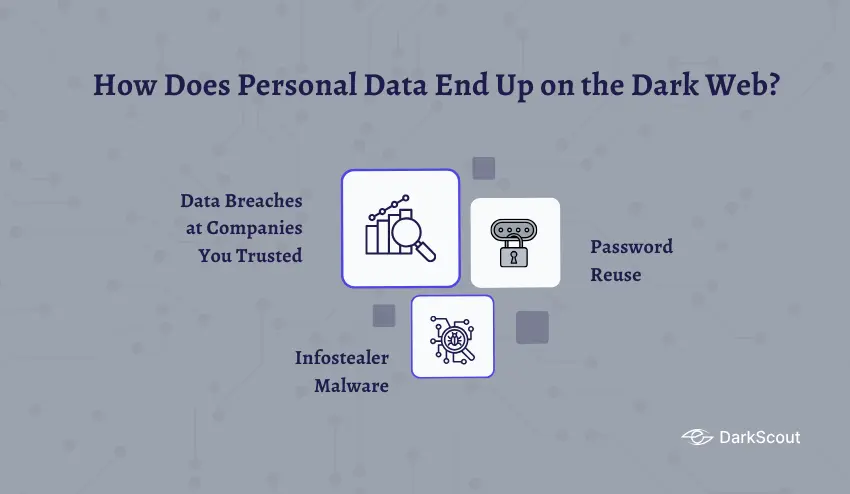
How Does Personal Data End Up on the Dark Web?
This is the part that matters most for everyday people.
Your data doesn’t end up on the dark web because you did something wrong. It ends up there because of things largely outside your control. Here are the most common ways it happens.
1. Data Breaches at Companies You Trusted
A retailer, a healthcare provider, a social media platform gets hacked. Millions of customer records get stolen at once. You were just a customer — and the fallout landed on you.
The US was on track for a record year in 2025, having already recorded 1,732 data breach incidents in the first half of the year alone, leading to over 165.7 million breach notifications.
2. Infostealer Malware
This is silent software that infects your device and harvests your saved passwords directly from your browser, without you ever knowing it’s there.
Often, both credentials and session cookies are stolen, making it easier for hackers to bypass even multi-factor authentication. You don’t have to click anything suspicious. Sometimes, just visiting a compromised website is enough.
3. Password Reuse
This is the oldest vulnerability in the book, and still one of the most damaging.
If you use the same password across multiple accounts, one breach is all it takes to unlock everything. Your email. Your bank. Your work accounts. All exposed from a single leak. Consider using password generators to create strong passwords and strengthen your proctection.
Why It Matters
Once your data is out there, it doesn’t just sit there quietly. Companies with leaked dark web accounts face a 2.56 times greater chance of a successful cyberattack.
The dark web isn’t just a place where stolen data is stored. It’s the fuel that powers most modern cyberattacks.
Can the Dark Web Be Used for Good?
Honestly, yes.
Not everything on the dark web is criminal. Some of it serves genuinely important purposes.
Journalists in authoritarian countries use it for secure communication with sources. Whistleblowers use it for information sharing without being identified. Privacy advocates use it for free and unmonitored browsing.
The Tor browser was first developed by the US Naval Research Laboratory for secure government communications.
But these legitimate uses exist alongside a vast criminal ecosystem. The same anonymity that protects a journalist in a dangerous regime also shields a ransomware operator running a criminal marketplace.
The tool is neutral. What people do with it is not.
Is It Illegal to Access the Dark Web?
In most countries, no. Simply accessing the dark web is not illegal.
Accessing the dark web itself isn’t illegal in most countries, but engaging in illicit activities on it is.
The legal line isn’t about where you go. It’s about what you do when you get there. Browsing out of curiosity is one thing. Buying stolen data, purchasing illegal goods, or hiring criminal services is another matter entirely.
That said, even “just browsing” carries real risks. The dark web is a place where malware is everywhere, scams are common, and your device can be compromised simply by visiting the wrong site.
Most people have no reason to go there. And most cybersecurity experts will tell you the same thing: the risks outweigh the curiosity.
How to Know If Your Data Is on the Dark Web
You can’t browse the dark web yourself to check, and you shouldn’t try.
What you can do is use a dark web monitoring service that does the scanning for you. Services like DarkScout continuously crawl hidden forums, criminal marketplaces, and leaked databases, watching specifically for your email address, credentials, and personal details.
The moment something surfaces, you get an alert. Fast enough to act before someone uses your data against you.
You can also start with a quick free check. DarkScout’s free email scan takes seconds and gives you an immediate picture of your current exposure.
What to Do If Your Data Is Already There
First, don’t panic. Finding out is the best-case scenario.
Here’s what to do immediately:
- Change the password on the compromised account, and every other account using the same one
- Enable two-factor authentication on everything important
- Alert your bank if financial details were exposed
- Check your credit report for accounts or loans you don’t recognise
- Scan your device for Infostealer malware
- Set up ongoing monitoring because new breaches happen every day, and a one-time check only tells you about today
The goal isn’t to erase your data from the dark web; once it’s there, it can’t be fully removed. The goal is to act fast enough that it can’t be used against you.
The Bottom Line
The deep web is not something to fear. You use it every day, and it keeps your private data private.
The dark web is something to take seriously, not because you’ll ever go there, but because your personal data might already be there without you knowing.
The dark web economy remains resilient, fueling ransomware and fraud on a scale most people don’t realise. And the people most affected are ordinary individuals who never did anything wrong.
Knowing the difference between these two layers of the internet is the first step. Knowing whether your data is already on the dark web is the next step.