Cloud security refers to the security of data, systems and networks which operate in the cloud. Cloud platforms are being used today to store files, execute applications and conduct day-to-day operations by businesses and individuals. Emails and documents, customer data, and internal tools are now a significant portion of contemporary digital life and are stored online.
Security threats are on the rise as the use of clouds is on the rise. The two main questions that people ask themselves are whether cloud data is safe, who is in charge and what happens in case of a system attack. The given concerns are justified since, in cloud environments, cyber threats, misconfigurations, and unauthorized access attempts are targeted constantly.
The blog describes cloud security in straightforward and easy terms. It begins with fundamentals and provides the answer to general questions without the use of technical terms. At the conclusion, you will have the idea of what cloud security is, why it is important and how it assists in securing cloud-based systems and data.
What Is Cloud Security?
Cloud security refers to the act of safeguarding data, applications and networks that are hosted on the cloud. It encompasses the tools, policies and controls that are employed to curb unauthorized access, data leaks and cyberattacks in the cloud environments.
To put it simply, cloud security ensures that cloud resources are only accessed by the appropriate persons and systems. It also makes sure that data remains confidential, accessible and secure at all times.
Cloud security is applicable in various cloud configurations. This encompasses public clouds, private clouds, and hybrid cloud environments. Both setups have their respective risks, but the aim is to ensure that cloud systems are safe.
Cloud security is based on a shared responsibility model. Cloud providers protect the infrastructure at the back end, e.g., data centers and physical servers. Users have the duty of protecting what they leave in the cloud such as data, access controls and configurations.
The cloud systems are easy to attack without adequate cloud security. Weak passwords, unsecured network settings, or unsecured APIs are commonly used by hackers. This is the reason why cloud security is necessary to any one using cloud services.
Why Cloud Security Matters
The significance of cloud security is that an increasing number of data and applications are now in the cloud today. In the absence of appropriate security, it is possible to expose or steal sensitive information.
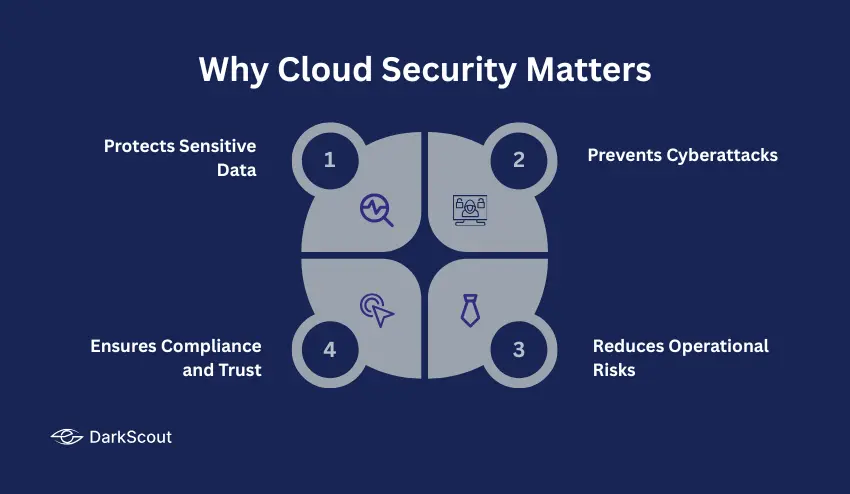
1. Protects Sensitive Data
The personal data, business records and customer data are stored in cloud systems. Close cloud security ensures that this information is not lost to hackers and unauthorized users.
2. Prevents Cyberattacks
Cloud systems can be attacked by cyberattacks such as phishing, ransomware, or account hijacking. These risks are minimized by cloud security, such as firewalls, monitoring, and access controls.
3. Ensures Compliance and Trust
There are numerous laws and regulations that many companies have to comply with, such as GDPR or HIPAA, when storing data. Cloud security assists in fulfilling these demands and creating customer and partner trust.
4. Reduces Operational Risks
The security breach may lead to downtime, lost information, or loss of money. Effective cloud security will ensure that systems are safeguarded hence businesses operate without disruptions.
Knowing the importance of cloud security, people and companies are able to take appropriate measures to secure their cloud-based systems and prevent the expensive issues.
How Cloud Security Works
Cloud security is an approach that integrates tools, policies and practices to secure cloud systems, data and networks. It provides security in the form of ensuring that only authorized applications and users can access resources and data is safe.
Shared Responsibility Model
Cloud security employs the shared responsibility model. The cloud provider takes care of the infrastructure (servers, storage, and network hardware) security. The user is in charge of the security of his or her data, applications and access controls. Knowing this division will avoid loopholes in security.
Security Controls in the Cloud
Cloud systems provide a number of controls to ensure the safety of the systems:
- Access management: Establishes the identity of people who are allowed to access cloud resources and their actions.
- Surveillance and recording: Tracks action and notifications of suspicious activity.
- Encryption: Secures data on rest and when transferred between systems.
- Firewalls and network policies: Block unwanted traffic and access.
Continuous Protection
Cloud security is not a one-time setup. Regular updates, monitoring, and security checks are needed to respond to new threats. Automated tools and best practices help maintain security as cloud environments grow and change.
By combining these measures, cloud security keeps systems protected while allowing businesses to take advantage of the cloud’s flexibility and scalability.
Types of Cloud Security
Cloud security may be subdivided into certain types that are aimed at securing various components of a cloud environment. Here are the main ones:
1. Network Security
Network security helps to reduce cloud networks to unauthorized access and attacks. These tools are firewalls, intrusion detection systems (IDS) and secure virtual networks. It maintains that only the legitimate traffic accesses your cloud resources.
2. Data Security
Cloud storage is secured by data security. This includes:
- Encryption: Makes data inaccessible to unauthorized parties.
- Data masking: Covers the sensitive data in apps.
- Backups: Provides the ability to recover data once lost or attacked.
3. Application Security
Hackers can exploit the vulnerabilities of cloud applications. Application security is concerned with:
- Frequent patching and updating.
- Secure coding practices
- Vulnerability scanning
4. Identity and Access Management (IAM)
IAM provides the right access to the right people. This includes:
- Multi-factor authentication (MFA)
- Role-based access control (RBAC).
- Good password regulations and key management.
5. Threat Detection and Cloud Security Monitoring.
Constant surveillance identifies suspicious activity or attacks. Automated alerts and tools such as security information and event management (SIEM) systems are effective in responding to the threats in a timely manner.
6. Security of Compliance and Governance.
Such type makes sure that the use of the cloud is in accordance with laws, regulations, and internal policies. Examples are GDPR compliance, HIPAA regulations, and routine access and activity auditing.
Network security protects cloud networks from unauthorized access and attacks. Tools include firewalls, intrusion detection systems (IDS), and secure virtual networks. It ensures that only legitimate traffic reaches your cloud resources.
Cloud Deployment Models and Their Security
There are various ways of deploying cloud environments and each model has its security considerations. These differences are what can make you safeguard your data and systems.
1. Public Cloud Security
Providers manage public clouds, such as AWS, Azure, or Google Cloud. The provider takes care of the infrastructure and users of the infrastructure take care of their data and applications. Security measures include:
- Strong access controls
- Data encryption
- Frequent monitoring and scanning of the network security.
2. Private Cloud Security
Single organization is assigned to private clouds. Security (firewalls, encryption and network security keys) is completely under the control of users. The protection of the private clouds may be stronger but the management and resources are demanded.
3. Hybrid Cloud Security
Hybrid clouds are the merger of the public and the private clouds. Security should be in the two environments. Organizations tend to apply:
- Separation of the resources of the state and the private.
- Uniform identity and access management (IAM).
- Constant surveillance on both clouds.
Organizations can strike a balance between cost, control and protection by selecting the correct deployment model and implementing the correct security measures.
Common Cloud Security Threats
Cloud systems are not immune to a number of risks even when they are highly secured. Awareness of these threats prevents loss or breach of data.
- Misconfigurations
Incorrectly configured cloud environments may reveal information. Examples are open storage buckets or too permissive access rules. Misconfigurations are identified by conducting regular network security scans.
- Data Breaches
Cloud environments may be compromised and sensitive data stolen by hackers. Secrecy and access control minimize the chances of breaches.
- Account Hijacking
Hackers can steal log-in credentials to gain access to cloud accounts. Strong network security keys and multi-factor authentication (MFA) can be used to prevent hijacking.
- Insider Threats
Cloud security can be compromised by employees or contractors on purpose or by accident. The restricted access and tracking of activity are used to mitigate this threat.
- Insecure APIs
APIs are commonly used by cloud applications. In case they are not secured, attackers can use them to gain access to data or services.
Knowing these threats, organizations and individuals will be able to take the appropriate protection and prevent the typical traps in cloud security.
Best Practices of Cloud Security.
Best Practice of Cloud Security
The appropriate practices and cloud security tips that can be implemented to ensure that the cloud environments are secure. Here are the key steps:
- Use Strong Access Controls
Control access to cloud resources. Reduce risk with role-based access and multi-factor authentication (MFA).
- Encrypt Data
Protect sensitive information when stored (at rest) and in transit between systems.
- Monitor Activity
Monitor every cloud movement. Constant surveillance can be used to identify abnormal behavior or possible attacks early enough.
- Run Regular Security Checks
Conduct regular network security scans and audits in order to discover vulnerabilities before attackers.
- Keep Systems Updated
Use patches and updates on cloud applications and infrastructure to correct identified security concerns.
- Protect API and Applications.
Ensure that the APIs and cloud apps are safeguarded against vulnerabilities. Apply secure testing and coding.
These best practices will help you mitigate risks and keep your data and applications stored on the cloud safe.
Common Cloud Security Mistakes
Mistakes in cloud security are widespread but can be prevented. Here are the main ones:
- Poor passwords or network security keys- Accounts are vulnerable to easy-to-guess credentials.
- Over-permitted users -Excessive access privileges expose the user to risks.
- None of the monitoring- Attacks or misconfigurations may be detected without monitoring activity.
- Suppose the provider does it all – Users are in charge of their data and access level.
These errors can be prevented by organizations and individuals, which will enhance the security of the clouds and minimize the likelihood of breaches.
Conclusion
Cloud security is necessary in safeguarding data, applications, and networks in the cloud. The need to ensure that there is knowledge and implementation of appropriate security measures is essential as more businesses and individuals are depending on cloud platforms.
Risks can be minimized, and your cloud environment can be secured by adhering to the best practices such as network security scans, encryption, robust access controls and monitoring. The most frequent errors are ineffective credentials, excessive permissions for the user, and the belief that the provider does everything.
Regardless of the type of cloud you use, be it the public, the private, or the hybrid, it is always best to keep up with threats and protect your systems so that your data can be confidential, available, and trusted. Cloud security not only represents a technical need, but it is a basis of secure and trustworthy online functions.