Cloud security monitoring assists in maintaining the security of cloud systems by monitoring the activities within the cloud system. Security risks are on the rise as more businesses and users transfer data and applications to the cloud. This renders monitoring a significant constituent of cloud security.
Cloud services are used by many individuals on a daily basis. They store files, execute applications, and process data over the internet. However, cloud environments evolve rapidly. New services, settings, and users are constantly added. It is difficult to observe what is going on and identify issues in time without monitoring.
Cloud security monitoring is concerned with visibility. It monitors user actions, system modifications as well as network actions in real time. This assists in identifying threats, misconfigurations, and suspicious activities before they can be destructive.
This blog describes cloud security monitoring in a simplistic language. It includes the definition, importance, mechanism, and advantages of it. This guide will guide you in case you are attempting to learn the fundamentals of cloud security monitoring.
What Is Cloud Security Monitoring?
Cloud security monitoring refers to the process of monitoring the activity in a cloud environment to identify the risk of security risks. It is the gathering and examination of data in cloud systems to detect threats, misconfigurations, and suspicious activities.
Cloud security monitoring simply monitors the activity in the cloud. It monitors the user of resources, the usage of data, and whether systems are operating as intended. This assists in identifying issues at an early stage and minimizes the possibility of security breaches.
Cloud security monitoring is continuous as opposed to security checks conducted once. Cloud environments are dynamic and thus constant monitoring is required to keep pace with the new users, services and settings.
As an illustration, when a user logs in at a suspicious place or attempts to access confidential information, the cloud security monitoring can identify the actions and send an alert. This will enable teams to react before it is too late.
Why Cloud Security Monitoring Is Important
The reason why cloud security monitoring is important is that the environment in the clouds is dynamic. Service, configuration and new users are added regularly. Security problems may remain unnoticed without surveillance.
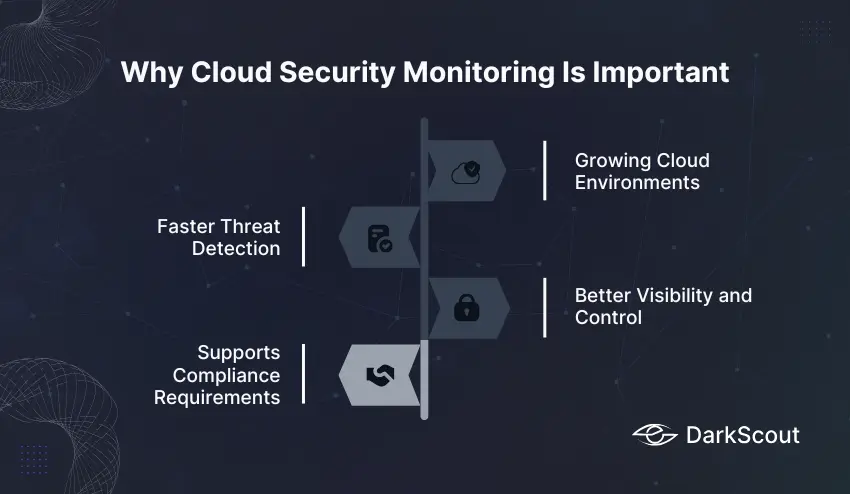
1. Growing Cloud Environments
Cloud systems are scalable. With the increase in systems, activity becomes more difficult to monitor manually. Cloud security monitoring gives end-to-end visibility of users, apps and infrastructure.
2. Faster Threat Detection
Security threats may occur anytime. The monitoring of cloud security can be used to identify suspicious behavior at an early stage, e.g., the presence of a suspicious log in or unauthorized access to data. Early warning minimizes the effects of intrusions and damages.
3. Better Visibility and Control
It is possible to monitor what is going on within the cloud. It assists in pointing out misconfigurations, policy breach and risky behavior. This provides the teams with more control over their cloud environments.
4. Supports Compliance Requirements
There are several regulations that many organizations have to abide by in the field of security and data protection. The cloud security monitoring provides logs and audit trails that accommodate compliance and reporting requirements.
How Cloud Security Monitoring Works
The operation of cloud security monitoring involves the gathering and analysis of data in the cloud environments. This is aimed at identifying security risks as they occur and reacting promptly.
1. Data Collection
Monitoring of cloud security begins with the collection of data. It collects events and logs of various sources in the cloud. This contains user activity, application logs, network traffic and system changes. All this information is gathered in a single location which makes it more visible.
2. Analysis and Threat Detection
After the data has been gathered, it is examined to identify security problems. Monitoring tools identify the abnormal behavior, including unusual logins attempts or security settings changes. These trends can be a sign of threat, misconfiguration or policy violation.
3. Alerts and Response
The system produces alerts when a possible risk is identified. Such alerts assist teams to respond fast. The responses are automated and others need to be reviewed manually. Rapid notification and reaction minimizes the effects of security breaches.
Cloud security monitoring is on a 24/7 basis. This is because of the constant visibility which keeps organizations informed of what is occurring in their cloud environments at any given time.
What Does Cloud Security Monitoring Monitor?
Cloud security monitoring is concerned with the monitoring of important activities and changes in the cloud environments. This is useful in risk identification and visibility.
- User activity and access
Tracks records the time when and the resources accessed by the user. - Network traffic
Scans traffic in and out of cloud systems to identify suspicious or unauthorized connections. - Application behavior
Monitors the behavior of cloud applications and notifies about suspicious behavior or errors. - Configuration changes
Identifies modifications to cloud configurations that can result in security vulnerabilities or misconfiguration. - Data movement and usage
Tracks the access, transfer, and storage of data in the cloud.
Cloud security monitoring assists in the detection of threats, mitigation of risks, and ensuring a secure cloud environment by observing the areas.
Cloud Security Monitoring vs Traditional Security Monitoring
Cloud security monitoring is different from traditional security monitoring. This is mainly because cloud environments work differently from on-premise systems.
Traditional security monitoring focuses on fixed systems. Servers, networks, and devices usually stay in one place. Changes happen slowly, and visibility is easier to manage.
Cloud environments are dynamic. Resources can be created, changed, or removed within minutes. Users can access systems from anywhere. This makes cloud security monitoring more complex and more important.
Here is a simple comparison:
| Area | Traditional Security Monitoring | Cloud Security Monitoring |
|---|---|---|
| Infrastructure | Fixed and on-premise | Dynamic and cloud-based |
| Visibility | Limited to internal systems | Covers users, apps, and cloud services |
| Scalability | Manual and slower | Automatic and scalable |
| Threat detection | Often delayed | Real-time detection |
| Configuration changes | Infrequent | Frequent and continuous |
Because of these differences, cloud security monitoring focuses on continuous visibility, automation, and real-time alerts. This approach helps security teams keep up with fast-changing cloud environments.
Key Benefits of Cloud Security Monitoring
Cloud security monitoring does not only give out alerts, but it enhances the overall effectiveness of cloud security and efficiency. The following is a more detailed view of the key advantages:
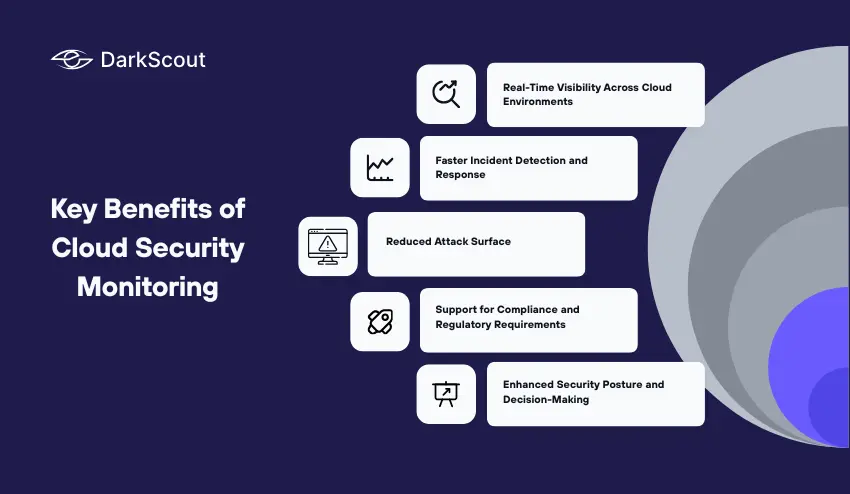
1. Real-Time Visibility Across Cloud Environments
Cloud environments are dynamic, and new users, applications and services are being added at a rate. Cloud security monitoring provides the security teams with a real-time perspective of activity. This real time visibility will make sure that suspicious logins, unusual behavior or unauthorized access attempts are identified instantly rather than being ignored.
2. Faster Incident Detection and Response
Speed is one of the most valuable benefits. Detection tools are automated to analyze logs and user activity and flag potential threats in real-time. Alerts enable security departments to respond promptly and in certain instances, automated responses may prevent malicious activity in real-time. This makes the harm of attacks to be minimized and minimizes downtime.
3. Reduced Attack Surface
Misconfigurations of the cloud and excessively liberal access may lead to vulnerabilities. These issues are detected through monitoring and before they are exploited by attackers. Organizations also minimize the weak points by identifying risky behavior and configuration gaps, which make their cloud environment more secure in general.
4. Support for Compliance and Regulatory Requirements
There are numerous companies that are obliged to adhere to such regulations as GDPR, HIPAA, or PCI DSS. Cloud security monitoring automatically creates logs and audit trails, recording the people who accessed what and when. Such records facilitate easier proving of compliance during audits and decrease the chances of punishment in case of non-compliance.
5. Enhanced Security Posture and Decision-Making
The knowledge acquired through the constant surveillance can enable organizations to make superior security decisions. Actionable information is provided by trends in user behavior, common misconfigurations, and possible threats. This enhances policies, access controls, and security practices over time, increasing the overall cloud security posture of the organization.
Common Cloud Security Monitoring Challenges
Organizations still have some challenges despite having cloud security monitoring. Knowledge of these can assist teams to plan in a more effective manner and ensure high protection.
1. Alert Fatigue
The tools used to monitor usually produce numerous notifications. Security teams may be overwhelmed without the appropriate filtering. This complicates prioritization of the most important threats and can slow down response.
2. Multi-Cloud Visibility Gaps
Numerous organizations have more than one cloud provider. Surveillance on various platforms may be challenging, and this may leave gaps through which threats may not be detected.
3. Large Volume of Logs
Cloud environments produce massive data. Logs may also be difficult to collect, store, and analyze, particularly when one is attempting to identify anomalies in real-time.
4. Tool Complexity and Integration
Security tools can involve complicated installation and integration with the current systems. Teams should have the monitoring solutions that integrate with applications, networks, and cloud services.
5. Rapidly Changing Environments
Cloud resources are developed, edited and deleted on a regular basis. It is difficult but necessary to keep the monitoring rules up to date in such dynamical environments to ensure the security coverage.
With awareness of such obstacles, organizations can make the following measures such as automated analysis, alerts prioritization, and selection of monitoring tools that are compatible with multi-cloud environments.
Best Practices for Cloud Security Monitoring
Cloud security monitoring is effective and reliable because of best practice. Here are the key strategies:
- Continuous Monitoring
Cloud environments are dynamic. It should be 24/7 monitoring and detecting threats, misconfigurations and abnormal activity in real-time.
- Prioritize Alerts
All alerts are not worthwhile. Ranking of threats and high-risk operations is one of the priority factors to reduce alert fatigue and increase the efficiency in responding.
- Regular Log Review
One is not just required to gather logs. Security teams should also review logs regularly to identify trends and suspicious behavior and potential vulnerabilities.
- Strong Access Controls
Always restrict access to sensitive cloud resources using role based access, multi factor authentication and secure network security keys.
- Automation Where Possible
It can be applied to large volumes of data, reduce human error, and offer rapid response to threats with automated detection and response.
- Ensure Multiple Cloud Visibility
In the case of using multiple providers of the cloud, choose tools and practices that can provide consistent monitoring in the environment.
- Keep Policies Updated
As cloud environments evolve, update monitors, alert configurations, and security policies to cover and be effective.
These best practices are able to make organizations highly secured in the cloud, respond quickly to threats, and minimize the risks of data breaches.
Tools & Techniques for Cloud Security Monitoring
Cloud security monitoring relies on the integration of tools and techniques to detect threats, track activity and provide secure environments. The right combination can make a significant contribution to cloud security.
1. Security Information and Event Management (SIEM)
SIEM systems collect and process logs of different types including cloud applications, networks, and user activity. They provide real-time alerts, detect anomalies and help to investigate incidents.
2. Log Management Tools
The log management solutions are systems that collect and store the log of cloud systems. This will help the security teams track the changes, review the history and identify any suspicious trends.
3. Anomaly and Behavior Analytics
Normal user and system behavior are monitored using behavioral analytics. Deviations are also notified in the case of abnormalities in either the time of logging in or when a user logs in at an unexpected place.
4. Automated Threat Detection and Response
The modern cloud monitoring systems can react and detect threats in an automatic manner. This includes preventing suspicious logins, isolating resources that were compromised or sending notifications to security teams in real time.
5. Multi-Cloud Visibility Tools
With multi-cloud providers, there will be dedicated tools that will be able to monitor centrally. They offer standard security coverage in the public, private as well as hybrid clouds.
6. Compliance Monitoring Tools
They are applicable to track the adherence to the regulatory requirements, such as GDPR, HIPAA, or PCI DSS. They make audit reports and maintain logs to maintain accountability and compliance.
All these tools and methods would assist organizations in coming up with a comprehensive cloud security monitoring strategy that would improve visibility, reduce risk, and improve the overall cloud security posture.
Conclusion
In the dynamic cloud environments of the current world, cloud security monitoring is necessary to secure the data, applications, and networks. This is because by constantly monitoring the activities of the users, system modifications, and network actions, organizations are able to identify the threats promptly and react in a timely manner.
It is characterized by advantages like real time visibility, quicker incident response, smaller attack surface, compliance support and an improved security posture. Although there are such problems as alert fatigue, gaps in multi-cloud visibility, and substantial data volumes, it is possible to overcome these obstacles through best practices and the application of the appropriate tools.
Regardless of the type of business or enterprise you are running, cloud security monitoring will go a long way in ensuring that your cloud environment is secure, compliant, and resilient to threats. The secrets of ensuring effective cloud security are regular monitoring, automatic detection, and continuous improvement.