Most people first hear about the dark web in a crime documentary or a breaking news story about a massive data breach. It sounds like something that exists in a completely different world, one that has nothing to do with your everyday life.
But here’s what those headlines don’t tell you: your personal information might already be sitting on the dark web right now. Your email address, your password, maybe even your bank details. And the worst part? You’d have absolutely no way of knowing unless something is actively watching for you.
That’s the whole point of dark web monitoring. It’s not a buzzword. It’s not just for IT departments or large corporations. It’s something every single person who uses the internet should understand. And after reading this, you will.
What Is the Dark Web?
The internet has three layers. Most people only ever see one of them.
The surface web is everything you find on Google. News sites, social media, and shopping. This is only about 4% of the entire internet.
The deep web is the private stuff in your email inbox, your bank account, and your medical records. Not hidden in a criminal way, just not searchable.
The dark web is something else entirely. You can’t access it with a normal browser. You need special software like Tor, which hides who you are and where you’re connecting from.
That anonymity is exactly why criminals love it. It’s where they go to buy and sell things they don’t want traced back to them.
Including your personal information.
The Internet Has Three Layers
Most people only ever see one of them. And that’s exactly why the dark web catches so many people off guard.
The Surface Web
This is the internet most of us know. Google, social media, news sites, online shopping, and YouTube. It feels massive — but it actually makes up only about 4% of the entire internet.
If you can find it by typing into a search engine, it lives here. It’s open, public, and accessible to anyone with a browser and an internet connection.
The Deep Web
This is everything search engines can’t index. Your email inbox, your online banking portal, your medical records, your streaming subscriptions, your company’s internal systems.
None of it shows up in a Google search, not because it’s dangerous, just because it’s private and password-protected. It makes up roughly 96% of the entire internet. Most of us dip in and out of it every single day without even thinking about it. Every time you log into your bank or check your email, you’re in the deep web.
The Dark Web
This is where things get very different. The dark web is a small, deliberately hidden section of the deep web that you simply cannot access with a regular browser like Chrome or Safari.
You need special software, most commonly the Tor browser, which bounces your connection through multiple servers around the world, making it nearly impossible to trace.
That anonymity was originally built for good reasons. Protecting journalists communicating with sources. Giving whistleblowers a safe channel. Helping activists in countries where free speech is outlawed.
But that same anonymity quickly became a magnet for criminal activity. Today, the dark web is filled with underground marketplaces, hacking forums, and stolen data dumps. It’s where your personal information ends up after a breach quietly traded between criminals, while you go about your day completely unaware.
That’s exactly what dark web monitoring is built to catch.
What Gets Sold There?
More than most people realise. Here’s what regularly appears on dark web marketplaces:
- Email addresses and passwords
- Credit and debit card numbers
- Social Security numbers and national IDs
- Bank account login details
- Medical and health insurance records
- Session cookies — tokens that let someone log into your account without needing your password
- “Fullz” — complete identity packages with your name, address, date of birth, and financial details bundled together
The prices are shockingly low.
A stolen credit card with a $5,000 balance can sell for as little as $110. A full identity package — everything needed to open loans and credit cards in your name — goes for between $20 and $200.
Your financial life, potentially destroyed, for less than a restaurant bill.
How Does Your Data End Up There?
Here’s the frustrating part: most people who get exposed didn’t do anything wrong.
The most common reason is a data breach at a company you trusted. A retailer, a healthcare provider, or a social media platform gets hacked. Millions of customer records get stolen at once. You were just a customer.
It’s happened at some of the biggest names you know.
In 2021, over 533 million Facebook users had their data leaked onto the dark web. Names, phone numbers, email addresses, and locations. In the same year, 700 million LinkedIn profiles were put up for sale. In 2024, AT&T confirmed a breach exposing over 70 million customers, including Social Security numbers.
There’s also infostealer malware, a silent software that infects your device and quietly harvests your saved passwords from your browser. You don’t even have to click a suspicious link. One visit to a compromised site can be enough.
And then there’s the oldest problem in the book: reusing passwords. Studies show that up to 94% of passwords follow reuse patterns across multiple services. One breach is all it takes to unlock every account where you used the same password.
What Is Dark Web Monitoring?
Dark web monitoring is a service that watches the hidden parts of the internet for your personal information 24 hours a day, 7 days a week.
Think of it like a smoke alarm for your identity.
It doesn’t stop your data from being stolen. But the moment it appears somewhere, it shouldn’t be a forum, a marketplace, a leaked database; you get an alert. Fast enough to act before the damage is done.
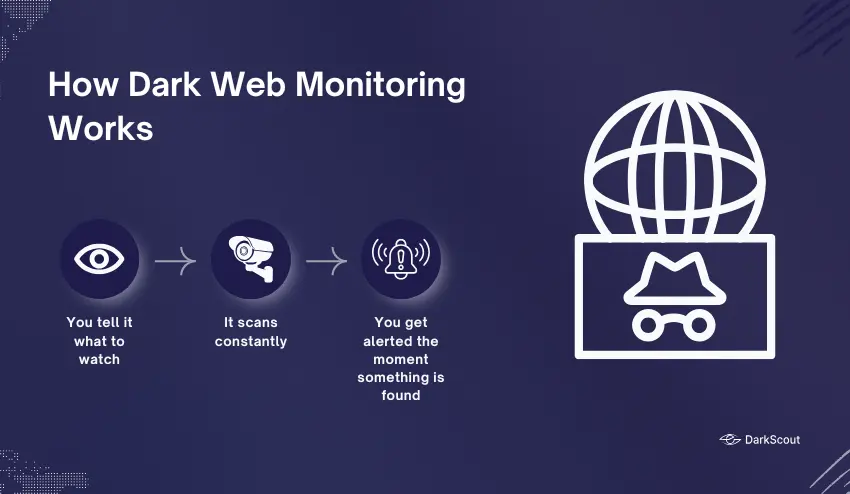
Here’s the simple version of how it works:
Step 1 — You tell it what to watch. Your email, phone number, financial details, and national ID. Whatever matters most.
Step 2 — It scans constantly. Automated tools crawl thousands of dark web sources around the clock. Forums, criminal marketplaces, paste sites, and encrypted channels are places you’d never find on your own.
Step 3 — You get alerted the moment something is found. Not weeks later. Right away. With clear steps on what to do next.
That speed is everything. Once credentials appear on a dark web marketplace, criminals can use them within hours. The sooner you know, the sooner you can protect yourself.
DarkScout’s dark web monitoring scans continuously across leaked data, stolen credentials, underground forums, and encrypted channels — alerting you the moment your information surfaces.
Why Individuals Need This — Not Just Businesses
A lot of people assume dark web monitoring is only for companies with large IT budgets.
It’s not.
Cybercriminals aren’t only targeting CEOs and celebrities. They’re targeting volume. Your credit card number might only sell for a few dollars, but when they have tens of thousands of them, the math works out fine for them.
Regular people are targeted precisely because they’re less likely to be watching.
Here’s what can happen if your data is found and exploited before you know about it:
- Identity theft — someone opens credit cards or takes out loans in your name
- Account takeovers — criminals log into your email, bank, or social media
- Financial fraud — money drained from your accounts without warning
- Targeted phishing — criminals use your real details to craft convincing scams aimed at you or your family
Dark web monitoring means you find out first.
What to Do the Moment Your Data Is Found
Getting an alert isn’t a disaster. It’s actually the best-case scenario — because now you know, and you have time to act.
Here’s exactly what to do:
- Change your password immediately — start with the compromised account, then any account using the same password
- Turn on two-factor authentication (2FA) — even if someone has your password, they can’t get in without your phone
- Call your bank — if financial details were exposed, flag it immediately and ask about fraud protection
- Check your credit report — look for accounts, loans, or inquiries you don’t recognise
- Use a password manager — create unique, strong passwords for every account going forward
- Watch for phishing attempts — criminals may use your exposed details to send convincing fake emails pretending to be your bank or a service you use
- Monitor regularly — a one-time check isn’t enough; ongoing monitoring keeps you protected as new breaches happen
Mistakes That Leave You Exposed
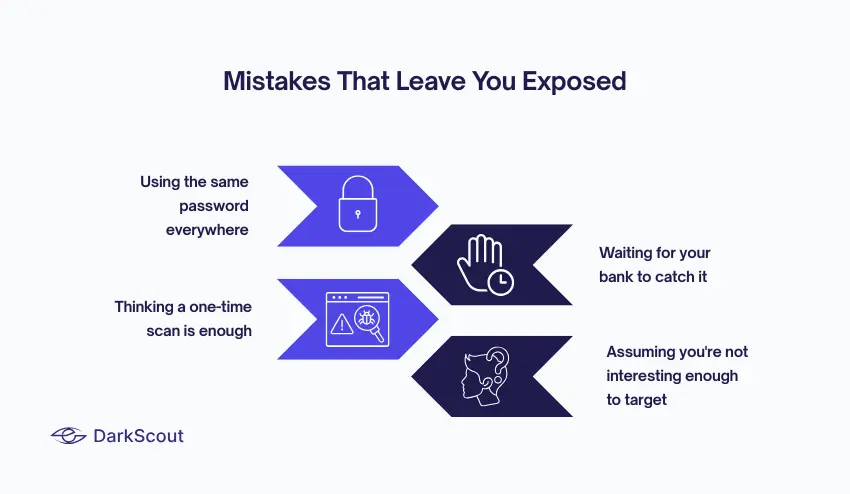
Using the same password everywhere. This is the single biggest vulnerability most people have. One breach opens every account you own.
Thinking a one-time scan is enough. The dark web updates constantly. New databases appear every single day. A scan from three months ago tells you nothing about what was posted last week.
Waiting for your bank to catch it. Banks catch fraud after it happens. Monitoring catches the warning signs before your account is ever touched.
Assuming you’re not interesting enough to target. Criminals don’t care who you are. They care that your data exists and can be monetised. Everyone is a target.
The Bottom Line
The dark web isn’t some distant, abstract threat.
It’s the place where the fallout from everyday data breaches ends up. And right now, billions of people’s personal details are being bought and sold there, most of them completely unaware.
Dark web monitoring won’t make you untouchable. But it will make sure you’re never the last to know when something goes wrong.
If you want to see what’s already out there with your name on it, DarkScout’s dark web monitoring scans continuously and alerts you the moment your data appears somewhere it shouldn’t.
No jargon. No complexity. Just clear, real-time protection.