Every day, people share personal and business information online, in emails, files, passwords, and financial data. Unless properly secured, this information may be hacked by hackers, advertisers, or even unsecured public Wi-Fi networks.s
Virtual Private Networks are important tools that can keep your internet connection safe as well as your privacy. They establish encrypted tunnels between your computer and the internet and your online activity is not exposed to the curious eyes.
The knowledge of Virtual Private Networks is no longer optional. These networks are private, protective, and liberating online, regardless of whether one is using it personally, working remotely or ensuring the security of their businesses.
What Are Virtual Private Networks?
VPN is a technology that keeps your online activity safe by establishing a secure and private connection via the internet. Just imagine that it is some kind of underground tunnel between your gadgets and the sites or services you visit. Rather than connecting directly to the internet, your traffic is diverted through this tunnel, and nobody can easily track, monitor, or steal your information.
Simply, a Virtual Private Network conceals your actual IP address and substitutes it with one of a distant server. This not only covers your location, but also keeps your browsing, downloads, and communications private.
Nowadays, the use of Virtual Private Networks has numerous purposes: to get to the sites that are prohibited by the Internet, to work safely on the Wi-Fi of the coffee shop, to keep confidential data safe, and even to watch streaming services in other countries.
You May Also Like: How to Use a URL Fuzzer to Protect Your Web Applications
How Do Virtual Private Networks Work?
When you access the internet without protection, your information is exposed in the air between your device and websites or applications you access. This simplifies the task of hackers, internet service providers (ISPs) or even the governments in understanding what you are doing on the internet.
The Virtual Private Network (VPN) alters this process and encrypts your internet traffic. After enabling a VPN, your information is now transferred via a safe tunnel to a VPN server and then to the internet. This encryption distorts your data in a manner that even if one intercepts it, one cannot be able to read it.
A brief summary of what happens is as follows:
- Encryption – Your online traffic is encrypted with powerful encryption standards such as AES-256.
- IP Masking – Your actual IP address will be concealed and substituted by the IP address of the VPN server.
- Secure Routing -All your traffic is directed via the VPN server, and your activity is more difficult to track.
For example, when you are in the U.S.and you use a VPN server located in France, websites will believe that you are in France, and not in the U.S.. That is how the Virtual Private Networks keep your identity safe and enable the viewing of the content that is restricted in the region.
Why Use a Virtual Private Network?
A Virtual Private Network (VPN) is not only an expert technology. It is now a convenient feature for daily internet users who desire to have greater control over their privacy and security online.
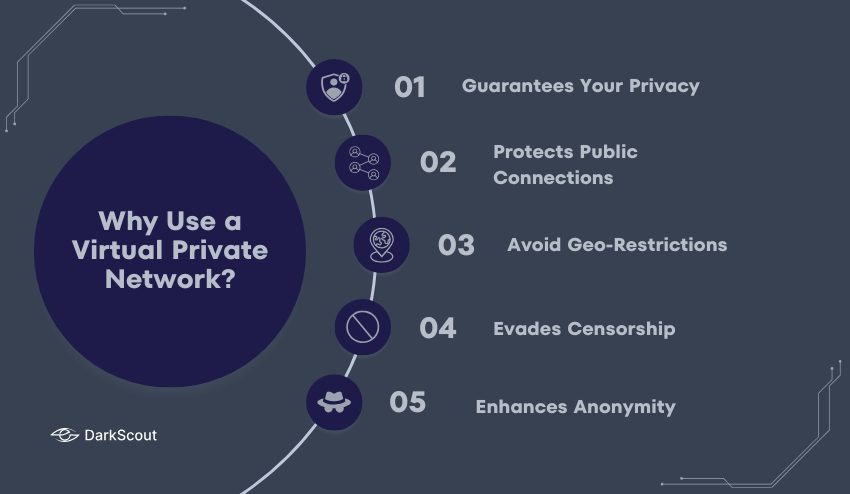
Here are the main reasons why people rely on a Virtual Private Network:
- Guarantees Your Privacy– A VPN conceals your web activity, internet service providers, advertisers, and even hackers on open Wi-Fi.
- Protects Public Connections – You are vulnerable to losing your data when you are on free Wi-Fi in a cafe, airport, or hotel. It is encrypted by a VPN, and your personal information is secure.
- Avoid Geo-Restrictions – Streaming websites and platforms tend to restrict content according to location. Under VPN, you will be able to access the global servers and access content that may be inaccessible in your area.
- Evades Censorship – In countries with severe restrictions on the internet, a Virtual Private Network will enable users to access blocked websites and services.
- Enhances Anonymity – Your anonymity is greatly enhanced because your actual IP address is concealed, and nobody can easily trace your online activity.
In other words, when you use a Virtual Private Network, you are assured of your privacy whenever you are online.
You May Also Like: Top 7 Subdomain Finder Tools to Boost Your Security in 2026
Types of Virtual Private Networks
Not every Virtual Private Network (VPN) functions the same. VPNs are available in various types depending on the requirement, whether business or personal:
Remote Access VPN
- Widely used by people.
- Enables users to access a private network (such as home or office) via the internet in a secure manner.
- Excellent when working at home or when one desires to be safe when using a public Wi-Fi.
Site-to-Site VPN
- Applied primarily in businesses that have more than one office.
- Connects one network (like an office branch) directly to another network (like the main office).
- Enables safe communication among offices without the need of having every employee to link individually.
Client-to-Site VPN
- A mix of remote access and site-to-site.
- Gives certain personnel or users access to an internal network of a company in a safe manner.
- Needs a VPN client on the device.
Cloud VPN (Virtual Private Network as a Service)
- Runs on cloud infrastructure.
- Best suited to cloud-based application businesses.
- Offers scalability and easy deployment without heavy hardware costs.
All kinds of Virtual Private Networks serve a different purpose, and yet they all aim at one thing: secure and private internet communication.
Benefits of Using a Virtual Private Network
It is not only about concealing your IP address: a Virtual Private Network (VPN) has many more advantages that can help to safeguard individuals and corporations.
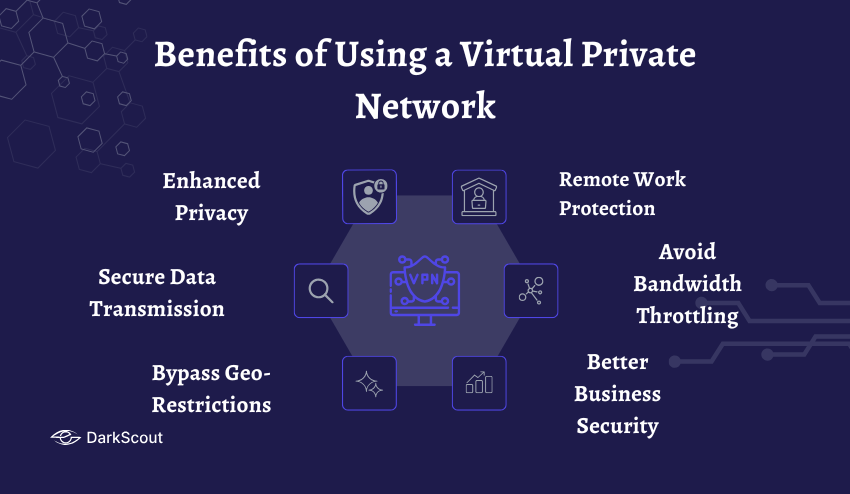
1. Enhanced Privacy
A Virtual Private Network conceals your actual address and IP, and it becomes significantly more difficult to have websites, advertisers or even your internet service provider monitor what you do online.
2. Secure Data Transmission
VPNs are used to encrypt your internet traffic and keep sensitive information (such as passwords, payment details, and work files) out of reach to hackers, particularly when using a public Wi-Fi.
3. Bypass Geo-Restrictions
Numerous streaming applications, websites, or apps are location-restricted. Using a Virtual Private Network, you can even connect to a server in a different country and access the content that would have otherwise been blocked.
4. Remote Work Protection
VPNs are used by businesses to make sure that their remote workers can access company resources without putting the network at risk of cyber threats.
5. Avoid Bandwidth Throttling
Other internet service providers throttle (or slow down) your service depending on its use. A VPN conceals your traffic, and it will assist you to have stable internet connection.
6. Better Business Security.
Virtual Private Networks are used by companies to ensure the safety of communication between various offices and safeguard sensitive data against cyber-attacks.
Simply put, a Virtual Private Network is a source of privacy and freedom, allowing users to have control over their online life.
You May Also Like: What is MDR Security and How Can It Protect Your Organization from Cyber Threats?
Common Uses of Virtual Private Networks
Depending on the user, a Virtual Private Network (VPN) can have many purposes. Here are the main categories:
- Personal Use
- Secure use of free Wi-Fi, e.g. in an airport or cafe.
- Watch films and sporting activities that are not within your locality.
- Block or unblock sites or applications depending on their location.
- Business Use
- Secure communication between remote employees and company servers.
- Obtaining confidential business information outside the office.
- Allowing the world teams to operate on encrypted links.
- Government Use
- Secrecy of classified communications and sensitive documents.
- Secure access to government databases.
- Expounding on how to avoid monitoring or interception of official communications.
- Educational Use
- Enabling students and faculty to access academic resources and research databases in a secure way.
- Obtaining security when using university networks via the Internet.
- Safe collaboration in online learning programs all over the world.
In a nutshell, VPNs are not just individual but also important in business, government, and schools.
Potential Drawbacks of Virtual Private Networks
Although Virtual Private Networks (VPNs) have a lot of advantages, one should learn about their limitations:
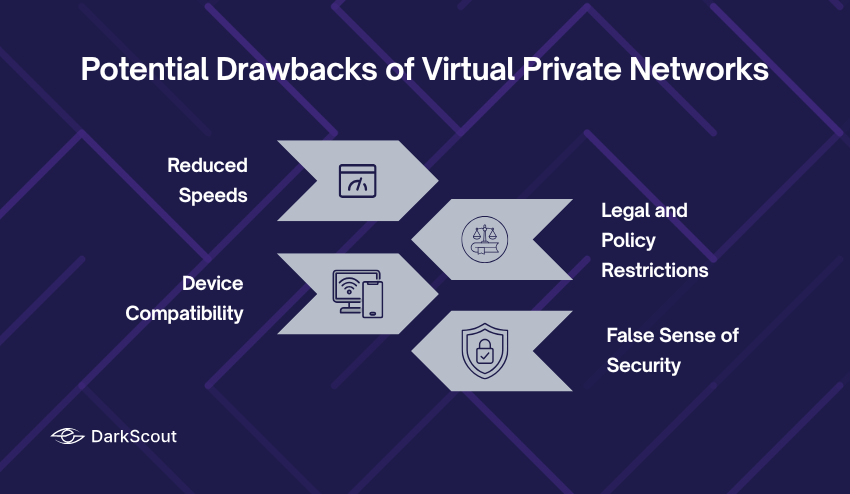
1. Reduced Speeds
Server routing and encryption have the potential of slowing down your internet connection. The level is determined by the VPN company and where you want to be.
2. Device Compatibility
VPN protocols are not compatible with all devices and operating systems. Older devices can have trouble connecting or have a stable connection.
3. Legal and Policy Restrictions
Some nations prohibit or even control the use of VPN. Local laws should always be checked before using a VPN to safely browse the internet.
4. False Sense of Security
VPN helps to secure your connection, but it does not stop phishing, malware, and bad passwords. There is still need of more cybersecurity measures.
With these negative aspects, the utilization of a Virtual Private Network is largely a positive thing for any individual who wants to enhance his privacy and security online. These limitations can be better understood to use VPNs.
Conclusion
VPNs are important tools to protect online privacy, secure sensitive data and unlimited access to content. They guard people and companies against hackers, tracking, and other cyber offenders and also give them liberty to navigate safely anywhere in the globe.
In selecting a VPN, you need to look at things such as the location of the server, encryption level, speed, and compatibility with the device. Although a VPN cannot resolve all security concerns, it is a preventative measure that would help secure your online life.
In the constantly changing online environment today, using Virtual Private Network has ceased to be an option, but a very viable necessity. Evaluate your security requirements and take the control of your privacy now.