You’ve trained your staff. You’ve enforced MFA. You’ve patched your systems. You’ve done everything right.
Then a vendor you trusted gets breached. And suddenly, your customer data is exposed, your regulators are calling, and the breach didn’t come from anything you controlled.
This is a third-party cyber risk. And in 2026, it’s one of the fastest-growing sources of security incidents across every industry.
Third-party involvement in breaches doubled to 30% in a single year, according to Verizon’s 2025 Data Breach Investigations Report. The organizations responsible for those breaches weren’t the ones that got hit. Their vendors were.
This guide covers what third-party cyber risk actually is, why it keeps getting worse, and what a practical management program looks like for your organization.
What Is Third-Party Cyber Risk?

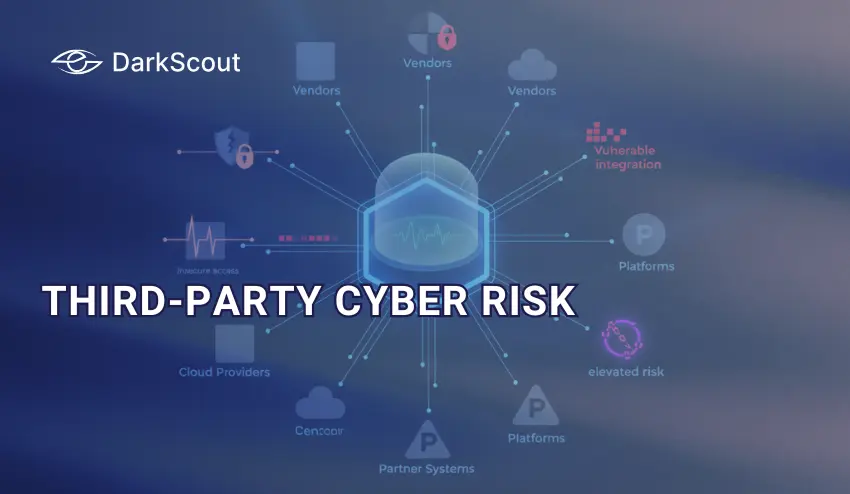
Third-party cyber risk is the potential for a cyberattack, data breach, or security failure that originates from an external vendor, supplier, partner, or service provider rather than from your own systems.
Your organization’s cybersecurity posture doesn’t end at your own network perimeter. Every company you share data with, give system access to, or rely on for business operations becomes a potential entry point into your environment.
When that company has a security failure, you feel the consequences.
The risk is real and specific. Your payroll provider gets breached, and your employees’ personal data gets exposed. Your cloud storage vendor misconfigures access controls, and your customer records become publicly readable. Your IT contractor’s laptop gets infected with an infostealer, and their credentials to your systems get sold on a dark web forum.
None of these incidents happened inside your environment. All of them are your problem.
What Counts as a Third Party?
A third party is any external organization that touches your systems, handles your data, or plays a role in delivering your business operations.
The list is usually longer than most organizations realize:
- Software vendors providing SaaS tools, enterprise platforms, or productivity applications
- Cloud and infrastructure providers running the compute, storage, or networking you depend on
- Managed service providers (MSPs) who have administrative access to your systems
- Payment processors and financial services partners handling transaction data
- IT contractors and consultants working directly inside your environment
- Marketing and analytics platforms with access to customer data
- Legal, HR, and accounting firms that receive sensitive internal documents
- Logistics and supply chain partners integrated into operational systems
- Subsidiaries and acquired companies whose security controls you may not fully control yet
Any of these relationships creates a potential pathway from their environment to yours.
Fourth-Party Risk: The Hidden Layer
Here’s the part that catches most organizations off guard.
Your vendors have vendors.
When your software provider uses a third-party data center, or your cloud platform relies on a third-party authentication service, those external dependencies become your risk too. These are called fourth parties.
You have no direct relationship with them. You didn’t sign a contract with them. You can’t audit them. But if they fail, your data and operations can still be affected through the chain.
The 2020 SolarWinds attack is the defining example. Attackers compromised SolarWinds, a vendor used by thousands of organizations. Those organizations’ customers were then exposed, even though they had no direct relationship with SolarWinds at all. The breach cascaded through the supply chain in ways that nobody’s third-party risk program had anticipated.
Fourth-party risk is why vendor questionnaires and one-time audits aren’t enough. You need visibility into the risk posture of your vendors’ external exposure, not just their self-reported security practices.
Why Third-Party Cyber Risk Is Getting Worse
Three forces are pushing third-party risk higher in 2026, and none of them is slowing down.
1. More vendors, more exposure
The average organization now works with hundreds of third-party vendors. SaaS adoption alone has grown dramatically, with companies averaging over 130 SaaS applications, each of which may have access to some layer of your data or systems. More vendors mean more potential entry points.
2. Attackers are targeting vendors deliberately
Supply chain attacks have become a primary attack strategy. Rather than trying to breach a well-defended enterprise directly, attackers target smaller, less-secure vendors who have privileged access to their larger clients. It’s the path of least resistance.
54% of large organizations identified supply chain challenges as the biggest barrier to achieving cyber resilience, according to the World Economic Forum’s Global Cybersecurity Outlook.
3. AI is creating new risk vectors
In 2026, vendors using AI and large language models in their products introduce new categories of risk: training data exposure, AI-generated outputs containing sensitive information, and insecure AI APIs that can be exploited. Most organizations haven’t updated their vendor risk assessment frameworks to account for these yet.
The Most Common Types of Third-Party Cyber Risk
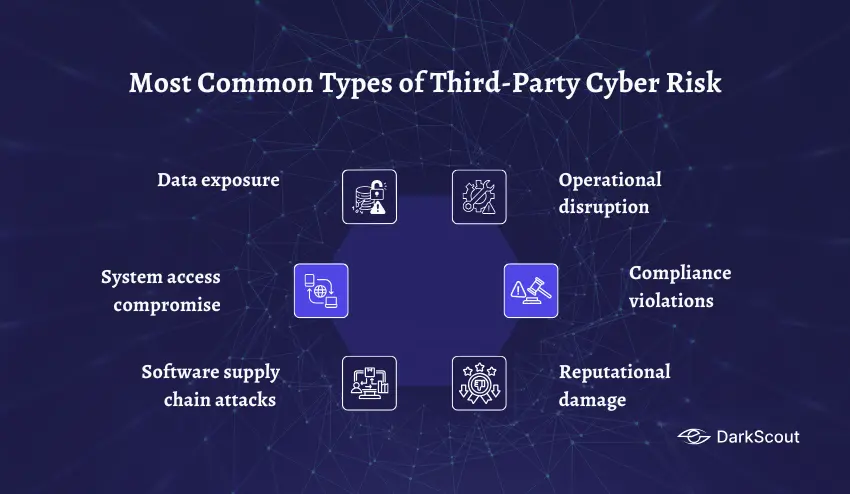
1. Data exposure
A vendor with access to your customer records, employee data, or financial information suffers a breach. That data gets exposed even though your own systems were never touched. This is the most common third-party risk outcome.
2. System access compromise
A vendor with administrative or privileged access to your environment gets their credentials stolen. The attacker uses those credentials to move directly into your network, bypassing your perimeter entirely. Managed service providers are a frequent target for exactly this reason.
3. Software supply chain attacks
Attackers compromise a software vendor’s build or update process and push malicious code to all of that vendor’s customers through a legitimate software update. The customer installs the update, trusting it’s legitimate. It isn’t.
4. Operational disruption
When a critical vendor goes down, your operations go down with it. The 2024 CrowdStrike outage caused Delta Air Lines an estimated $350 million in losses from a single vendor failure. It wasn’t a cyberattack. It was a software update. The dependency risk is the same.
5. Compliance violations
If a vendor mishandles data that’s subject to GDPR, HIPAA, or other regulations, your organization can share in the legal and regulatory consequences, even if the vendor was responsible. Regulators look at data controllers, not just data processors.
6. Reputational damage
A breach traced back to one of your vendors puts your name in the news alongside theirs. Customers and partners don’t always distinguish between “your breach” and “your vendor’s breach.” The reputational impact lands on you either way.
Real-World Examples
These aren’t hypothetical scenarios. They happened.
1. MOVEit (2023, still impacting organizations in 2026)
The MOVEit data breach of the file transfer software has impacted over 1,000 organizations and more than 60 million people. No organization was breached directly. All organizations were MOVEit vendor customers. The Cl0p ransomware group utilized one vulnerability in one vendor and unleashed the largest cascading exposure in history.
2. CrowdStrike outage (2024)
A faulty software update from a cybersecurity vendor caused an estimated 8.5 million Windows devices to crash globally, affecting airlines, hospitals, banks, and emergency services. Delta’s $350 million loss was the highest-profile consequence, but the disruption hit organizations across every sector simultaneously through a single vendor dependency.
3. SolarWinds (2020, lessons still relevant)
Nation-state attackers compromised SolarWinds’ software build process and delivered backdoored updates to over 18,000 clients, including government agencies in the US and companies in the Fortune 500. The original attack vector was the software vendor. The impacted entities were thousands of their customers.
The pattern across all three is the same: attackers or failures at one vendor created consequences that cascaded across hundreds or thousands of organizations that had no direct involvement in the initial incident.
How to Build a Third-Party Cyber Risk Management Program
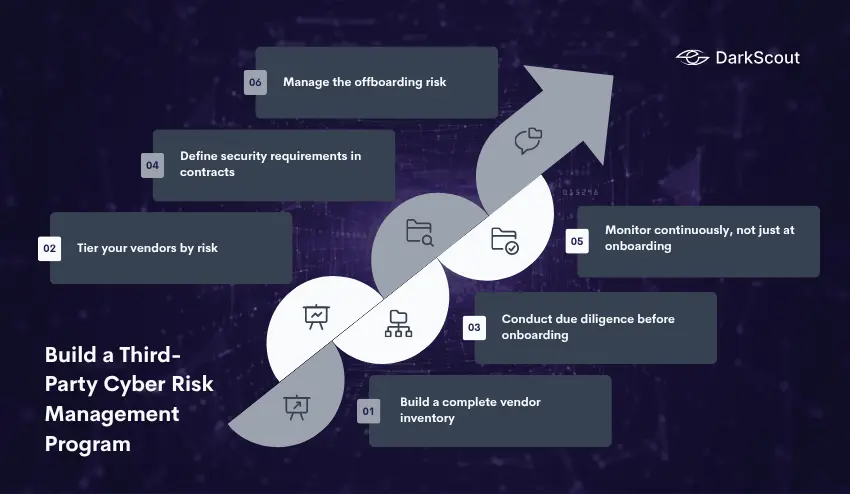
A third-party cyber risk management (TPRM) program isn’t a vendor questionnaire. It’s a lifecycle process that starts before you sign a contract and doesn’t end until the vendor relationship is fully terminated.
Here’s how to structure it.
Step 1: Build a complete vendor inventory
You can’t manage risk you don’t know exists. Start by cataloging every third party that has access to your systems, data, or operations. Include software vendors, cloud providers, contractors, SaaS platforms, and any other external party.
Most organizations discover vendors they had forgotten about during this process. That discovery is valuable.
Step 2: Tier your vendors by risk
Not every vendor deserves the same level of scrutiny. A vendor with access to your patient health records carries more risk than the company that services your office printers.
Tier vendors are based on three factors: the sensitivity of the data they access, the level of system access they have, and the operational dependency you have on them. High-tier vendors get a rigorous assessment. Lower-tier vendors get lighter-touch reviews.
A common tiering approach:
- Level 1 (Critical): Access to highly sensitive data, core systems; Close integration; High potential breach impact
- Level 2 (High): Limited access to sensitive data; Some reliance on your operation;
- Level 3 (Standard): No or minimal access to sensitive data; Low reliance on your operation
Step 3: Conduct due diligence before onboarding
Before any vendor gets access to any system or data, evaluate its security. This shouldn’t simply be a security questionnaire that the vendor fills out.
Evaluate security certifications (ISO 27001, SOC 2 Type II). Ask to see the latest penetration test reports. Learn how incidents are responded to and when (and how) notification will be made. Ask about their vendor management procedures to ensure adequate fourth-party risk is evaluated. Review data handling and data retention policies.
It may be beneficial for high-tier vendors to have an on-site or virtual review rather than simply a questionnaire.
Step 4: Define security requirements in contracts
Your contract with your vendor is the legally binding document of your TPRM program. Ensure it specifies:
- Security standards to be maintained by the vendor
- Timeliness of breach notification (72 hours per GDPR, but aim for faster)
- Right to audit vendor’s security practices
- Data handling, retention, and destruction
- Penalties for failure of security controls
- Right to terminate if the vendor’s security posture deteriorates substantially
The vast majority of organizations under-negotiate the security aspects of vendor contracts. It is one of the highest leverage points in the entire TPRM process.
Step 5: Monitor continuously, not just at onboarding
Vendor risk isn’t static. A vendor that passes a thorough assessment today might suffer a breach next quarter. Their security posture can deteriorate without ever telling you.
Continuous monitoring means watching your vendors’ external security posture in real time: their external attack surface, certificate health, newly discovered vulnerabilities in software they use, and any signals from the dark web about their exposure.
Step 6: Manage the offboarding risk
This step gets skipped more than any other. When a vendor relationship ends, the risk doesn’t automatically end with it.
You need to confirm that the vendor has deleted all your data. Revoke every credential they had access to. Review every system integration that ran through them. Audit access logs to confirm there’s no residual access.
Former vendors with lingering access or retained data are a surprisingly common source of exposure that standard TPRM programs don’t address.
What Good Vendor Monitoring Looks Like
A lot of TPRM programs rely on annual questionnaires and periodic reviews. That’s not monitoring. That’s paperwork.
Real vendor monitoring is continuous. It watches for:
Changes in the vendor’s external attack surface: New exposed services, expired certificates, misconfigured cloud assets, or vulnerable software versions on the vendor’s internet-facing infrastructure. This is the same capability that external attack surface management delivers for your own organization, applied to your vendor ecosystem.
Security rating changes: Continuous security rating platforms assess vendors’ external security posture and flag significant drops. A vendor whose security rating falls sharply often signals a breach, a failed audit, or a significant deterioration in their security controls.
Breach and incident intelligence: News of a breach affecting your vendor should reach your security team immediately, not when you read about it in the press. Real-time breach intelligence services monitor for vendor incidents across the industry.
Regulatory and compliance changes: A vendor operating in a heavily regulated space that falls out of compliance creates risk for you. Monitoring for compliance status changes keeps you informed before a compliance failure becomes your problem.
Third-Party Risk and the Dark Web
Here’s where most third-party risk programs have a significant blind spot.
Your vendors’ credentials, internal documents, and access details circulate on the dark web just like your own data does. And when a vendor gets compromised, the evidence often appears on dark web markets, leak sites, and forums hours before any formal breach notification arrives.
Monitoring the dark web for signals related to your vendors is one of the most valuable early warning capabilities you can add to a TPRM program.
Specific signals to watch for:
- Vendor credentials in stealer logs. If your key vendors’ employee credentials appear in infostealer logs being sold on dark web markets, that’s a signal their environment may already be compromised, before they know it themselves.
- Vendor data on ransomware leak sites. If a ransomware group posts data from one of your vendors, your data may be in that leak even if your organization isn’t named.
- Initial Access Broker listings referencing vendor infrastructure. IABs sell access to compromised networks on dark web forums. If your vendor’s network access is listed, an attacker is already inside and looking for buyers.
- Dark web forum discussions about vendor vulnerabilities. Attackers discuss specific vendor targets, tools, and exploits before attacks are launched. Early intelligence from these forums can give organizations time to reduce their exposure.
This is exactly what DarkScout’s Dark Monitoring service tracks. By continuously scanning darknet forums, ransomware leak sites, credential markets, and underground channels, DarkScout gives your team early warning when your vendors’ exposure creates risk for your organization.
Combining dark web monitoring with a solid cybersecurity risk assessment process means third-party risk gets treated as a concrete, measurable dimension of your organization’s risk posture, not just a compliance checklist.
Regulatory Requirements You Need to Know
It’s no longer a best practice to manage third-party cyber risk; in most regulated industries, it’s required by law.
1. GDPR
For organizations operating under GDPR, you are ultimately responsible for your vendors’ data protection practices if they process the personal data of EU residents. Vendor breaches are your breaches in the eyes of the regulator. You will need to have data processing agreements in place for all vendors processing the data of EU residents. All vendor breaches require notification to the regulator within 72 hours.
2. DORA (Digital Operational Resilience Act)
For all organizations in the EU financial sector. DORA fully comes into effect in January of 2026 and requires a register of all third-party ICT service providers, including regular third-party ICT service risk assessments and a remediation plan documentation should a critically important vendor fail. Significant penalties are associated with failure to comply.
3. HIPAA
Healthcare organizations are required to have Business Associate Agreements in place for all business associates with whom they share Protected Health Information (PHI). HIPAA breaches of PHI that are committed by business associates still require notification and carry heavy civil and criminal penalties for the covered entity, regardless of where the breach occurred.
4. ISO 27001
The ISO 27001 information security management standard requires organizations to manage suppliers as a part of their overall security program. Supplier security requirements, monitoring, and review are documented controls in the standard.
5. NIS2 (EU Network and Information Security Directive)
Now with a broader scope, implemented in January 2024, NIS2 covers a larger scope of organization than NIS1. NIS2 directly mandates a consideration of supply chain risks by the organization and requires an assessment of the security posture of direct suppliers.
Conclusion
Your security posture is only as strong as the weakest link in your vendor ecosystem.
That’s not a cliche. It’s the lesson from every major supply chain breach of the last five years: MOVEit, SolarWinds, CrowdStrike, and the dozens of smaller incidents that never made the news but still cost organizations millions.
You can’t control what happens inside your vendors’ environments. But you can control how much access they have, what data they can reach, how carefully you monitor their risk posture, and how quickly you detect when something goes wrong.
A strong third-party cyber risk management program starts with knowing who your vendors are, tiers them by the risk they represent, assesses them properly before onboarding, monitors them continuously throughout the relationship, and closes every door when the relationship ends.
Frequently Asked Questions
Third-party cyber risk is the potential for a cyberattack, data breach, or security failure that originates from an external vendor, supplier, partner, or service provider that has access to your systems, data, or operations. When a vendor is compromised, the consequences can cascade directly to your organization even if your own systems were never touched.