Threat intelligence used to mean subscribing to a feed and hoping your SIEM caught something.
In 2026, that approach is obsolete.
The volume of threat data has grown far beyond what human analysts can process manually. Credential dumps containing billions of records appear daily. Darknet forums run constantly. Ransomware groups spin up new infrastructure hourly. Malware variants mutate faster than signature databases can update.
But with the advent of Artificial Intelligence, the possibilities are now far broader than they used to be. Today’s threat intelligence platforms are now leveraging machine learning, NLP, and behavioral analytics to sift through vast amounts of data at a pace and scale that no human team can even rival, thereby highlighting actual threat signals and cutting through the noise.
But not all AI threat intelligence tools are the same. Some are built for enterprise SOCs with armies of analysts. Some are built for specific use cases like dark web monitoring or supply chain risk. Some are built for teams with no dedicated security analysts at all.
This guide covers the best AI threat intelligence tools in 2026, what makes each one genuinely strong, who it’s best suited for, and how to choose the right one for your organization.
What Makes AI Threat Intelligence Different?
Before jumping into the tools, it’s worth understanding specifically what AI brings to threat intelligence that traditional approaches couldn’t deliver.
1. Processing at scale
The raw data volume in threat intelligence is enormous. Billions of IOCs. Millions of dark web forum posts. Thousands of new malware samples daily. Hundreds of vulnerability disclosures every week. No human team can monitor all of that simultaneously.
AI processes it continuously. Machine learning models ingest, correlate, and score data across sources at a scale that makes manual approaches look like a garden hose next to a fire hydrant.
2. Pattern recognition across sources
The most valuable threat intelligence often comes from connecting signals across multiple unrelated sources: a credential appearing in a stealer log, a matching domain registered three days later, a forum post discussing a specific vulnerability in the same software stack you use.
AI connects those dots automatically. Human analysts find connections like these occasionally. AI finds them consistently, across millions of data points simultaneously.
3. Reduced analyst fatigue
Alert fatigue is one of the most significant problems in threat intelligence. Too many alerts, too little context, too much noise. Analysts learn to tune out alerts when the signal-to-noise ratio gets bad enough.
AI-driven triage scores and prioritizes alerts before they reach analysts, filtering noise and surfacing only the signals that meet defined relevance and confidence thresholds. Analysts spend time on real threats, not validation work.
4. Natural language processing for unstructured sources
Dark web forums, threat actor blogs, paste sites, and criminal community discussions are unstructured text. Traditional tools can’t read them at scale. NLP-powered AI can scan, interpret, and extract structured intelligence from vast volumes of unstructured text automatically.
5. Behavioral detection beyond known signatures
AI behavioral analysis detects threats without existing signatures. This process relies not on matching a known hash value, but on matching patterns of malicious activity with known attack methodology, and can detect zero-day exploits, or variations on an existing virus that are otherwise undetected by signature-based systems.
How We Evaluated These Tools
Every tool on this list was evaluated against the same criteria.
- AI capability depth – Is AI used to enhance a core intelligence capability, or is it just an AI marketing term used on a traditional platform? We looked for genuine machine learning integration in collection, processing, analysis, and dissemination.
- Dark web and underground coverage – The dark web is where the most actionable pre-attack intelligence lives. Tools with deep, continuous dark web monitoring coverage scored higher than those with limited or surface-level coverage.
- Output Actionability – Does the platform output intelligence that analysts can immediately act on, or data that they need to process? We sought tools that provided a bridge from data to action.
- Value for Organization Sizes – Only a very few organizations will need a complex, large team, months-long deployment. We looked for how a solution could be implemented and utilized by different-sized and mature teams.
- Integrations into existing security stack – intelligence is only valuable if it can be plugged into existing systems that will action it. Integration with SIEM, SOAR, EDR, ticketing systems, etc are important.
- Value for investment – enterprise tools at enterprise prices are not always the right answer; we took this into account relative to the functionality provided.
The Best AI Threat Intelligence Tools in 2026
1. Recorded Future
Best for: Enterprise organizations looking for the most comprehensive AI-powered threat intelligence platform on the market
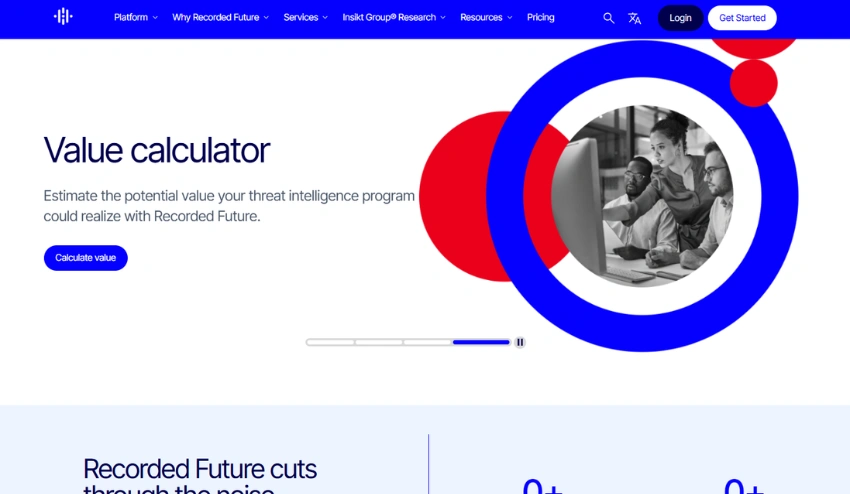
Recorded Future is known as the gold standard in AI-powered threat intelligence. It delivers real-time threat actor activity, vulnerabilities, infrastructure relationships, and geopolitical trends mapped into contextual risk narratives by its Intelligence Graph, which indexes and correlates relationships across over one million global sources.
The platform’s Autonomous Threat Operations capabilities leverage AI-powered hunting in the Intelligence Graph to automatically surface correlated risks, saving analysts from the manual investigation workload.
What makes it stand out: Recorded Future’s Insikt Group provides analyst-validated research on cybercrime operations, underground marketplaces and state sponsored campaigns. This human intelligence layer on top of the AI platform provides strategic and tactical reporting that can’t be replicated by an AI platform alone.
The breadth of source coverage is unmatched. Surface web, deep web, dark web, technical feeds, OSINT, and human intelligence all flow into a single correlating model.
Where it falls short: Recorded Future is geared towards the enterprise market. Its price and complexity of use made it too expensive for most SMBs and mid-market companies without dedicated CTI teams. The platform generates more intelligence than smaller organisations can have the capacity to act on.
Best fit: Large businesses, government bodies, financial institutions and organisations with existing CTI analysts able to implement the potential of the platform.
2. Flare
Best for: Organizations with a need for comprehensive coverage of the deep dark web and cybercriminal ecosystem, along with robust AI-driven analyst workflows.
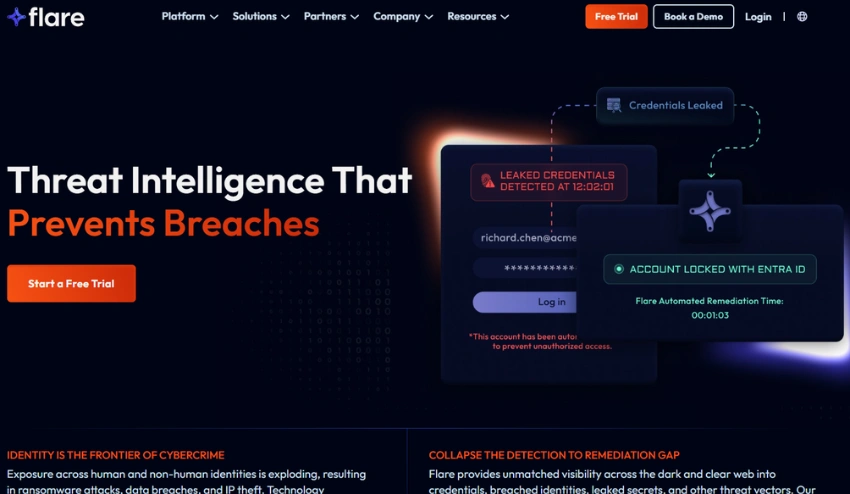
Flare is one of the most complete dark web and cybercriminal community monitoring tools on the market. It is tracking more than 58,000 cybercriminal Telegram channels, hundreds of dark web forums, and past marketplaces, gathering more than one million new stealer logs weekly.
The AI allows for automatic triaging, relevance scoring, and alert prioritization which significantly reduces the work of processing raw dark web data and turning it into actionable intel. Alerts appear in real-time so organizations learn of credential exposures and company mention while its clean admin panel is designed for a CTI analyst-lite workflow rather than an analyst!
What makes it stand out: Breadth (all the dark web markets, Telegram and stealer logs) and relevance scoring through AI. Flare is not about presenting exposure snapshots, but rather how exposures and trends are evolving over time and provide historical context.
Where it falls short: Flare is strong in dark web and the cybercriminal ecosystem. For organizations who require a deeper ITOC management, MITRE ATT&CK mapping and a full threat intelligence lifecycle, it must be supplemented by other tools.
Best fit: Security teams of any size seeking dark web, credential exposure and cybercriminal community intelligence as part of their core CTI capabilities.
3. DarkScout
Best for: Organizations that need AI-powered dark web threat intelligence and continuous darknet monitoring without enterprise complexity or cost
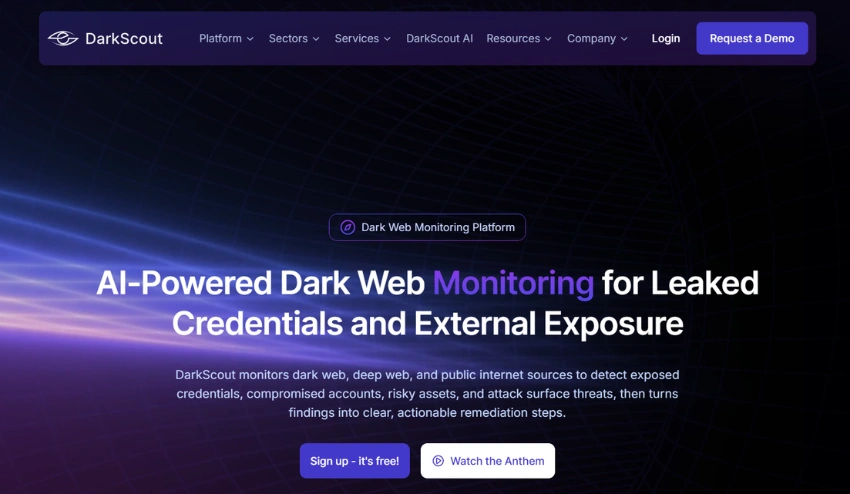
DarkScout delivers AI-powered darknet threat intelligence built specifically around what organizations need most: continuous visibility into the underground environments where threats against them are forming, packaged in a way that’s immediately actionable without requiring a dedicated CTI team to operationalize it.
Where large enterprise platforms treat dark web coverage as one component of a broader intelligence suite, DarkScout is purpose-built around it. The platform continuously scans darknet forums, ransomware leak sites, credential markets, stealer log databases, and Initial Access Broker listings for signals directly relevant to your organization.
What makes it stand out:
DarkScout’s intelligence focus is deliberate. Rather than providing a broad platform that touches every corner of threat intelligence with moderate depth, DarkScout provides deep, continuous dark web intelligence that covers the specific threat channels most organizations have no visibility into at all.
The Dark Monitoring service runs continuously, delivering real-time alerts when your organization’s credentials appear in stealer logs, when your domain surfaces in ransomware group targeting discussions, when data from your organization appears on leak sites, or when an Initial Access Broker lists access to infrastructure connected to your organization.
The Darknet Threat Assessment provides a comprehensive analysis of your organization’s current dark web exposure: what’s already circulating, where it came from, and what it means for your risk posture. It’s the intelligence foundation that tells you where you stand before building ongoing monitoring.
AI capability: DarkScout applies AI to the collection, triage, and relevance scoring of dark web intelligence, filtering the enormous volume of darknet data down to the signals that are specifically relevant to your organization. This dramatically reduces the analyst time required to turn dark web monitoring into actionable security decisions.
Where it fits in a broader program: DarkScout complements rather than replaces broader threat intelligence capabilities. For organizations using an enterprise TIP or SIEM-based intelligence workflow, DarkScout’s dark web layer adds the underground visibility that most other platforms don’t cover adequately. For organizations without a formal CTI program, DarkScout provides an immediately operational intelligence capability that delivers value from day one.
Where it falls short: DarkScout is specialized. Organizations that need a full-spectrum TIP handling IOC management, MITRE ATT&CK mapping, technical feed aggregation, and strategic intelligence production will need to combine DarkScout with broader tooling.
Best fit: SMBs and mid-market organizations that need serious dark web intelligence without enterprise platform complexity. Security teams that recognize dark web monitoring as a gap in their current program. Organizations that have experienced breaches or near-misses and want to understand what’s circulating about them in underground markets. Any organization looking to add the dark web intelligence layer that most CTI programs are currently missing.
Start point: DarkScout’s free email scan gives you an immediate picture of your organization’s current dark web exposure in seconds. No setup required.
4. SOCRadar
Best for: Mid-market and enterprise teams that are looking to gain AI-powered threat intelligence and external attack surface management from one single platform.
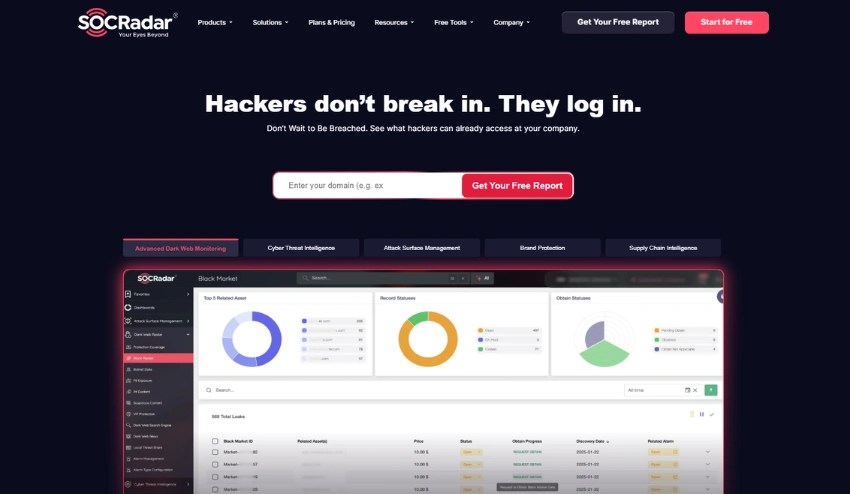
SOCRadar has transitioned into an Extended Threat Intelligence (XTI) platform that is able to correlate external attack surface management and digital risk protection with threat intelligence. With the launch of its new Agentic Threat Intelligence platform, the process of creating and processing threat intelligence has been automated and driven by AI agents to automate threat identification, analysis, and reaction with less human involvement.
What makes it stand out: An EASM and TI combination in a single platform is a highly efficient method for security teams wanting holistic awareness of the internal exposure and external threat activity surrounding their organization. SOCRadar’s AI-generated summaries for any detected threat are able to give a quick summary without having to search for a variety of raw intel information.
In March 2026, SOCRadar launched an AI Agent Marketplace at RSA Conference, allowing organizations to deploy specialized AI agents for specific threat intelligence workflows.
Where it falls short: The breadth of SOCRadar’s platform means depth in any individual capability is sometimes traded for breadth across many. Organizations with very specific, deep requirements in one area may find specialist tools more effective.
Best fit: Organizations that want to consolidate threat intelligence and attack surface management into fewer tools. Mid-market security teams looking for a platform that grows with their program maturity.
5. CrowdStrike Falcon Intelligence
Best for: Organizations already in the CrowdStrike ecosystem that want threat intelligence deeply integrated with endpoint detection
CrowdStrike Falcon Intelligence provides more than 265 threat actor profiles alongside dark web monitoring and contextual indicators. Falcon Adversary Intelligence links adversaries, malware families, and vulnerabilities into structured investigative threads.
The AI-driven adversary tracking is consistently referenced in independent evaluations for strong detection engineering and adversary tracking capabilities. For organizations using CrowdStrike for endpoint protection, the intelligence integration with their EDR is seamless.
What makes it stand out: The depth of adversary attribution and threat actor profiling is outstanding. The OverWatch and Counter Adversary Operations teams at CrowdStrike provide human intelligence to the platform’s profiles that automated systems can’t match.
Where it falls short: Value drops off a cliff when it’s not used within the CrowdStrike ecosystem. The benefit of the integration is not available to organizations that are not using Falcon for endpoint protection, nor is it priced accordingly.
Best fit: CrowdStrike customers who wish to continue investing in threat intelligence. Companies that have well-established SOCs and are able to effectively implement adversary intelligence.
6. Mandiant Advantage (Google)
Best for: Companies requiring analyst-validated intelligence supported by Google’s infrastructure and Mandiant’s incident response capabilities
Mandiant Advantage is the integration of Mandiant’s serious threat research experience and VirusTotal and Google’s extensive data infrastructure. The outcome is easy-to-use, searchable cyber intelligence that has an unprecedented amount of data aggregation due to Google’s global visibility.
What makes it stand out: Mandiant’s frontline incident response work feeds intelligence that’s grounded in real-world attacker behavior observed during active investigations. This gives tactical and operational intelligence a credibility that comes from actually handling the incidents being described.
The VirusTotal integration provides one of the largest malware analysis databases available, making technical IOC enrichment particularly strong.
Where it falls short: Mandiant Advantage can seem like a bunch of good individual tools that don’t necessarily work as well as native-built tools. Newer, purpose-built platforms might be easier to onboard for organizations that don’t already have a Google or Mandiant relationship.
Best fit: Organizations that appreciate analyst-backed and credible research house intelligence. Businesses that have already adopted Google Cloud infrastructure and desire intelligence that fits their current infrastructure.
7. Cyble
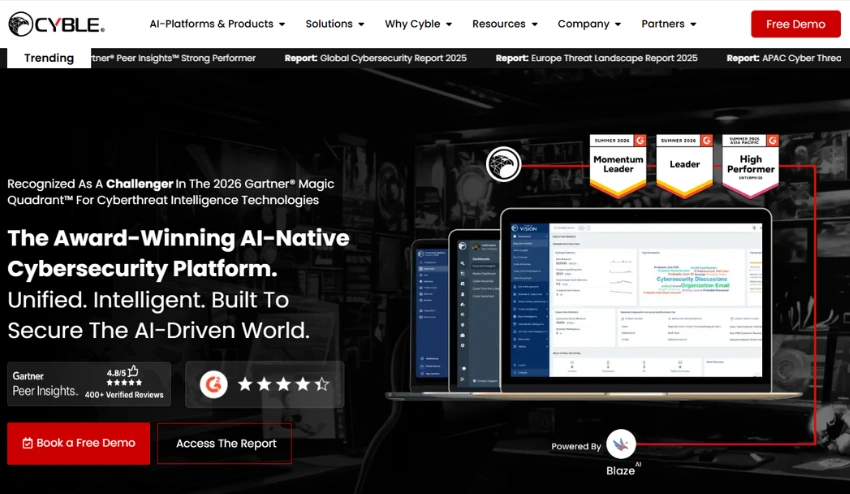
Best for: Organizations requiring predictive AI-driven threat intelligence with strong dark web and brand protection.
Cyble scans tens of thousands of data sources across the deep and dark web to reveal threats, fraud, and data breaches through an AI-driven process. These processes have a depth that brings greater context to each threat by identifying and correlating signals that range from credentials leaked to harmful online conversations. Their takedown services further secure a digital footprint.
The platform also offers takedown support, helping organizations respond to brand abuse and impersonation threats quickly.
What makes it stand out: Real predictive AI; the platform can detect threats and their associated patterns at the earliest stages, while the threats are not yet a reality for the organization.
Where it falls short: Primarily focuses on digital risk protection and dark web monitoring; organizations with SOCs needing MITRE ATT&CK mapping, IOCs management, and full threat intelligence platform services will require integration of additional solutions.
Best fit: Organizations focusing on digital risk protection and dark web monitoring, capable of middle-market SOCs requiring an AI-driven intelligence platform without the complex structure of enterprise platforms.
8. ThreatQuotient
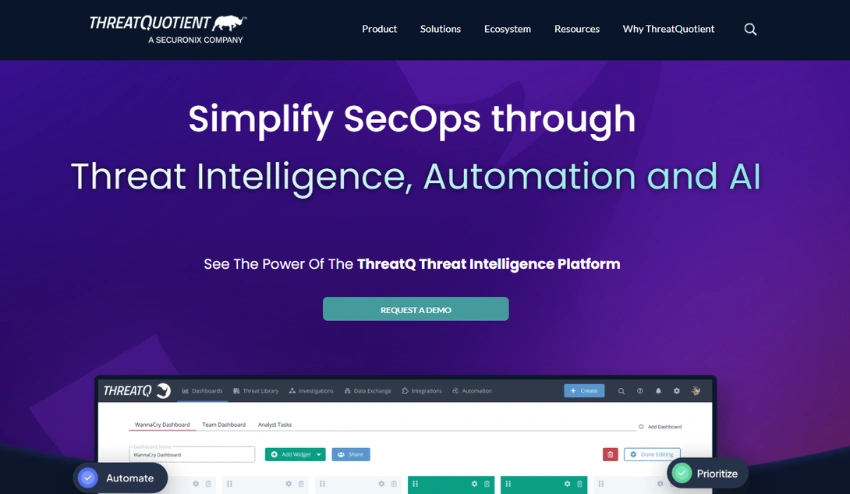
Best for: Security ops teams that want a flexible, analyst-friendly platform to centralize and operationalize intelligence from many sources.
ThreatQuotient’s idea is for teams that would like to bring to the table their own sources and workflow to a central intelligence platform rather than being locked into the structure set forth by a vendor’s preset collection and analysis framework. This platform’s flexible nature can allow for sophisticated security operations teams to tailor the way intelligence workflow is set up around their own internal tool set and structure.
What makes it stand out: ThreatQuotient’s ThreatQ platform is great at helping you tie threat intelligence to security operations. Through powerful analytics and an analyst-friendly interface, the flexibility and power of analytics can help sophisticated CTI programs excel.
Where it falls short: While the flexibility of the platform is great for mature operations teams, the platform’s initial interface can be a bit more challenging to begin with for less mature programs. Organizations seeking to experience little setup with an out-of-the-box feel may find other options more fitting.
Best fit: Mature, existing CTI programs needing a flexible solution that aggregates multiple threat intelligence sources, tools, and workflows into one central location.
How to Choose the Right Tool for Your Organization
With a strong list of options, the selection challenge isn’t finding a good tool. It’s finding the right tool for your specific situation.
1. Start with your intelligence requirements, not the feature list
Go back to your Priority Intelligence Requirements. What questions does your organization most need threat intelligence to answer? A tool that answers those questions well is more valuable than a tool with more features that doesn’t directly address your needs.
2. Match the tool to your team’s capacity
An enterprise platform that requires three full-time analysts to operationalize delivers zero value to a team with one part-time security person. Be honest about your team’s actual capacity. A simpler tool that your team fully uses is better than a sophisticated platform that sits underutilized.
3. Prioritize dark web coverage if you’re missing it
Most organizations have some form of technical threat intelligence through their SIEM and endpoint tools. The gap is almost always dark web intelligence: credential monitoring, IAB listings, ransomware leak site tracking. If that gap exists in your current program, prioritize closing it. The threats forming in underground markets are the ones most likely to become real incidents.
4. Consider integration requirements
Intelligence only creates value when it flows into the tools that act on it. Check that any platform you evaluate integrates with your SIEM, EDR, ticketing system, and SOAR environment. Integration quality matters as much as intelligence quality.
5. Evaluate on real data, not demos
Every vendor demo shows their platform at its best. Ask for a proof of concept using your actual organization as the target. DarkScout’s free email scan is a good example of exactly this: you see real results about your actual exposure before committing to anything.
6. Don’t over-invest before you can operationalize
Intelligence you can’t act on isn’t intelligence. Before expanding your threat intelligence stack, confirm you have the processes, workflows, and personnel to actually use what each tool produces.
The Dark Web Gap Most Tools Miss
There’s a pattern across the threat intelligence market worth calling out directly.
Most threat intelligence platforms include dark web coverage as a single feature. These services are likely to provide a basic or moderately comprehensive overview of some of the more visible corners of the dark web. However, the coverage is rarely as granular and targeted as the reality of the dark web threat landscape requires for 2026.
The underground economy has grown and professionalized dramatically. Stealer log markets process millions of new entries weekly. Ransomware groups operate dedicated leak sites. Initial Access Brokers sell corporate network access in structured auction formats. Threat actors discuss specific organizational targets in closed forums.
All of this is intelligence that has a direct, immediate impact on your organization’s security posture. And most of it falls outside the coverage scope of general-purpose threat intelligence platforms.
This is the specific gap that purpose-built darknet intelligence services exist to fill.
For organizations evaluating their threat intelligence program, adding dedicated dark web intelligence coverage alongside a broader platform is often the single highest-impact addition available. The intelligence is uniquely actionable: a credential appearing in a stealer log can be force-reset before it’s used. An IAB listing referencing your infrastructure can trigger an immediate investigation before a ransomware payload is deployed.
Understanding how data harvesting works and how harvested data flows into these underground markets makes the urgency of dark web coverage concrete.
And for the broader picture of how AI is reshaping both the attack and defense sides of threat intelligence in 2026, the types of threat intelligence guide covers where AI capability fits into each intelligence type and what it enables that manual approaches couldn’t.
Conclusion
The best AI threat intelligence tool isn’t the one with the most features. It’s the one your team can fully operationalize against your specific threat landscape.
For enterprise organizations with large CTI teams, Recorded Future’s depth and breadth is unmatched. For teams prioritizing dark web and cybercriminal ecosystem coverage, Flare delivers exceptional coverage with strong AI-assisted workflows. For organizations that need serious darknet intelligence without enterprise complexity, DarkScout provides purpose-built dark web monitoring that delivers immediate, actionable results.
The tools at positions four through eight each excel in specific contexts: SOCRadar for combined threat intelligence and EASM, CrowdStrike for ecosystem-integrated adversary intelligence, Mandiant for analyst-validated research depth, Cyble for predictive digital risk protection, and ThreatQuotient for mature programs needing a flexible centralization platform.
Whichever platform you choose, make sure dark web coverage is explicitly part of your intelligence program. The threats that matter most in 2026 are forming in underground markets, not on the public internet. If your tools can’t see them, your program has a gap that attackers are already exploiting.