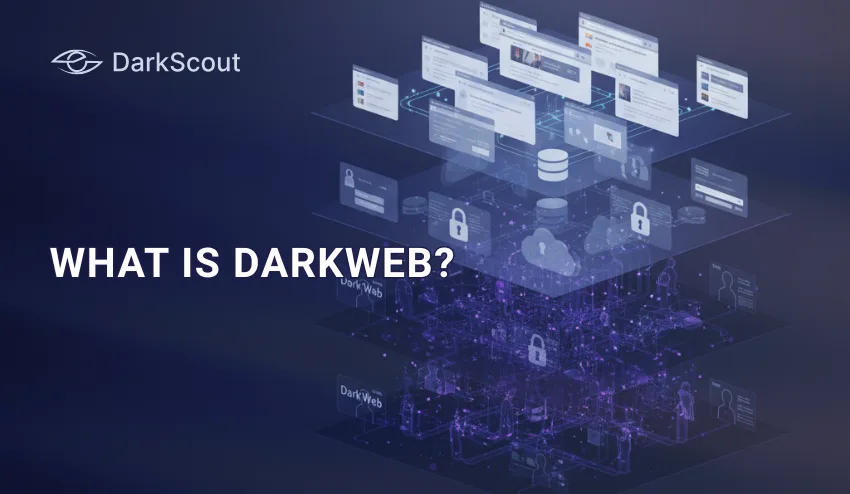
What Is the Dark Web?
The dark web is that section of the internet that search engines like Google have not indexed, and which you cannot visit using a regular web browser.
It is deliberately hidden. To view the dark web, you have to use specific software, most often the Tor browser. Once the Tor browser is opened, it will not bring you to traditional websites ending in .com or .org, but rather those which are designated by a lengthy randomized sequence of characters with a .onion address ending.
However, Contrary to what movies make the dark web out to be, it is not one specific website. The dark web consists of a series of encrypted networks and hidden services that are hosted across thousands of servers located throughout the world.
Key definition: The dark web is that portion of the internet accessible only by means of specialized software, configurations, or authorization and deliberately obscured from general search engines and browsers.
The Three Layers of the Internet
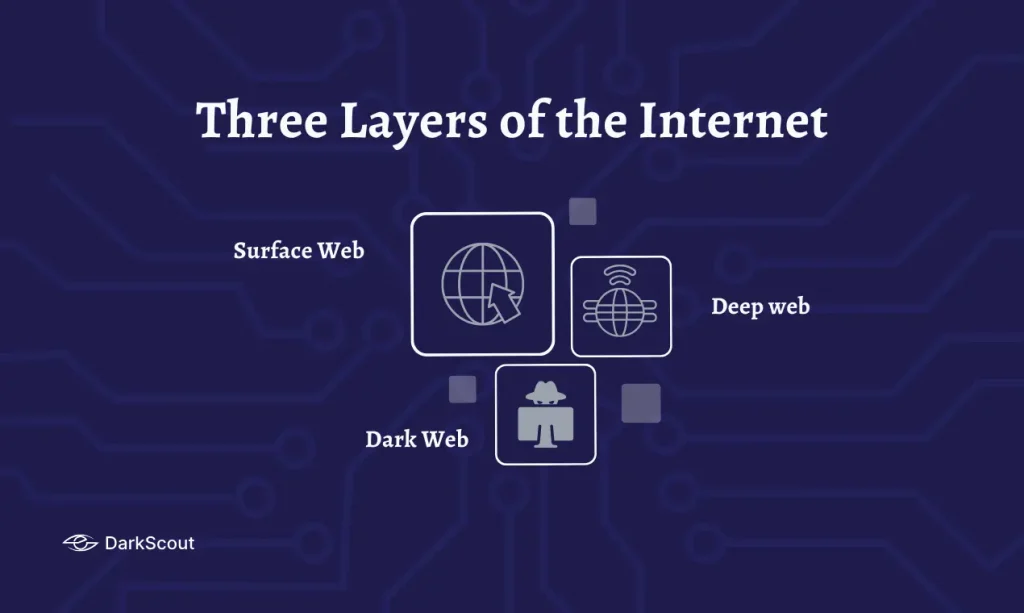
To truly understand the dark web, you need to understand where it sits within the broader internet.
Think of the internet as an iceberg.
1. Surface Web
The Surface Web is the tip above water, everything Google can find and index. This includes news sites, social media, e-commerce stores, and public blogs. It makes up only about 4–5% of the total internet.
2. Deep web
The Deep Web is everything below the surface that is not indexed. This is not sinister. Your online banking portal, your email inbox, private databases, academic journals behind paywalls, and internal corporate systems are all part of the deep web. It is simply content that requires a login or is not meant to be publicly searchable. The deep web makes up around 90–95% of the internet.
3. Dark Web
The dark web is the extremely tiny, encrypted portion of the deep web. It must be accessed via a Tor browser or other equivalent and must be deliberately anonymized.
Want to understand the difference in more detail? Read our full breakdown: Dark Web vs Deep Web: What’s the Real Difference?
The confusion between these three layers is common. Many people use “deep web” and “dark web” interchangeably, but they are very different things.
How Does the Dark Web Work?
The dark web primarily runs on Tor. Short for The Onion Router, it was originally developed by the U.S. Naval Research Lab in the mid-1990’s to secure governmental communication.
The process is as follows:
With Tor your traffic is first encrypted and then bounced around a group of volunteer servers called nodes or relays, of at least 3. Each node peels away a layer of the encryption (like an onion, therefore The Onion Router).
Each node in the chain does not know the sender nor the receiver of the traffic, so it’s extremely difficult to trace activity to a specific person.
Besides Tor, other networks such as I2P (Invisible Internet Project) or Freenet are sometimes used, but they are much less frequent.
Dark websites use .onion domains that only work within the Tor network. These sites are often hosted on servers with no fixed IP address, making them very hard to locate or shut down.
What Is Actually on the Dark Web?
This is where people’s assumptions often break down. Not everything on the dark web is illegal.
Legitimate content includes:
- Privacy-focused email services — ProtonMail has an .onion version for users in censored regions
- Secure messaging tools — used by journalists and activists
- News organizations — outlets like the BBC and The New York Times maintain .onion mirrors for users in countries that restrict press freedom
- Whistleblower platforms — SecureDrop, used by major news organizations, helps sources leak documents anonymously
- Privacy forums and communities — spaces for people to discuss sensitive topics without fear of surveillance
Illegal content includes:
- Stolen credentials — usernames, passwords, and email address dumps from data breaches
- Financial fraud — stolen credit card numbers, banking details
- Drugs and counterfeit goods — dark web marketplaces modeled on e-commerce sites
- Hacking services — ransomware-as-a-service, DDoS-for-hire
- Dark web forums — where cybercriminals share tools, trade data, and coordinate attacks
- Personal information used for identity theft and synthetic identity fraud
The dark web’s reputation as a criminal marketplace is earned, but it is not the whole picture.
Who Uses the Dark Web and Why?
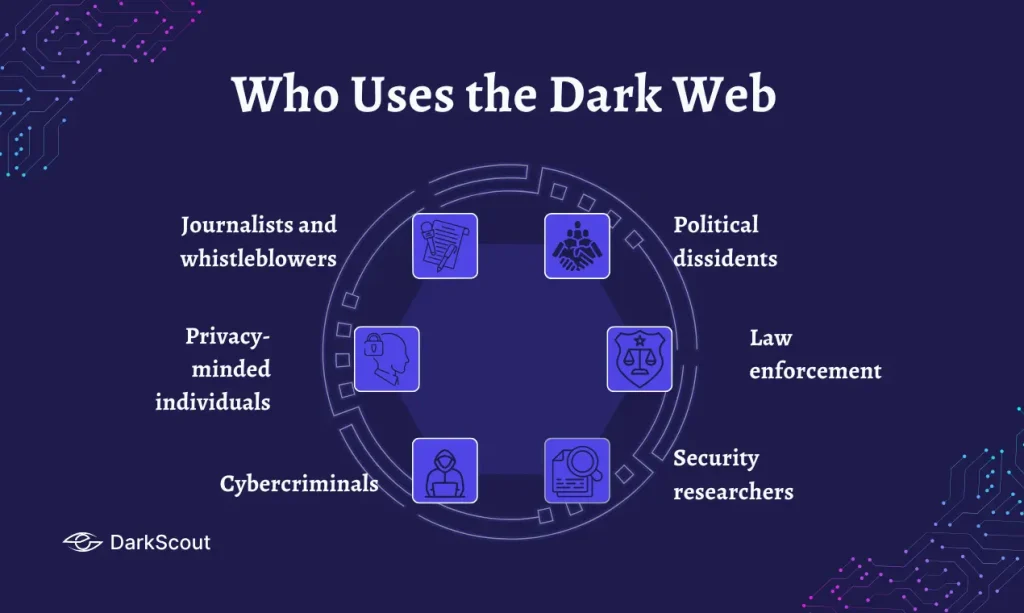
Usage of the dark web spans a wide spectrum of people and motivations.
1. Journalists and whistleblowers
Journalists and whistleblowers communicate safely and share information through it with people they are working with without leaving a trace. In autocratic states, this can be a life and death matter.
2. Political dissidents
Political dissidents and activists under restrictive governments are able to organize and talk freely about what they want on the dark web without any state supervision.
3. Privacy-minded individuals
Privacy-minded individuals who simply do not want their internet browsing tracked by corporations or governments utilize the dark web for greater privacy online.
4. Law enforcement
Law enforcement is not asleep as they keep a watchful eye over the dark web, and there are constant operations by bodies like the FBI, Europol, and Interpol where they attempt to locate and capture criminals on the dark web.
5. Cybercriminals
Cybercriminals exploit it to sell private information and hacking services, sell illegal products, or use it to plan and execute attacks on businesses and corporations by distributing viruses or malware.
6. Security researchers
Security researchers watch over the dark web to find any new threats or information that can be collected, and to help discover the criminal methods used by criminals.
Dark Web Marketplaces and Forums
Dark web marketplaces, in short, are just an online version of an illegal marketplace. Think Amazon or eBay: you have a listed product, a rating, and a review section, but anonymous transactions and cryptocurrency only.
Some of the best-known markets of history include Silk Road (shut down in 2013), AlphaBay, and Hansa Market. When one is shut down, another takes its place. Markets today contain everything from account credentials and hacking exploits to drugs, counterfeit documents, and weapons.
Today’s active markets sell everything from stolen credentials and hacking tools to drugs, counterfeit documents, and weapons.
Dark web forums serve as discussion and coordination hubs. They are where threat actors share tools and techniques, recruit collaborators, sell exploit code, and post stolen data. Our dedicated post on dark web forums covers the most active ones and what makes them dangerous.
Threat intelligence teams, including tools like DarkScout, monitor these forums continuously to spot emerging threats before they reach the surface.
How Does Your Data End Up on the Dark Web?
Most people do not choose to put their data on the dark web. It ends up there through events they never see coming.
- Data breaches are the most common route. When a company is hacked, and its database is stolen, that data, which may include your email, password, name, and payment information, often ends up for sale on dark web markets within hours or days. The Discord data breach is one documented example of how user data gets exposed.
- Credential stuffing is another major pathway. Criminals take leaked usernames and passwords from one breach and try them across dozens of other sites. Accounts that reuse passwords are quickly compromised. Read more about what credential stuffing is and how it works.
- Stealer logs are created by malware installed on a victim’s device. The malware silently harvests saved passwords, session cookies, and browser data, then sends it all to the attacker. These logs are then sold in bulk on dark web markets. Our post on what a stealer log is explains this threat in detail.
- Phishing attacks trick users into entering credentials on fake websites. Those credentials go directly to the attacker and often end up on the dark web for resale.
Once your data is on the dark web, it can be sold, traded, and reused for months or even years.
The Real Risks of the Dark Web {#real-risks}
The dark web creates real, concrete risks for individuals and organizations alike.
For individuals:
- Identity theft using your personal details
- Account takeovers from stolen credentials
- Financial fraud from exposed credit card or banking data
- Doxing — the exposure of private personal information, sometimes leading to harassment or physical threats
- Blackmail using personal files or private communications
For businesses:
- Intellectual property theft — source code, product plans, and trade secrets sold to competitors
- Compromised employee credentials used to breach internal systems
- Ransomware attacks — often planned and sold on the dark web before being deployed
- Brand reputation damage from leaked customer data or forged company documents
- Regulatory fines if breached, customer data is found exposed
A data breach response plan is no longer optional; it is something every business needs before a breach happens, not after.
The threat is not hypothetical. Data from breaches is actively being used. Every day, stealer logs containing fresh credential data are posted on dark web markets and forums.
How to Know If Your Data Is on the Dark Web
Most people find out their data is on the dark web long after it has already been used — if they find out at all.
There are several warning signs to watch for:
- You receive an alert that someone logged into your account from an unknown location
- You see transactions you did not make on a bank or credit card statement
- You start getting targeted phishing emails that use your real name or specific personal details
- A service you use announces a data breach
- Your passwords stop working on accounts you haven’t changed
The most reliable way to know is through active monitoring.
DarkScout’s dark web monitoring service continuously scans dark web markets, forums, and breach databases for your email addresses, domains, and credentials. When something is found, you get an immediate alert, not a notification weeks later.
You can start by running a quick free email scan to see if your email address has appeared in known breaches. You can also run a website scan to check your domain’s exposure.
How to Protect Yourself from Dark Web Threats
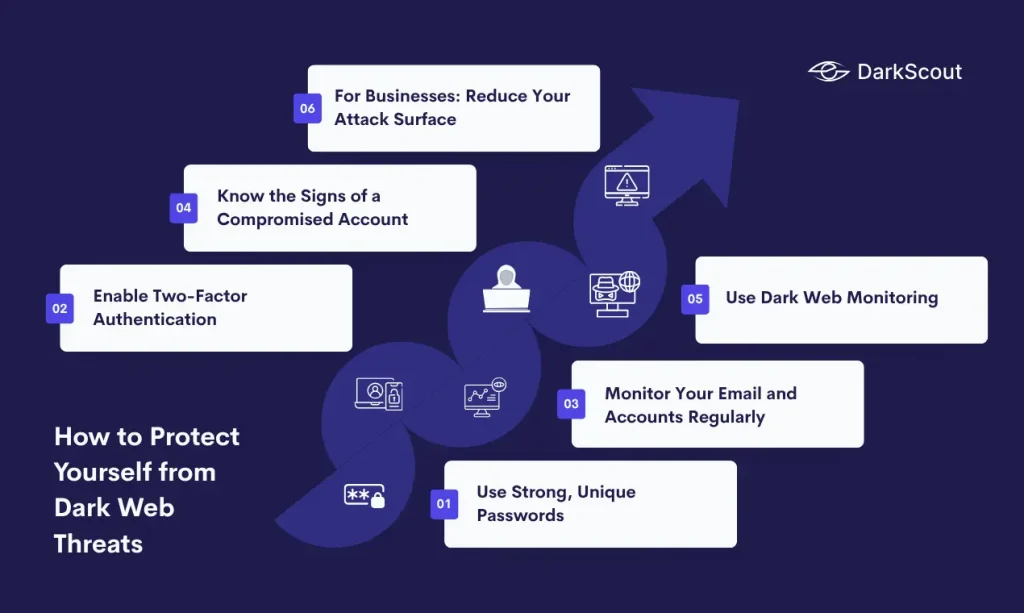
You cannot remove data that is already on the dark web. But you can take steps to limit the damage and prevent future exposure.
1. Use Strong, Unique Passwords
Password reuse is the single biggest factor that turns one breach into many compromised accounts. When criminals get your password from one leaked database, the first thing they do is try it everywhere else.
Use a password manager to generate and store unique passwords for every site. Not sure where to start? Our guide on how to create a strong password walks you through it step by step. You can also use DarkScout’s free password generator to create a secure password instantly.
2. Enable Two-Factor Authentication (2FA)
A stolen password is far less dangerous when 2FA is active. Even if a criminal has your login credentials, they still cannot get in without the second verification step, usually a code sent to your phone or generated by an app.
Enable 2FA on every account that supports it, starting with email, banking, and any platform that stores personal or financial data.
3. Monitor Your Email and Accounts Regularly
Most people find out their data was exposed months after it happened. By then, the damage is often done.
Regularly check whether your email has appeared in known breaches. Our email security guide explains what signals to look for and how to respond when something looks off. You can also run a free email scan directly on DarkScout to check your exposure right now.
4. Know the Signs of a Compromised Account
Sometimes the first warning is subtle. Watch for:
- Login alerts from locations or devices you don’t recognize
- Unexpected password reset emails you did not request
- Contacts telling you they received strange messages from your account
- Accounts you can suddenly no longer access
Our post on signs your email has been breached covers each of these in detail and explains what to do immediately if you spot them.
5. Use Dark Web Monitoring
It’s not possible for any one individual to be vigilant all of the time; searching dark web markets and forums manually is not viable-automated monitoring is-24/7.
Dark web monitoring services continuously monitor breach databases, criminal forums, and underground markets for your email addresses, login credentials, domain names, etc. Upon the discovery of an occurrence, an immediate alert is delivered rather than days or even weeks later.
6. For Businesses: Reduce Your Attack Surface
The less attack surface your business exposes, the less likely it is that any theft occurs on the dark web in the first place.
Perform vulnerability assessment and identify weaknesses of your systems. Utilize attack surface management to continuously monitor and shrink the surface of your organization’s external attack vectors, subdomains, open ports, and poorly configured systems, shadow infrastructure, etc., before attackers can discover them.
Final Thoughts
The dark web is real, it is active, and it is where your stolen data ends up after a breach.
Understanding what it is and separating fact from myth is the first step to protecting yourself. The dark web is not a boogeyman. It is a specific, well-defined part of the internet with a clear structure and real consequences for those whose data ends up there.
The good news is that exposure on the dark web is detectable. The right monitoring tools give you visibility into what criminals see, and time to respond before the damage is done.