Most businesses think they know what they’re protecting.
Their website. Their servers. Their email system. Maybe a few cloud tools.
But the reality is very different. Every new app your team signs up for, every vendor with access to your systems, every forgotten test environment still sitting online, all of it is part of your attack surface. And most organisations have far less visibility into it than they think.
According to cybersecurity research, 70% of successful breaches started with unknown or unmanaged assets.
That’s not a technical failure. That’s a visibility failure. And it’s exactly what attack surface management is designed to fix.
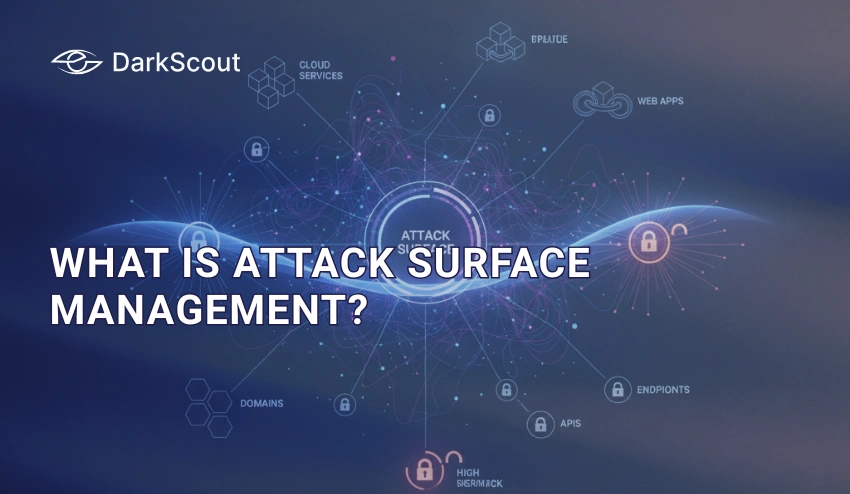
What Is Attack Surface Management?
Attack surface management, often shortened to ASM, is the continuous process of discovering, monitoring, and reducing all the ways an attacker could get into your organisation.
Every business leaves digital footprints. Some are deliberate and well-documented, cloud applications, websites, domains, and external integrations. Others are like faint or forgotten tracks that reemerge unexpectedly: test environments left open to the public, untracked SaaS services spun up without IT approval, or leaked credentials surfacing on dark web forums.
ASM is the discipline of finding all of it, the things you know about, the things you’ve forgotten, and the things you never knew existed, before an attacker does.
Without ASM, most organisations are flying blind across parts of their infrastructure, leaving shadow assets and outdated systems exposed to increasingly automated and opportunistic attackers.
What Is an Attack Surface?
Before we go further, it helps to understand what an attack surface actually is.
Your attack surface is the sum total of every possible entry point an attacker could use to get into your systems. Every exposed server, every login page, every open port, every third-party tool with access to your data, every employee device, all of it.
The attack surface can be broken down into three primary categories: digital, physical, and human.
The Digital Attack Surface
This is the largest and fastest-growing category.
It includes your websites, web applications, APIs, cloud infrastructure, SaaS platforms, email systems, databases, and any internet-facing service your organisation runs. It also includes things your IT team may not even know about, shadow IT tools employees are using without approval, old subdomains nobody decommissioned, and developer environments accidentally left public.
On average, 100 or more new vulnerabilities emerge every single day, creating an overwhelming burden on already stretched security teams.
The Physical Attack Surface
This covers the physical world, servers, laptops, mobile devices, USB drives, printers, and any hardware that connects to your network.
A stolen laptop with saved credentials. An unsecured office printer. An employee’s personal phone is used to check work email. Each one is a potential entry point if not properly managed.
The Human Attack Surface
This is the one most organisations underestimate.
People are consistently the most exploited part of any attack surface. Phishing emails, social engineering, and impersonation attacks all target humans rather than systems. The MGM Resorts breach in 2023 was triggered by voice phishing, demonstrating how attackers exploit people to infiltrate networks. No firewall stops a well-crafted phone call.
Why Attack Surfaces Are Growing So Fast
Ten years ago, most businesses had a relatively contained digital footprint. A website, some servers, and a local network.
That world is gone.
Cloud infrastructure, SaaS apps, mobile devices, hybrid work, and third-party vendors have all contributed to a sprawling and often invisible digital footprint. Every new tool, every new integration, every new remote employee adds to the attack surface.
The average number of cyberattacks per week rose 47% globally in early 2025. Digital infrastructure is growing faster than most security teams can keep up with.
And then there’s shadow IT, the tools employees adopt without telling IT.
Research found that 65% of all SaaS applications in use are unsanctioned, creating significant challenges for security teams managing this sprawl. Moreover, 35% of data breaches last year involved shadow data, information stored in tools and systems the organisation didn’t even know it had.
IBM research shows data breaches involving shadow data cost an average of $5.27 million, 16.2% more than breaches without shadow data. The hidden tools nobody is managing are costing businesses more than almost anything else.
How Attack Surface Management Works
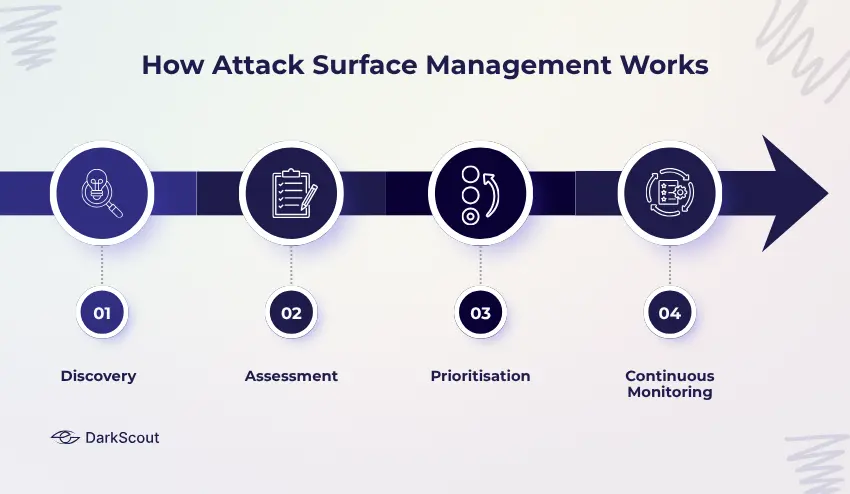
ASM isn’t a one-time scan or an annual audit. It’s a continuous cycle with four core stages.
Stage 1 — Discovery
You can’t protect what you don’t know exists.
The first step is finding everything, every domain, every subdomain, every cloud instance, every API, every application, every device connected to your network. This includes assets your IT team manages, assets they’ve forgotten, and assets that were never officially sanctioned in the first place.
Effective discovery blends multiple external signals: DNS sweeps, certificate transparency logs, WHOIS lookups, and internet-wide scans. Automation is essential here; no human team can manually track thousands of assets across a constantly shifting environment.
Stage 2 — Assessment
Once you know what you have, you need to understand how exposed each asset is.
Security teams assess each asset for potential vulnerabilities, everything from misconfigurations and coding errors to social and human factors such as susceptibility to phishing schemes or business email compromise attacks.
Not every vulnerability carries the same risk. A forgotten subdomain with no sensitive data is different from a misconfigured cloud database containing customer records. Assessment puts context around each finding so you know what actually matters.
Stage 3 — Prioritisation
Security teams can’t fix everything at once. Prioritisation ensures the most dangerous exposures get addressed first.
Risk-based prioritisation focuses security efforts on high-risk vulnerabilities, enabling automated response workflows to mitigate threats efficiently.
Without prioritisation, security teams drown in noise, lists of vulnerabilities with no clear sense of which ones an attacker would actually use.
Stage 4 — Continuous Monitoring
Your attack surface changes every day.
New assets get deployed. New vulnerabilities get discovered. Employees sign up for new tools. Vendors update their systems. Modern organisations face constant change, new cloud resources are deployed, SaaS tools are adopted without security review, identities are created and modified, and third-party services are integrated into critical workflows.
Continuous monitoring means your visibility keeps pace with those changes, instead of leaving a window of exposure every time something new appears.
The Shadow IT Problem Nobody Is Talking About
Shadow IT deserves its own section because it’s one of the biggest and most underappreciated risks in modern organisations.
When an employee signs up for a new productivity tool, joins a project management platform, or stores files in a personal cloud account, all without IT approval, they’re expanding the attack surface in ways nobody is tracking.
In 2022, a marketing specialist posted a public Trello board so contractors could track email campaigns. Google indexed it within hours. Attackers scraped 120,000 addresses, pivoted on recycled passwords, and drained loyalty-point balances across five regional storefronts. The board stored no payment data, but it unlocked credentials that did.
The problem is accelerating with AI tools. 37% of employees are now using generative AI tools without approval, creating risks ranging from accidental data leaks to GDPR violations.
By 2027, it’s estimated that 75% of employees will acquire, modify, or create technology outside IT’s visibility.
The only way to manage shadow IT is to find it. And the only way to find it is with continuous attack surface monitoring.
What Happens Without Attack Surface Management
Let’s be direct about the consequences of flying blind.
In the first half of 2025, zero-day and one-day exploits increased significantly, putting even stronger emphasis on knowing your assets and patching quickly. Attackers are scanning the internet constantly, looking for exposed services, unpatched systems, and misconfigured databases. They don’t need a sophisticated plan. They just need to find the door you didn’t know was open.
BitSight threat research has identified over 230 million exposures in the US alone, representing more than 40% of all exposures worldwide. Most of those exposures belong to organisations that don’t know they’re exposed.
Cyberattacks are estimated to cost businesses globally over $10 trillion annually by 2025. A significant portion of that cost traces back to assets that weren’t discovered, monitored, or secured in time.
How DarkScout Helps
DarkScout’s Attack Surface Mapper continuously scans for assets exposed across your organisation’s digital footprint — domains, IP addresses, cloud instances, open ports, misconfigurations, and shadow IT that bypasses traditional security tools.
It also goes where most ASM tools don’t. DarkScout correlates your external attack surface with dark web intelligence — identifying whether your exposed assets are already being discussed, targeted, or traded in criminal communities. That combination of surface-level visibility and dark web awareness gives you a far more complete picture of your actual risk.
When a new asset appears, when a misconfiguration is detected, when a credential tied to your organisation surfaces on a dark web forum — you know about it in real time. Not weeks later when the damage has already been done.
Attack Surface Management Best Practices
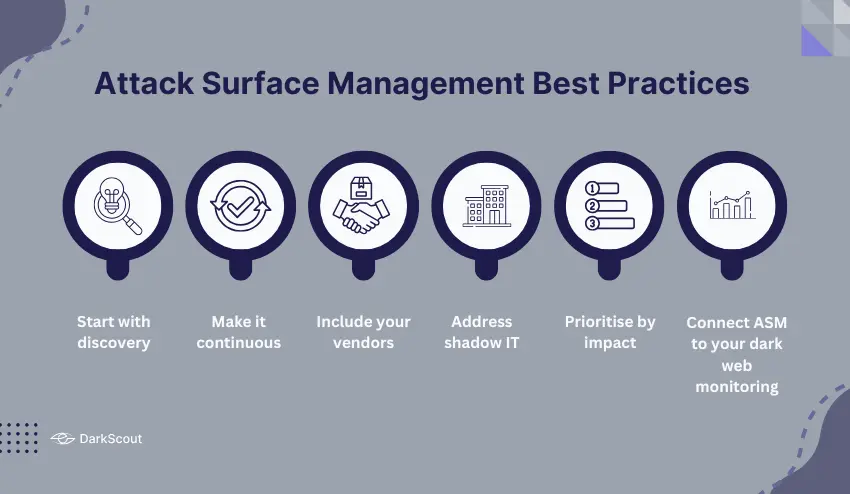
Start with discovery — and assume you’re missing things. Most organisations underestimate their attack surface. Start from the assumption that there are assets out there you haven’t accounted for.
Make it continuous, not periodic. A point-in-time assessment becomes stale the moment it’s finished. Your attack surface changes daily. Your monitoring needs to as well.
Include your vendors. Third-party risk is part of your attack surface. Map it. Monitor it. Hold vendors to the same standards you hold yourself.
Address shadow IT head-on. Create clear, accessible processes for employees to request new tools. The reason shadow IT exists is usually that the official process is too slow or too complicated. Fix the process, and you reduce the behaviour.
Prioritise by impact, not just severity. A critical vulnerability in a low-value system matters less than a medium vulnerability in a system holding your customer database. Context is everything.
Connect ASM to your dark web monitoring. Knowing your exposed assets is important. Knowing whether those assets are already on an attacker’s radar is even more important. Dark web monitoring helps with knowing this information.
The Bottom Line
Your attack surface is bigger than you think. It’s growing faster than you’re tracking it. And attackers are scanning it constantly.
Attack surface management isn’t about achieving perfection. It’s about maintaining visibility — knowing what you have, knowing what’s exposed, and knowing the moment something changes.
The organisations that get breached aren’t always the ones with the worst security. They’re often the ones with the biggest blind spots.
Without ASM, security teams are stuck reacting to incidents instead of preventing them. Complete attack surface visibility is no longer optional — it’s the first step toward controlling digital risk and proving resilience.