Most people use these two terms interchangeably. Security teams do it. Executives do it. Job postings do it.
And most of the time, nobody notices.
But when a compliance auditor asks why your physical records aren’t covered under your security policy, or when a regulator questions why your data classification framework doesn’t align with your incident response plan, the distinction suddenly matters a lot.
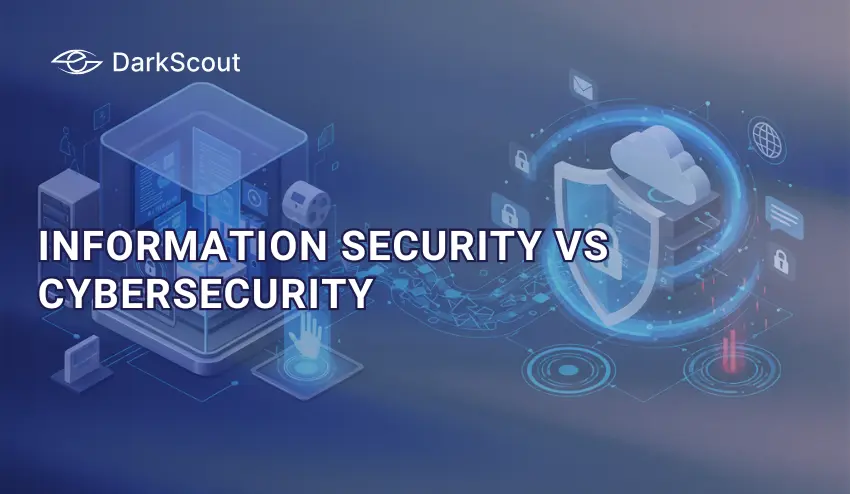
Information security and cybersecurity are related. They overlap significantly. But they are not the same thing, and treating them as identical leads to real gaps in how organizations protect themselves.
This guide explains what each term actually means, where the two fields differ, where they converge, and why understanding the difference makes your security program stronger.
What Is Information Security?
Information security, often shortened to InfoSec, is the practice of protecting information in all its forms from unauthorized access, use, disclosure, modification, or destruction.
The key phrase is “all its forms.”
Information security doesn’t just cover digital data sitting on a server. It covers printed documents in a filing cabinet. It covers a conversation in a meeting room that shouldn’t be overheard. It covers the data on a USB drive someone leaves on their desk. It covers handwritten notes, physical access logs, and archived paper records.
If information exists and has value, information security is concerned with protecting it.
This broad scope is what separates InfoSec from cybersecurity. Information security is a discipline built around governance, policy, risk management, data classification, and the people and processes involved in handling sensitive information, regardless of whether that information ever touches a digital system.
In practice, information security programs typically address:
- Data classification policies (what counts as confidential, internal, public)
- Access control policies (who is allowed to see or handle what)
- Data retention and destruction policies
- Physical security controls (secure facilities, clean desk policies, locked cabinets)
- Employee training and security awareness
- Regulatory compliance and audit readiness
- Risk management frameworks and governance
It’s a wide field. And it deliberately covers territory that most cybersecurity tools and teams never touch.
What Is Cybersecurity?
Cybersecurity is all about defending computers, servers, applications, networks, mobile devices, and the information contained within each from malicious intrusions or attacks, unauthorized access without permission, and various digital threats.
While information security broadly encompasses its very nature, cybersecurity has a narrow focus: the defense of the digital realm (your computers, servers, networks, cloud instances, and all the information passing through each). It also demands a higher degree of technicality as a profession compared to the information security field as a whole.
It encompasses the tools, the technology, and the hands-on work used to secure digital infrastructure, such as firewalls, endpoint detection, intrusion detection systems, penetration testing, vulnerability scanning, threat hunting, incident response, etc.
Typically, a cybersecurity program would cover:
- Network security and perimeter defense
- Endpoint protection (laptop/desktop, servers, and mobile devices)
- Application security and secure development lifecycle
- Cloud security and cloud infrastructure security
- Threat detection and incident response
- Identity and access management in a digital space
- Vulnerability management and patch life cycle
- Dark web monitoring for digital threat intelligence
In short, cybersecurity is where all of the technical controls are established. It’s the portion of the information security domain that implements the tools, watches the alerts, and actively responds when things go wrong in your digital space. You should remember that cybersecurity is technically a subdivision of the entire field of information security.
The CIA Triad: The Foundation They Share
Both Information Security and Cybersecurity are built upon the same model – The CIA Triad.
CIA stands for Confidentiality, Integrity, and Availability, which describe what it takes for an information resource to be secure, and all of the controls used in either field can be broken down into one or more of these.
Confidentiality is ensuring that only those with the required authorization to view data can access it – this is just as true of an encrypted database as a locked file cabinet.
Integrity is ensuring that an information resource is accurate, complete, and has not been tampered with – digitally signed documents are the equivalent of a countersigned piece of paper in regard to their integrity.
Availability is ensuring that an information resource can be accessed when it is required -ransomware, which denies the attacker the use of their systems, could be referred to as an availability attack, likewise, a flooded data room.
It is this CIA Triad that forms the link between information security and cybersecurity-the three goals are the same, and both utilize information security or cybersecurity to attain them, although in different environments and with varying tools.
Having an understanding of this will enable organisations to judge whether or not the controls put in place actually serve a purpose to satisfy a security need rather than a form of security theater that makes them appear to be secure.
Information Security vs Cybersecurity: Key Differences
Here’s where the two fields genuinely diverge.
| Information Security | Cybersecurity | |
|---|---|---|
| Scope | All information, digital and physical | Digital systems and data only |
| Focus | Governance, policy, risk management | Technical controls and defense |
| Threats addressed | Unauthorized access, misuse, physical theft, insider threats | Cyberattacks, malware, hacking, and network intrusions |
| Key tools | Policies, frameworks, training, classification systems | Firewalls, EDR, SIEM, vulnerability scanners |
| Who owns it | CISOs, risk managers, compliance teams | Security engineers, SOC analysts, threat hunters |
| Relevant frameworks | ISO 27001, NIST SP 800-53, COBIT | NIST CSF, CIS Controls, MITRE ATT&CK |
| Physical dimension | Yes, explicitly included | No, limited to digital environments |
| Regulatory alignment | GDPR, HIPAA, SOX, privacy laws broadly | Sector-specific cyber regulations |
The single biggest practical difference is scope.
Information security says: protect all information, wherever it lives, in whatever format, from any threat.
Cybersecurity says: protect digital systems and the data within them from cyberattacks.
An organization that only has a cybersecurity program has technical defenses but may have no policy governing what happens when an employee prints a sensitive report and takes it home. Or what happens when a contractor accesses files in a shared folder they shouldn’t have visibility into. Or how paper-based patient records are stored and destroyed.
An organization that only has an information security program has strong governance and policies but may lack the technical tools to detect a ransomware attack, monitor for credential exposure on the dark web, or respond to an active intrusion.
Both are necessary. Neither is complete without the other.
Where They Overlap
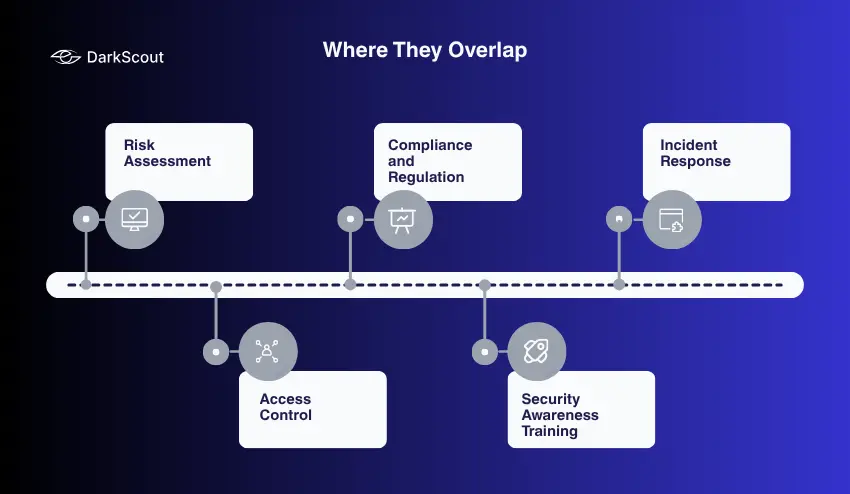
Despite their differences, information security and cybersecurity share a large amount of common ground. In most mature organizations, the two fields operate together rather than in isolation.
1. Risk Assessment
Risk assessment sits at the center of both. Whether you’re assessing the risk of a physical breach of your document storage room or the risk of a ransomware attack on your cloud infrastructure, the underlying methodology is the same: identify assets, identify threats, evaluate likelihood and impact, prioritize controls. A good cybersecurity risk assessment covers both physical and digital risk dimensions.
2. Access Control
Access control is a principle shared across both fields. Information security defines who should have access to what information. Cybersecurity implements and enforces those decisions technically through identity and access management systems, multi-factor authentication, and privileged access controls.
3. Compliance and Regulation
Compliance and regulation drive requirements in both disciplines at the same time. For instance, with GDPR, we need both strong technical security controls (cybersecurity) and strong policy regarding classification, retention, and breach notification (information security). We can’t comply with the requirements of GDPR with only cybersecurity tools, and we can’t comply with the requirements of GDPR with only policies.
4. Security Awareness Training
Security awareness training benefits both. Teaching employees to recognize phishing attempts protects digital systems. Teaching them to handle printed sensitive documents properly, lock their screens, and avoid discussing confidential matters in public spaces protects information broadly.
5. Incident Response
Incident response crosses both domains. When a breach occurs, the response requires both technical containment (cybersecurity) and information governance decisions: what was exposed, who needs to be notified, what are the regulatory obligations, and how is the incident documented. Both disciplines are active simultaneously during any serious incident.
Why the Distinction Matters for Your Business
Here’s the practical reason this matters beyond the theoretical.
Organizations that treat information security and cybersecurity as the same thing often have strong technical defenses but weak governance. Or strong policies but tools that don’t actually enforce them.
Both gaps create real risk.
Gap 1: Technical controls without governance
You have a firewall, endpoint detection, and vulnerability scanning. But you have no data classification policy, so your security team doesn’t know which assets are most critical. They’re monitoring everything equally, which means they’re effectively monitoring nothing with focus.
When a breach happens, you can’t quickly assess what was taken because you don’t have a clear inventory of what was where and how sensitive it was.
Gap 2: Policies without technical enforcement
You have a robust information security policy. It says employees must use strong passwords, that sensitive data must be encrypted, and that remote access requires approval. But you have no technical controls enforcing any of it. Employees reuse passwords because there’s no password manager policy enforcement. Data sits unencrypted in shared drives. Remote access happens over personal VPNs.
The policy exists. The protection doesn’t.
Gap 3: Missing the physical and human layer
Pure cybersecurity programs focus on digital threats. But according to Verizon’s 2025 Data Breach Investigations Report, the human element, which includes social engineering, insider threats, and physical security failures, remains a factor in the vast majority of breaches.
A phishing email is a cybersecurity threat. An employee who holds the door open for an unknown visitor who accesses a server room is an information security threat. Both result in breaches. Only one gets covered if your program is cybersecurity-only.
Gap 4: Compliance failures
Most regulatory frameworks expect both. ISO 27001 is an information security management standard that explicitly covers physical controls, human resources security, and supplier relationships alongside technical controls. Auditors reviewing your ISO 27001 compliance don’t just check your firewalls. They check your policies, your training records, your clean desk enforcement, and your supplier agreements.
Having strong cybersecurity tools but weak InfoSec governance is a common reason organizations fail compliance audits they expected to pass.
Common Roles in Each Field
Looking at the roles in each of these areas highlights the practical distinction between the two.
Roles in InfoSec tend to focus on the governance, risk, and policy aspects of security:
- Chief Information Security Officer (CISO): Holds responsibility for the overall security strategy of the company’s information security and cybersecurity functions. The CISO role is estimated at around $321,000 on average by Glassdoor for 2026.
- Information Security Manager: Runs the information security function within an organization, responsible for risk assessments and compliance monitoring. The Information Security Manager role earns around $189,516 per year, according to Glassdoor for 2026.
- GRC Analyst: Also known as a Governance, Risk, and Compliance analyst, their role focuses on compliance and policy. Often, an entry role in the information security domain.
- Security Auditor: Examines whether technical and non-technical security controls comply with required standards/frameworks like ISO 27001, SOC 2, or HIPAA.
- Data Protection Officer: Role mandated by GDPR in specific organizations where the information governance and data privacy function resides.
Cybersecurity roles tend to emphasize technical defense and operations:
- SOC Analyst: The day-to-day security professional, monitoring for security alerts, triaging them for potential threats, and escalating confirmed threats. Usually an entry level into technical work.
- Threat Hunter: Proactively searches for hidden threats that automated tools haven’t detected, using OSINT dark web tools and threat intelligence alongside internal telemetry.
- Penetration Tester: Authorized “attacker”, identifying system vulnerabilities that malicious users can take advantage of.
- Cloud Security Engineer: Responsible for security within a company’s cloud environment, securing cloud configurations, and managing IAM (Identity and Access Management).
- Incident Responder: Takes a lead in an actual attack to try and stop/mitigate it and perform an investigation afterwards.
- Security Architect: The designer of the overall security of an infrastructure, influencing future toolset and controls.
However, in practice, professionals often switch between these two fields throughout their careers. This is perhaps most prevalent with the CISO role, as it necessitates a thorough enough technical understanding to manage cybersecurity operations while possessing a strong governance framework.
Which Frameworks Apply to Each?
Many organizations use frameworks from both categories simultaneously. A company might align to ISO 27001 for its overall information security management approach and use the NIST CSF to structure its technical cybersecurity program within that broader framework.
Information Security Frameworks
ISO 27001 is an international standard for an ISMS (Information Security Management System). It is comprehensive and includes physical security, HR security, supplier security, asset security, and technical security controls. Achieving ISO 27001 certification means that the organization’s entire information security management approach is in compliance with a recognized international standard, not just its technical controls.
NIST SP 800-53 provides a catalog of security and privacy controls for federal information systems and is often used by private-sector organizations as a thorough control framework, including technical and governance controls across a wide range of domains.
COBIT (Control Objectives for Information and Related Technologies) relates to IT governance and management and provides a framework for alignment between security, business, and governance controls.
Cybersecurity Frameworks
The NIST Cybersecurity Framework (CSF) categorizes cybersecurity activities into five core functions: Identify, Protect, Detect, Respond, and Recover. It is designed to be practical, providing organizations with a framework for identifying, managing, and reducing cybersecurity risk without necessarily prescribing a specific tool or technology.
The CIS Controls provide a list of technical security actions organizations can implement that will provide a defense against common threat vectors. These are extremely practical when looking for a starting point for an organization’s cybersecurity program.
The MITRE ATT&CK framework is a knowledge base of attacker tactics and techniques based on real-world observation and is often used by threat hunters, red teams, and detection engineers to predict attacker behavior and evaluate defenses.
It is common for organizations to utilize more than one framework from both categories.
Many organizations use frameworks from both categories simultaneously. A company might align with ISO 27001 for its overall information security management approach and use the NIST CSF to structure its technical cybersecurity program within that broader framework.
Do You Need Both?
Yes. But the balance depends on your organization’s size, industry, and risk profile.
If you’re a small business with limited resources, start with the basics of cybersecurity: endpoint protection, MFA, patch management, backups, and a basic incident response plan. Then layer in information security governance: a simple data classification policy, an acceptable use policy, and basic security awareness training. You don’t need a 200-page ISO 27001 program to be meaningfully protected. You need the right controls for your actual risk.
If you’re a mid-sized organization in a regulated industry, both fields demand attention simultaneously. Your compliance obligations likely require documented information security governance (policies, training, risk assessments, supplier management) alongside technical cybersecurity controls. Treating one as optional will create audit failures and compliance gaps.
If you’re an enterprise, you almost certainly need dedicated functions for both. A CISO and GRC team own the information security governance layer. A SOC and security engineering function owns the cybersecurity operations layer. The two functions need to work closely together, sharing risk data, aligning on what assets matter most, and ensuring that technical controls actually enforce what governance policies require.
The practical starting point for any organization is a cybersecurity risk assessment that maps both your technical vulnerabilities and your governance gaps, giving you a clear picture of where your biggest risk exposure actually lives before deciding how to prioritize your investments.
Where the Dark Web Fits In
Here’s a dimension that most discussions of information security vs cybersecurity miss entirely.
The dark web is where the output of both types of security failures ends up.
When cybersecurity fails, credentials get stolen by infostealer malware and end up in stealer log markets. When information security fails, printed documents get photographed, USB drives get pocketed, and insider threats exfiltrate data that ends up posted on darknet forums or sold to competitors.
Both failure modes lead to the same place: your organization’s sensitive information circulating in environments you have no visibility into.
This is why dark web monitoring sits at the intersection of both disciplines. It’s a technical capability (cybersecurity) that monitors for the output of both technical and governance failures (information security). When your employee’s credentials appear in a stealer log, it might be because their device was infected (a cybersecurity failure) or because they used a personal device with no security controls for work (an information security governance failure). Either way, the dark web is where you’ll find the evidence first, if you’re looking.
Understanding how data harvesting works and how harvested data flows into underground markets shows clearly why the divide between digital threats and information governance threats has blurred almost completely in 2026. Data gets out through technical channels and human channels. It ends up in the same places.
DarkScout’s Dark Monitoring service gives organizations visibility into what’s circulating about them underground, regardless of whether the exposure originated from a technical breach or a governance gap. It’s the intelligence layer that tells you when either type of failure has resulted in real exposure.
You can check your current dark web exposure right now with DarkScout’s free email scan. It takes seconds and often reveals exposure that neither your cybersecurity tools nor your information security policies have caught.
Conclusion
Information security and cybersecurity aren’t competing disciplines. They’re complementary layers of a complete protection program.
Information security is the foundation: the policies, governance, risk management, and culture that determine how information is valued, classified, handled, and protected across every environment it exists in.
Cybersecurity is the technical layer built on top of that foundation: the tools, controls, and operations that defend digital systems from the specific threats that target them.
Get the foundation wrong, and your technical controls protect the wrong things, or protect them inconsistently. Get the technical layer wrong, and your policies exist on paper while your digital environment is exposed.
Most organizations that experience serious breaches haven’t failed at one or the other. They’ve had gaps in both, and those gaps connected.
The good news is that closing those gaps doesn’t require two entirely separate programs. It requires a clear understanding of what each discipline covers, where the responsibilities sit in your organization, and how your technical controls and your governance policies reinforce each other rather than operating in silos.
Start by knowing what you’re protecting and why it matters. That’s information security thinking. Then build the technical defenses around what actually matters most. That’s cybersecurity in practice. Together, they’re what a real security program looks like.