Two alerts land in your SIEM at the same time.
The first flags a known malicious IP address connecting to one of your servers. That’s an Indicator of Compromise.
The second flags an unusual process spawning a command shell, accessing files it has never touched before, and preparing to communicate outbound. That’s an Indicator of Attack.
Same threat. Completely different signals. Completely different response windows.
One tells you a breach has happened or is happening. The other tells you an attack is in progress right now and can potentially still be stopped.
Understanding the difference between IOCs and IOAs is one of the most practically important distinctions in modern cybersecurity. This guide breaks both down completely: what they are, how they work, where each one falls short, and how the best security programs use them together.
What Is an Indicator of Compromise (IOC)?
An Indicator of Compromise is a specific and measurable indicator that proves that a system has been compromised or is in the process of being compromised.
Think of an IOC as the forensic evidence. They are the digital signatures left behind by an attacker: file hashes, domain names, network signatures, IP addresses, or registry keys that correlate to an already documented attack.
When your security device or software discovers an artifact matching an IOC within your network, it is signaling to you: this particular item has been correlated with a cyberattack, and therefore something bad has occurred, is occurring, or will likely occur.
IOCs are precise. They match specific, known artifacts to known threats. That precision is both their strength and their biggest limitation.
The key characteristic of an IOC: it’s evidence-based and retrospective. It identifies a threat that is already known because someone, somewhere, has seen that artifact in a previous attack and documented it.
What Is an Indicator of Attack (IOA)?
An Indicator of Attack (IOA) is a behavioral cue that an attack is underway or being attempted, regardless of the particular tool or malware in use.
Where IOCs identify specific known artifacts, IOAs identify suspicious patterns of behavior.
An IOA doesn’t say “this file hash matches known malware.” It says, “This process is behaving in a way that attackers typically behave when moving laterally through a network, even if we’ve never seen this specific tool before.”
IOAs are rooted in intent. They ask not “what is this?” but “what is this trying to do?”
A user account accessing hundreds of files it has never touched before. A process spawning a command shell at 3 a.m. An application communicating outbound to an IP address it has never contacted. A script disabling backup services before initiating large file transfers.
None of those behaviors requires a known malware signature to be detected. They’re suspicious because of what they’re doing, not what they are.
The key characteristic of an IOA: it’s behavior-based and proactive. It can detect attacks that use entirely new tools and techniques because it focuses on attacker behavior, which changes far more slowly than attacker tooling.
IOC vs IOA: The Core Difference
The clearest way to understand the difference is through timing and focus.
| IOC | IOA | |
|---|---|---|
| Focus | What the artifact is | What the behavior is doing |
| Timing | Retrospective (after or during) | Proactive (in progress or imminent) |
| Detection basis | Known signatures and artifacts | Behavioral patterns and intent |
| Question answered | Has a known threat touched our environment? | Is an attack in progress right now? |
| Threat coverage | Known threats only | Known and unknown threats |
| Shelf life | Short (attackers rotate infrastructure constantly) | Long (behaviors persist even as tools change) |
| False positive risk | Low (specific matches) | Higher (behavioral patterns need tuning) |
| Primary use | Incident confirmation and forensics | Real-time detection and prevention |
The single most important distinction: IOCs tell you what already happened. IOAs tell you what’s happening right now.
That timing difference defines how each one is used in practice. IOCs confirm and scope a breach. IOAs stop an attack before the breach completes.
Common Examples of IOCs
IOCs are tangible, specific artifacts. Here’s what they look like in practice.
Network-based IOCs
- Specific IP address known to be associated with command and control infrastructure.
- Domain name registered by a known threat actor.
- Outbound network traffic targeting an IP address in a country with which your organization doesn’t have business.
- Network traffic pattern matching known malware communication patterns.
File-based IOCs
- Specific file hash (MD5, SHA-256) that matches that of known malware.
- Suspicious file name appearing in system locations that are outside normal file locations.
- Obfuscated script that matches a known attack toolkit.
- Document with known phishing macro.
Host-based IOCs
- Registry key modified by known malware.
- A newly created scheduled task was added to the system, which doesn’t have a reason for doing so.
- Windows service was added, which is a known persistence technique.
- Suspicious Windows event logs.
Account-based IOCs
- Log in from an IP address associated with a known threat actor.
- Login attempt against an account that has previously been documented as having stolen credentials.
- Geographic impossibility for a user’s login to have happened from their last login point.
Common Examples of IOAs
IOAs are behavioral patterns, not specific artifacts. Here’s what they look like in practice.
Process behavior IOAs
- A Word document spawning PowerShell
- PowerShell executes encoded commands or downloads content from the internet
- A legitimate Windows tool like certutil.exe is being used to decode and execute a file
- A process injecting code into another process’s memory space
Account behavior IOAs
- A user account accessing significantly more files than usual in a short time period
- An account logging in from a new device and immediately accessing sensitive directories
- Admin account activity outside of normal working hours with no prior pattern
- A service account performing actions that don’t match its intended function
Network behavior IOAs
- Internal systems communicating with external IP addresses on unusual ports
- Sudden large data transfers from an internal server to an external location
- DNS queries for newly registered domains with no prior query history
- Lateral movement patterns: one internal system scanning ports on other internal systems
System behavior IOAs
- Backup services being stopped or disabled
- Volume shadow copies being deleted (a near-universal ransomware precursor)
- Security tools being terminated by a non-admin process
- New admin accounts are being created outside of change management windows
Where IOCs Fall Short
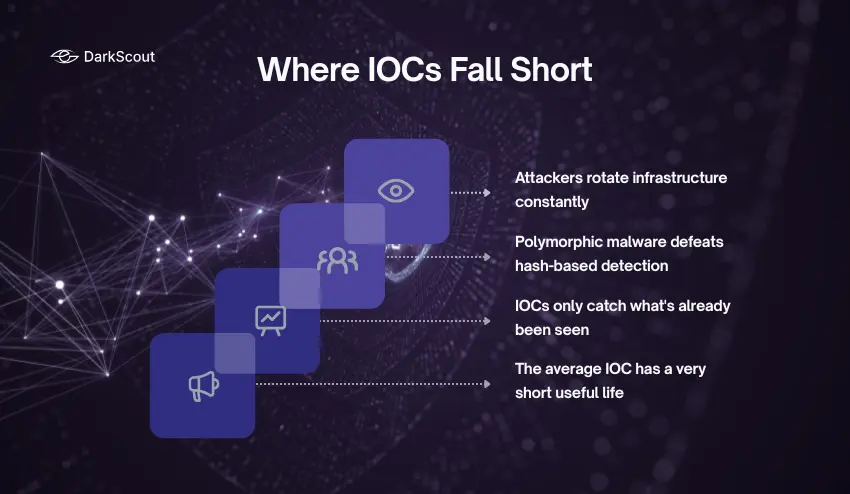
IOCs are valuable. They’re also increasingly insufficient on their own. Here’s why.
1. Attackers rotate infrastructure constantly.
An IP address or domain used in an attack gets blacklisted quickly. Professional threat actors know this. They cycle through new infrastructure constantly, sometimes changing IP addresses and domains daily.
By the time an IOC makes it into a threat feed, gets ingested into a SIEM, and gets deployed as a detection rule, the attacker may already be using different infrastructure. The IOC is technically accurate and completely useless.
2. Polymorphic malware defeats hash-based detection.
Hash-based IOCs match specific file signatures. Polymorphic malware automatically generates new variants with different hashes every time it executes. A piece of ransomware can produce thousands of unique variants daily, each with a different hash that matches no existing IOC.
Relying on file hash detection alone is like trying to catch someone who changes clothes every five minutes by looking for a specific shirt.
3. IOCs only catch what’s already been seen.
IOCs are created from known threats. They’re built by analyzing attacks that have already been documented.
Zero-day exploits, novel malware, and new attack techniques have no IOCs because nobody has seen them before. An attacker using a brand-new tool against your environment produces no IOC matches at all. The attack is completely invisible to IOC-only detection systems.
4. The average IOC has a very short useful life.
Research suggests that a significant proportion of IOCs become stale within days. Network-based IOCs like IP addresses and domains have particularly short useful lives. Organizations that don’t actively manage IOC freshness end up with detection systems full of dead signals that consume processing resources without providing protection.
Where IOAs Fall Short
IOAs solve the problems IOCs can’t. But they introduce their own challenges.
1. Behavioral detection requires careful tuning.
Normal business processes sometimes look suspicious. A developer running PowerShell scripts as part of their work. A system administrator accessing large volumes of files during an audit. A backup process initiates large data transfers at midnight.
IOA-based systems that aren’t carefully tuned to the organization’s specific environment generate significant false positive volumes. Alert fatigue sets in. Analysts start dismissing behavioral alerts, and real attacks get missed.
2. Context matters enormously.
An IOA that’s accurate in one environment may be meaningless in another. A process behavior that’s suspicious for a typical office worker is completely normal for a security researcher. Building an IOA detection that’s accurate enough to be actionable requires deep knowledge of what “normal” looks like in your specific environment.
3. More complex to implement and maintain.
IOC-based detection is relatively straightforward: match artifacts against a list of known bad indicators. IOA-based detection requires behavioral baselining, machine learning models, ongoing tuning, and analyst expertise to build and maintain effectively.
For organizations with limited security resources, implementing sophisticated behavioral detection without the capacity to tune and manage it can make security worse, not better, by burying real signals in noise.
How They Work Together: A Real Attack Scenario
The strongest argument for using both IOCs and IOAs is seeing what happens when you rely on only one.
Imagine a ransomware attack against a mid-sized manufacturing company. Here’s how it unfolds.
Day 1, 9:00 AM – A user at the company opens a phishing e-mail and clicks on the attached malicious document. An infostealer is executed, which exfiltrates VPN credentials, then self-deletes.
IOC detection: None. The new version of the infostealer has no matching hash; there is no malicious domain being communicated with that is on the IOC list yet.
IOA detection: An unusual child process is spawned from the document. An encoded PowerShell command is run. The alert is fired; the attack can be stopped at this point if security is vigilant.
Day 3, 2:00 AM – A cybercriminal purchases the stolen credentials from an Initial Access Broker. He then logs into the company’s VPN via the corporate VPN in a country where the company does not operate.
IOC detection: The IP address is not known to have malicious intent yet. There is no matching IP.
IOA detection: VPN login from an unknown country during off-hours, shortly after an unknown country has access to an account, the IP from which sensitive data directories not previously accessed are explored. The alert is fired.
Day 5, 11:00 PM – The criminal begins to exfiltrate data and then installs ransomware. Volume shadow copies are deleted, and all backup services are stopped; file encryption is commenced.
IOC detection: The ransomware variant eventually matches a known hash. Alert fires. Too late. Encryption is already underway.
IOA detection: Shadow copy deletion plus backup service termination plus mass file modification. Alert fires. Critical ransomware precursor behavior detected. If responded to immediately, encryption may still be stopped.
After the incident: Forensic investigators recover IOCs from the attack: the attacker’s infrastructure IP addresses, the ransomware file hash, and the domain contacted during data exfiltration. These get added to threat intelligence feeds and help protect other organizations from the same group.
The lesson: IOAs had multiple opportunities to stop the attack early. IOCs confirmed what happened after the fact and helped prevent the next victim. Both have value. Neither alone is sufficient.
IOC vs IOA in Your Security Tools
Understanding what IOCs and IOAs look like in the actual tools your security team utilizes will make this practical as opposed to purely theoretical.
SIEM tools deal mostly with IOCs. SIEMs ingest threat feeds and correlate log events to known indicators of maliciousness. This helps them to notify when there’s a match, while newer SIEMs incorporate behavioral analytics, leading to IOA-like detections, yet the SIEM’s core functionality relies on correlation.
The best place where I/O detection can reside is in EDR and XDR tools. EDR and XDR systems perform behavioral monitoring at the endpoint and cross-environment level in real-time. Through machine learning and behavioral baselines, suspicious patterns are detected regardless of whether or not the malware has already been seen or identified by its signature. CrowdStrike’s methodology focuses on threat actor behavior rather than known malware signatures and therefore has an IOA-based methodology for detecting threats.
Tip platforms are mostly focused on IOCs and deal with aggregating threat feeds, removing duplicate indicators, adding context and context data to IOCs, and finally feeding them to security tools. Tip platforms are essentially a base of infrastructure that supportsIOC-based detection on a larger scale.
ATT&CK is the matrix where I/O detection takes place. This framework breaks down actor behaviors (tactics, techniques, and procedures) into actionable knowledge, which detection engineers use to create behavioral detection rules. So when a security tool states it is “ATT&CK coverage”, it means it can detect an IOA-style threat mapped to Known adversary behaviors.
MDR and SOC services utilize both. With IOC-based detections, an MDR analyst uses their discretion and context to discern true positives from false positives. Similarly, when an IOA pattern is detected and provided by an automated tool, an MDR analyst again uses their judgment and experience to interpret the behaviors.
For a deeper look at how these capabilities fit into a broader security program, the types of threat intelligence guide covers how IOCs map to technical intelligence and IOAs map to tactical intelligence within the full CTI framework.
Introducing IOEs: The Third Category
We have two established categories, IOCs and IOAs. But in 2026, we’re likely going to be hearing about a third category, which is becoming increasingly relevant, which is called Indicators of Exposure (IOE).
The key here is that, unlike IOCs and IOAs, an IOE indicates conditions that increase the likelihood that an attack is or will occur, as opposed to indicating an attack has occurred (IOC) or an attack is ongoing (IOA).
Think of IOEs as risk signals. It’s a misconfiguration, a vulnerability, exposed credentials, or a weak attack surface that an attacker could potentially take advantage of, but as of now, has not.
Examples of IOEs:
- An unpatched critical vulnerability on an internet-facing server
- Employee credentials are circulating on dark web markets
- A misconfigured cloud storage bucket with public read access
- An expired TLS certificate on a production service
- A subdomain pointing to an unclaimed third-party resource
IOEs sit before IOAs in the timeline. They’re what the attacker exploits to gain initial access in the first place.
The emerging security maturity model looks like this:
- IOEs identify exposure before an attack begins (preventive)
- IOAs detect attacks in progress (proactive)
- IOCs confirm compromises and support forensics (reactive)
The most complete security programs operate across all three. IOE monitoring through external attack surface management and attack surface monitoring reduces the opportunities for attack. IOA detection stops attacks that get through. IOC matching confirms and helps contain what manages to breach defenses.
Which Should You Prioritize?
This question gets asked constantly. The real answer is: both, but the right balance depends on your maturity and resources.
If you’re early in building detection capability:
Start with IOC-based detection. It’s faster to implement, requires less tuning, and produces fewer false positives. Subscribe to quality threat intelligence feeds relevant to your industry. Feed them into your SIEM and firewall. This gives you baseline protection against known threats with reasonable analyst overhead.
As you mature:
Begin implementing behavioral IOA detection leveraging an EDR platform with behavioral analytics. Utilize only the most confident IOA patterns (i.e. Shadows copy deletion, power-shell encoded command, spawned by an unexpected process) then expand over time. Enable adequate tuning to reduce false positives.
If you’re evaluating advanced threats:
Add IOE monitoring through external attack surface management and dark web credential monitoring. Knowing what attackers can see and exploit before they act gives you the earliest possible warning signal in the attack chain.
The non-negotiable point:
Organizations relying on IOCs alone are increasingly vulnerable. Polymorphic malware, fileless attacks, and living-off-the-land tactics are being deliberately engineered around an IOC-only monitoring approach.
Behavioral IOA-based detection is no longer a nice-to-have capability for organizations focused on detecting advanced threat activity; it is a necessary component that catches what IOCs do not.
A mature cyber threat intelligence program integrates IOC management, behavioral IOA detection, and IOE monitoring into a coherent detection strategy rather than treating each as a separate point solution.
Conclusion
IOCs and IOAs aren’t competing approaches. They’re complementary layers that together give you visibility across the entire attack timeline.
IOCs tell you what you know to be bad. IOAs tell you what’s behaving badly, whether you’ve seen it before or not. And IOEs tell you what could be exploited before anything has happened at all.
The organizations that detect and contain attacks fastest aren’t the ones that chose one over the other. They’re the ones that built detection across all three stages: exposure monitoring before attacks begin, behavioral detection while attacks are in progress, and artifact matching to confirm and scope what made it through.
No single indicator type is enough on its own in 2026. Attackers are too sophisticated, their tools change too fast, and the attack surface is too complex.
Build the layers. Start where your resources allow. And make sure you’re not leaving the dark web out of your intelligence sources, because that’s where early warning signals for both IOCs and IOEs appear before they ever touch your environment.