Modern classifiers trained on AI threat detection can identify malware variants with over 99% accuracy, including samples the model has never seen before.
That number sounds like the problem is solved. It isn’t.
AI threat detection has fundamentally changed what’s possible in cybersecurity, but it has also introduced a new set of risks, blind spots, and attacker countermeasures that most vendor pitches conveniently leave out. Attackers are already studying how detection models work and crafting attacks specifically designed to stay inside the boundary the model considers “normal.”
Understanding AI threat detection properly means understanding both halves of that picture: what it genuinely fixes, and what it genuinely doesn’t.
This guide covers the real mechanics behind AI threat detection, the six distinct techniques powering it, the security domains where it’s applied, the honest limitations most vendors don’t lead with, and a practical framework for evaluating whether a specific AI detection claim is real or marketing.
What Is AI Threat Detection?

AI threat detection is the application of artificial intelligence and machine learning to identify, analyze, and prioritize cyber threats across network, endpoint, cloud, identity, email, and application environments.
It’s important to understand upfront that this is not one technology. AI threat detection is an umbrella term covering a full taxonomy of distinct AI and machine learning approaches, including supervised learning, unsupervised learning, deep learning, natural language processing, reinforcement learning, and graph neural networks, all operating at machine speed to find threats that traditional methods miss.
Behavioral analytics, anomaly detection, and User and Entity Behavior Analytics (UEBA) are important subsets of this field, but they represent only a fraction of the broader landscape. When a vendor says their product uses “AI threat detection,” that phrase could mean almost any of these underlying techniques, applied to almost any of the security domains where threats occur.
The core shift AI represents is moving detection from matching known patterns to recognizing what normal looks like and flagging meaningful deviations from it. That shift is genuinely powerful. It’s also the source of every limitation this guide will cover.
Why Signature-Based Detection Stopped Being Enough
Security tools primarily operate on the principle of signatures, which are a catalogue of known threats, assembled from past attacks. This approach has one fundamental limitation that no amount of database expansion can fix. It cannot detect what it hasn’t seen before.
Every new malware variant, every new attack technique, every piece of infrastructure an attacker spins up for the first time produces no signature match. The detection gap is built into the architecture, not a bug that can be patched.
Attackers understood this limitation and exploited it systematically. Polymorphic malware that changes its own code with each execution defeats signature matching by design. Living-off-the-land techniques that use legitimate administrative tools rather than custom malware leave no malicious signature to match at all. Novel infrastructure with no prior reputation passes every blacklist check because it’s never been documented as malicious.
AI-based detection flips the underlying question. Instead of asking “does this match something we’ve seen before?” it asks “does this behavior look normal for this user, device, or network segment?” That reframing is what allows detection of genuinely novel threats, attacks using infrastructure and techniques that have never been catalogued anywhere.
The Six AI Techniques Behind Modern Threat Detection
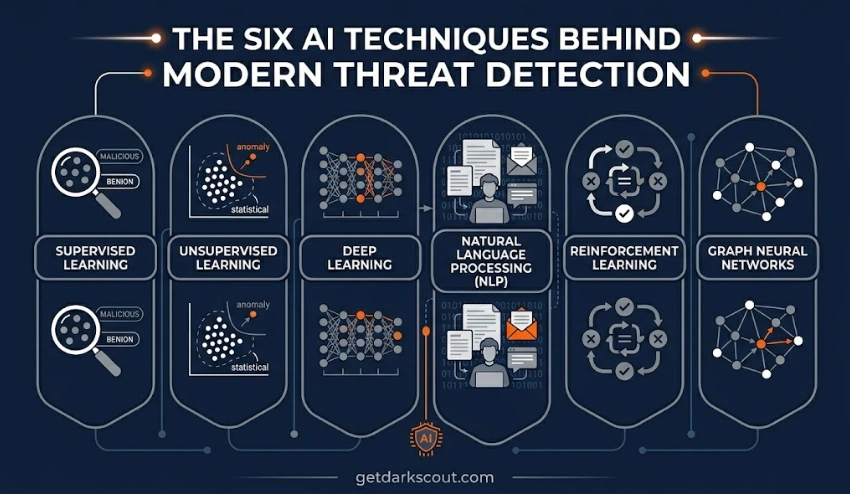
Being aware of the individual methods that are grouped under “AI threat detection” explains exactly what can or cannot be realistically expected of a given tool.
1. Supervised learning
These are models that have been trained on a dataset that has been labeled, containing malicious samples, as well as clean/benign samples. This type of model learns what features in the data are characteristic of one category or the other and uses the resulting pattern to classify future unknown samples. Trained on millions of examples of malware, supervised models are capable of classifying a new variant with a high degree of accuracy, even though this specific example has never been seen before, as it shares underlying structural similarities with the training set.
The limitation: supervised models are only as good as their training data. If the training set doesn’t represent a genuinely novel attack category, the model has no learned basis for recognizing it.
2. Unsupervised learning
Models that don’t require labeled attack data at all. Instead, they learn the baseline of normal activity within a specific environment and flag statistical outliers. This is the technique behind most behavioral anomaly detection: the model doesn’t need to know what an attack looks like in advance. It only needs to know what normal looks like, and treat meaningful deviation as worth investigating.
This is particularly valuable for detecting genuinely novel threats and insider activity that wouldn’t match any known attack signature.
3. Deep learning
Designs and methods like autoencoders or transformer-based architectures that are capable of learning intricate non-linear relationships in large high-dimensional datasets. Models leveraging deep learning have the capability of learning patterns from uninterpreted data from the network, from system logs, or file systems, that simpler statistical approaches wouldn’t discover.
Some of the more effective malware classification schemes can be built using deep learning techniques, but are often quite computationally expensive and require a great deal of training data.
4. Natural language processing (NLP)
Analysis of unstructured text, including the contents of phishing emails, dark web forum chats, threat intelligence feeds, and security analyst logs. NLP models can detect phrasing commonly used in phishing emails, condense long threat reports into manageable summaries, and efficiently extract intelligence from large bodies of unstructured, underground forum communications much more quickly than an analyst can manually.
5. Reinforcement learning
Models that learn optimal response strategies through trial and error, refining their decision-making based on the outcomes of previous actions. This technique is increasingly applied to automated response orchestration: learning which containment actions are most effective for specific threat patterns over time.
6. Graph neural networks
Models specifically designed to analyze relationship structures: connections between users, devices, accounts, and network segments. Graph-based detection is particularly effective for identifying lateral movement and command-and-control infrastructure because these attack patterns are fundamentally about relationships and connections rather than isolated events.
The Six Security Domains Where AI Detection Operates
AI-powered threat detection does not stop in one place of the security stack, but is applied in distinct domains, which have different characteristics of the data available and requirements for detection.
1. Network detection and response (NDR)
AI-based NDR analyzes network traffic in real-time to detect lateral movement, data exfiltration, and C2 communications, which are regularly missed by rule-based systems, including even encrypted traffic where the contents of the payload are not accessible by payload inspection.
2. Endpoint detection and response (EDR)
The machine learning models analyze process behavior, file system operations, and system calls on each device to detect behavior associated with attacks, even when the attack payload has never been seen before.
3. Identity and access (UEBA)
UEBA creates a behavioral baseline of each individual user and entity. When they access things they have not previously, such as a finance analyst logging into payroll at 2 AM, or a user account suddenly accessing a number of resources they have never used before, this raises an alert.
4. Cloud security
The AI-driven Cloud Security Posture Management system flags misconfigurations, anomalous API call patterns, and abnormal resource creation in multi-cloud environments, which simply could not be checked by manual means.
5. Email security
AI analyzes email content and the characteristics and behavior of senders to detect Phishing and BEC that get around reputation and signature-based detection.
6. Application security
Anomalous behaviors in application code, non-standard API call patterns, and likely attacks against a web application are detected by machine learning in real time.
How AI Threat Detection Actually Works: The Pipeline
Most AI threat detection systems (regardless of the domain) operate along the following general pipeline.
1. Data ingestion and normalization
Raw data flows in from endpoint agents, network sensors, identity providers, and cloud logs. This data arrives in inconsistent formats from different sources and must be normalized into a consistent structure before any analysis can begin.
2. Baseline creation
The system establishes what normal looks like for each user, device, application, subnet, or role. This baseline period typically requires days to weeks of observation before the model has enough data to distinguish normal variation from genuine anomalies.
3. Anomaly scoring
Every observed event is scored based on how far it deviates from the established baseline. This isn’t a binary malicious/benign classification. It’s a continuous score reflecting the statistical unusualness of the behavior.
4. Contextual correlation
Individual anomalies are correlated across multiple data domains to build confidence and reduce noise. A single anomalous login means little on its own. That same anomalous login correlated with an unusual data access pattern and an unfamiliar outbound connection represents a meaningfully different risk picture.
5. Analyst feedback loop
Security analysts evaluate triggered events and give feedback on how accurate the detection was. This information iteratively adjusts the detection thresholds so that the same false positive, if it recurs, will not trigger as often, and helps “train” the rules on the local environment over time.
It’s this pipeline that enables AI-driven triage tools to have 50-60% fewer false positives, according to a Stellar Cyber’s 2026 study, than just rule-based tools.
Real-World Detection Performance: What the Data Actually Shows
The genuine performance improvements from AI threat detection are measurable, but the honest picture includes important caveats that vendor marketing typically omits.
Modern supervised classifiers can achieve detection rates exceeding 99% for malware classification while maintaining low false positive rates, a genuine improvement over signature-based approaches that achieve far lower detection rates against novel variants.
AI-powered triage reduces false positive rates by 50 to 60% in production deployments, directly addressing the alert fatigue problem that drives analyst burnout and missed detections in traditional SOC environments.
But these numbers come with conditions that matter significantly. The figures of 99% accuracy are almost certainly with test data and may not represent performance against specially tailored attack traffic if in production. The false positive reduction numbers depend heavily on the quality of the baseline period and the specific tuning applied to the environment, not a fixed property of “AI” as a category.
The honest summary, echoed even by vendors selling these tools: this is a genuine improvement, not a miracle. It’s a better tool in the hands of security teams who understand both its capabilities and its limits.
What AI Threat Detection Cannot Do
This is the section most vendor content skips entirely. Understanding the genuine limits is what separates an informed buying decision from one driven by marketing claims.
It cannot detect threats with no behavioral signal
Anomaly-based detection requires a meaningful deviation from baseline to flag. Sophisticated attackers who move deliberately, mimic normal administrative behavior, and operate patiently over weeks rather than minutes can stay below the threshold that triggers detection. This is precisely the strategy nation-state actors increasingly use, specifically because they understand how behavioral baselines work.
It requires extended baseline periods that create blind spots
Behavioral detection needs time to learn what normal looks like. During the baseline establishment period, typically days to weeks, the system has limited ability to distinguish genuine anomalies from normal variation. New environments, newly onboarded users, and recently deployed systems all represent periods of reduced detection confidence.
It cannot replace contextual human judgment
AI threat detection produces scored, prioritized alerts. It does not understand business context: which systems are mission-critical, which vendor relationships carry elevated risk, or what the organization’s actual risk tolerance is for a specific type of incident. Threat hunting by experienced analysts who understand this institutional context remains essential for investigating the complex, ambiguous cases that automated scoring alone can’t resolve.
Models degrade without continuous tuning
A model trained on last year’s traffic patterns and threat landscape doesn’t automatically stay accurate as the environment changes. Networks evolve, user behavior shifts, and new legitimate tools get adopted. Without ongoing tuning and retraining, detection accuracy degrades, and false positive rates climb as the baseline drifts away from current reality.
It’s only as good as its training and tuning data
Noisy, incomplete, or biased data leads to unreliable detections regardless of how sophisticated the underlying model architecture is. An AI model trained primarily on data from one industry or environment type may perform poorly when deployed in a meaningfully different context without adequate retuning.
Adversarial AI: When Attackers Target the Model Itself
This is the threat category least considered relative to its significance in 2026.
Attackers are actively probing what detection models consider their baselines and developing ways specifically to circumvent them. Adversarial machine learning approaches involve making small alterations to the characteristics of an attack such that it still remains just within the boundary of behavior a detection model expects to consider as normal, in effect “hiding in plain sight”.
This isn’t a theoretical academic concern. It’s an active arms race. As AI cyber attacks become more sophisticated, attackers increasingly use AI on their own side specifically to study and probe defensive AI systems, identifying the boundaries of normal behavior and crafting intrusions that stay just inside them.
Model theft and extraction attacks represent a related and growing concern. Through API probing, model inversion, and distillation attacks, adversaries can extract enough information about a detection model’s decision logic to craft inputs specifically engineered to evade it, or to replicate proprietary detection capability without authorization.
The practical implication: organizations deploying AI threat detection need to treat the detection model itself as an asset requiring protection, not just a tool that protects everything else. Security teams should assume sophisticated adversaries are actively probing detection boundaries and plan defense-in-depth accordingly, rather than relying on any single AI detection layer as a complete solution.
AI Agents as a New Detection Surface
One of the most significant emerging requirements in 2026 security operations is treating AI agents themselves as identities that require behavioral monitoring.
Gartner identifies “agentic AI demands cybersecurity oversight” as a top cybersecurity trend for 2026. As organizations deploy AI agents with access to internal systems, documents, and business processes, those agents become a new category of identity operating inside the environment, capable of taking actions, accessing data, and interacting with other systems autonomously.
This creates a detection requirement that didn’t meaningfully exist three years ago: monitoring AI agent behavior for anomalies the same way security teams monitor human user behavior. An AI agent that suddenly accesses systems outside its defined scope, or that behaves differently than its established operational pattern, represents a security signal that traditional UEBA systems weren’t originally designed to interpret, because they were built around human behavioral patterns.
IDC predicts that 85% of detection playbooks will be AI-generated by 2027, reflecting how rapidly this shift toward AI-to-AI security operations is accelerating. Organizations building or expanding AI threat detection capability in 2026 need to explicitly account for AI agents as both a detection target and, increasingly, a detection mechanism operating with meaningful autonomy.
The Intelligence Quality Problem
AI threat detection models are only as effective as the context and intelligence feeding their decision-making. This is the dependency most architecture discussions underweight.
A behavioral anomaly detection system operating purely on internal telemetry has no visibility into whether the unusual login it just flagged is connected to credentials that are already circulating on a dark web market. It can tell you the behavior is statistically unusual. It can’t tell you why, or how urgently to respond, without external context.
This is where cyber threat intelligence integration significantly improves detection quality. Feeding AI detection systems with current intelligence on active threat actor campaigns, known indicators, and credential exposure data gives the anomaly score meaningful context: not just “this is unusual” but “this is unusual and correlates with a known active threat pattern.”
Dark web intelligence specifically closes a gap that purely internal AI detection can’t address on its own. When employee credentials appear in stealer log markets or breach databases, that’s a precursor signal that precedes the behavioral anomaly an internal detection system would eventually catch, often by hours or days. DarkScout’s Dark Monitoring service provides this external intelligence layer: continuous scanning of dark web markets and underground forums for signals related to your organization, feeding context into security operations before the internal behavioral signal even appears.
Organizations evaluating AI threat detection platforms should specifically ask how the system ingests and incorporates external threat intelligence, not just internal telemetry. A system operating purely on internal data, however sophisticated its underlying models, is working with an incomplete picture.
How to Evaluate AI Threat Detection Claims
With nearly every security vendor now claiming “AI-powered” capability, evaluating genuine value requires asking specific, pointed questions rather than accepting the label at face value.
Does it only block known threats, or does it also watch for unusual behavior?
If the answer is only known threats, there’s a meaningful blind spot regardless of how the marketing describes it. Genuine AI threat detection includes behavioral analysis capable of identifying threats with no prior signature.
How long after a threat starts does the system actually detect it?
Vendors should give you a specific, defensible answer measured in minutes, not vague reassurance. If a vendor can’t answer this clearly, that’s a signal worth pushing on.
Who reviews the alerts the system generates?
AI tools produce prioritized warnings. Someone still has to interpret and act on them. Understand whether the platform includes MDR security capability with human analyst review, or whether your own team needs to staff that function.
What happens during the baseline period for a new deployment?
Ask specifically how detection confidence is affected during initial deployment and how the vendor handles newly onboarded users, devices, or environments that haven’t yet established a behavioral history.
How does the system incorporate external threat intelligence?
A platform relying purely on internal telemetry is missing context that materially improves detection accuracy and urgency assessment, particularly for credential-based threats that originate outside the network perimeter.
If a vendor tells you their AI tool means you no longer need security staff, that’s a clear signal to walk away. AI threat detection is a genuine force multiplier for skilled security teams. It is not a replacement for human judgment, institutional context, or the contextual decision-making that complex incidents require.
Conclusion
AI threat detection represents a genuine architectural shift in how cybersecurity defends against modern threats. Moving from signature matching to behavioral baseline analysis closes a detection gap that traditional tools structurally couldn’t address: the inability to catch threats nobody has documented yet.
But the honest picture includes real limits. Sophisticated attackers are actively studying and evading behavioral models. Baseline periods create temporary blind spots. Models degrade without continuous tuning. And purely internally-focused detection systems are missing the external intelligence context, including dark web signals, which significantly improves both accuracy and response urgency.
The organizations getting genuine value from AI threat detection aren’t the ones that bought the platform with the most impressive accuracy statistics. They’re the ones that understood what the technology actually does, built human oversight into the parts that require judgment, and fed their detection systems with the external intelligence context that internal telemetry alone can’t provide.