Every organization has security tools. Firewalls, endpoint protection, vulnerability scanners, SIEMs. Most organizations are generating enormous amounts of security data every single day.
And yet breaches keep happening. Not because organizations lack data. Because they lack the intelligence to know which data matters, which threats are actually aimed at them, and what attackers are going to do before they do it.
That’s the gap cyber threat intelligence exists to close.
CTI isn’t another tool you install. It’s the function that transforms raw threat data into knowledge that improves every security decision your organization makes. From the CISO’s budget conversation to the SOC analyst responding to an alert at 2 a.m., cyber threat intelligence is what separates reactive security from a program that actually gets ahead of threats.
This guide covers everything: what cyber threat intelligence is, how it works, why it matters in 2026, and how to build a program that actually improves your security posture rather than just adding noise.
What Is Cyber Threat Intelligence?
Cyber threat intelligence (CTI) is the process of collecting, analyzing, and applying information about cyber threats to help organizations make better security decisions.
The key word is “intelligence,” not “data.”
Data is a list of malicious IP addresses. Intelligence is understanding which of those IP addresses are being used by a ransomware group that specifically targets healthcare organizations in your region, what initial access methods they prefer, and what your organization should do differently today because of that.
Data describes what exists. Intelligence tells you what it means and what to do about it.
According to Gartner, cyber threat intelligence is “evidence-based knowledge, including context, mechanisms, indicators, and actionable advice about an existing or emerging threat to assets that can be used to inform decisions regarding the subject’s response to that threat.”
Every part of that definition matters.
- Evidence-based: Grounded in real-world observation, not speculation. CTI is built on documented threat actor behavior, confirmed attack campaigns, and verified indicators, not assumptions.
- Context: Unlinked IOCs are just noise. Intelligence will articulate the relationship, confidence level, and likely impact of what was observed.
- Actionable: Intelligence that doesn’t change what someone does isn’t intelligence. Good CTI produces decisions: patch this vulnerability today, reset these credentials now, hunt for this behavior in your environment.
CTI has become much more than an ad hoc or peripheral function in the security team; it’s a $37 billion market anticipated in 2026. This is largely due to the shift in approach to security from defensive postures to a more proactive approach to security by analyzing potential and emerging threats.
Why CTI Matters More Than Ever in 2026
In 2026, the threat landscape is nowhere similar to what it was in 2021.
State-sponsored cyberattacks surged 150% in 2025 alone. Active ransomware groups increased by 125% year over year. The time between a vulnerability being disclosed and attackers exploiting it has collapsed from 63 days in 2018 to just five days today. Supply chain weaknesses now contribute to roughly 30% of all incidents.
Attackers are operating faster, more professionally, and with greater resources than at any point in history.
Traditional security approaches can’t keep pace. Signature-based detection misses novel threats. Periodic vulnerability scans leave weeks of undetected exposure between cycles. Reactive incident response engages only after damage is already done.
Cyber threat intelligence changes the posture. Rather than wait for attacks to trigger an alarm, CTI platforms actively watch the threats, determine which adversaries to focus on, and enable security teams to react to and prevent attacks before they occur.
Some 87% of global security leaders said that AI-induced vulnerability was the fastes growing cyber risk with which they were dealing (source: WEF’s Global Cybersecurity Outlook 2026) while 22% of all security breaches are due to stolen credentials (source: Verizon’s 2025 DBIR) while literally hundreds of entities can be affected via the compromise of one single vendor account (source: supply chain attacks). Supply chain attacks that cascade through vendor systems impact hundreds of organizations through a single point of failure.
All of these threats are more manageable with intelligence than without it. You can’t defend against what you can’t see. CTI makes threats visible before they become incidents.
The Four Types of Cyber Threat Intelligence
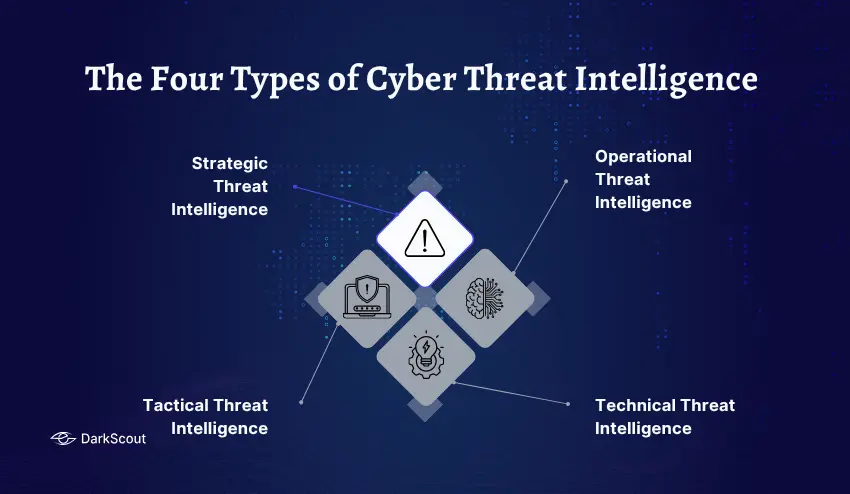
Not all threat intelligence serves the same purpose or the same audience. CTI is organized into four distinct types, each operating at a different level of abstraction and serving different security functions.
Understanding which type you need for which decision is fundamental to building a CTI program that actually delivers value.
1. Strategic Threat Intelligence
Strategic intelligence is high-level, long-term, and designed for executive and board-level decision-making.
It covers the big picture: which threat actor groups are targeting your industry, how the geopolitical landscape is affecting cyber risk, what the emerging threat trends look like over the next six to twelve months, and how your organization’s risk profile compares to peers.
Lists of IOCs and technical attributes are not strategic intelligence. Strategic intelligence is the interpretation of dense threat information into business-speak for informing investment decisions, discussions of risk appetite, and executive-level governance.
The audience is CISOs, CFOs, board members, and risk committees. The output is briefings, reports, and risk narratives. The measure of success is whether it changes a budget decision, a policy, or a governance posture.
2. Operational Threat Intelligence
Operational intelligence sits between the executive view of strategic intelligence and the immediate technical response of tactical intelligence.
It focuses on specific adversary campaigns: who is behind active attacks in your sector right now, what their objectives are, which techniques they’re currently using, and how their targeting patterns are evolving over weeks to months.
Operational intelligence is what security managers use to adjust their defensive posture, what incident responders use to understand an active attack, and what threat hunters use to design targeted hypotheses.
The output is campaign profiles, threat actor reports, and attack pattern analyses. It gives security teams context that turns alerts from isolated events into coherent narratives about what adversaries are trying to accomplish.
3. Tactical Threat Intelligence
Tactical intelligence aims to define attacker actions once they have gained access to an environment, in terms of specific TTPs.
MITRE ATT&CK is the primary framework for organizing tactical intelligence. When threat intelligence is mapped to ATT&CK, detection engineers can translate it directly into detection rules and hunting hypotheses. Tactical intelligence tells the SOC not just that an attack happened, but how it happened and what specific behaviors to look for across your environment.
The shelf life of tactical intelligence is longer than that of technical IOCs. Attackers rotate IP addresses and domains constantly, but behavioral patterns persist across campaigns for months or years.
4. Technical Threat Intelligence
Technical Intelligence is the most granular. Specific, machine-readable items, such as artifacts, which security products can consume without human review to prevent and detect ongoing threats.
Examples are: IP addresses, domains, file hashes, registry keys, network signatures, and any indicator of compromise (IOC). This type of intelligence goes into SIEMS, firewalls, EDR products, and DNS filters, where they can block on their own.
The trade-off is shelf life. Technical indicators age quickly. An IP address used in an attack today may be legitimate infrastructure tomorrow. Managing the freshness and quality of technical intelligence is an ongoing operational challenge.
For a comprehensive breakdown of all four types, how they connect, and who uses each one, the types of threat intelligence guide covers the full picture.
The Threat Intelligence Lifecycle
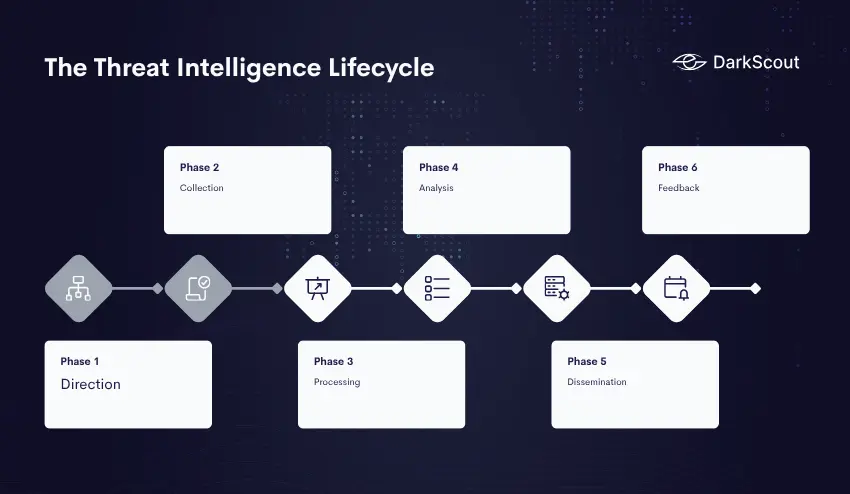
Cyber threat intelligence doesn’t appear fully formed. It’s produced through a structured, repeating process called the intelligence lifecycle.
Understanding the lifecycle is what separates organizations that collect data from organizations that produce intelligence. The lifecycle is the mechanism that turns raw inputs into actionable outputs, consistently and repeatedly.
Phase 1: Direction
Everything starts here. Direction is the process of defining what intelligence your organization actually needs: which threats matter to you specifically, which decisions intelligence needs to inform, and who the audiences are for each type of output.
The structured tool for capturing direction is Priority Intelligence Requirements, or PIRs. These are specific, answerable questions that the intelligence program exists to address.
Good PIRs are precise. Not “monitor the threat landscape” but “which ransomware groups have targeted organizations in our sector in the last 90 days, and what initial access methods did they use?”
Direction is the most commonly underdeveloped phase in CTI programs. Vague requirements produce unfocused collection, irrelevant analysis, and intelligence that nobody acts on. Clear requirements ensure every downstream phase produces output that matters.
Phase 2: Collection
Collection is gathering raw data from the sources relevant to your intelligence requirements.
Sources will exist on a spectrum and range from technical threat intelligence feeds that supply IOCs, to dark web monitoring for illicit threat activity and, OSINT obtained from public reports and governmental advisories, to internal telemetry information that is collected through your own security tools, to human intelligence sourced through communities where it can be shared across an industry.
Collection strategy should match intelligence requirements, not maximize volume. More sources don’t mean better intelligence. They mean more processing burden and more noise if the sources aren’t aligned with what your program actually needs to produce.
Phase 3: Processing
Processing turns raw collected data into a usable format for analysis.
For technical intelligence, this means deduplication, normalization, validation, and enrichment. The same IP address appearing in fifteen different feeds gets collapsed into one record. Stale indicators get filtered. Fresh indicators get enriched with geolocation, WHOIS data, and known malware associations.
Here is where the most immediate operational value is derived from a Threat Intelligence Platform – namely, taking high-volume, laborious, mechanical data handling out of the analyst’s day and pushing it into a Threat Intelligence Platform so the analyst can proceed to analysis where a human can exercise actual decision-making.
Phase 4: Analysis
Analysis is the process whereby data becomes intelligence.
This is the step whereby expertise, context, and judgment use processed data to respond to the intelligence requirements laid out in Phase 1.
Good analysis doesn’t summarize what sources said. It synthesizes new insight: what patterns exist across the data, what those patterns mean for your organization specifically, what confidence level the conclusions warrant, and what specific actions should follow.
Analysis quality is what determines whether a CTI program produces genuine intelligence or expensive noise.
Phase 5: Dissemination
Dissemination delivers intelligence to the right people in the right format at the right time.
The executive who needs a strategic briefing and the SOC analyst who needs a TTP report are different people with different needs. One format distributed to everyone serves neither well.
Strategic intelligence reaches executives as concise briefings tied to business risk. Tactical intelligence reaches detection engineers as ATT&CK-mapped TTP reports. Technical intelligence reaches security tools automatically through feed integrations. Operational intelligence reaches security managers and responders as structured campaign profiles.
Format matters as much as content. Intelligence that arrives in the wrong format doesn’t get used, regardless of its quality.
Phase 6: Feedback
Feedback is the most commonly skipped phase and the most important for program improvement.
Without feedback, the lifecycle doesn’t actually cycle. The program produces the same quality of output indefinitely, with no mechanism to improve collection sources, analytical methodologies, or dissemination formats.
Feedback asks intelligence consumers whether what they received was useful, accurate, timely, and actionable. Their answers flow back to update intelligence requirements and improve every subsequent cycle.
Programs with strong feedback loops compound their effectiveness over time. Programs without feedback stagnate.
For a full deep dive into every phase with practical guidance on what goes wrong at each step, the threat intelligence lifecycle guide covers each phase in detail.
Key Sources of Cyber Threat Intelligence
CTI programs draw from multiple source categories simultaneously. The right mix depends on your intelligence requirements, but strong programs typically cover all of these.
1. Technical feeds
A steady stream of IOCs is derived from vendors, government bodies, or communities engaged in information sharing. There is a wide range of options: free and open-source feeds (CISA advisories, AlienVault OTX, etc.) to paid, commercial feeds offering higher quality, fresher IOCs, and specific industry coverage.
2. Open source intelligence (OSINT)
This data is widely publicly available: security whitepapers, threat reports produced by vendors, CVE databases, government advisories, academic studies, and conference talks. This data is freely available, widely varied, and very useful, but can be time-consuming to process and integrate.
3. Dark web and underground sources
Darknet forums, ransomware leak sites, credential markets, stealer log databases, and Initial Access Broker listings. One of the most valuable and most underutilized CTI source categories. Covered in detail in the section below.
4. Internal telemetry
Your own SIEM logs, EDR alerts, firewall data, and incident response findings. Internal sources provide the highest-context intelligence about your specific environment and are the primary input for understanding what threats are actually reaching you.
5. Human intelligence and sharing communities
Industry Information Sharing and Analysis Centers (ISACs), peer exchanges with trusted organizations in the same sector, and vendor threat briefings. Provides sector-specific intelligence that generic feeds don’t cover.
6. Incident response findings
Every security incident your organization responds to generates intelligence about the specific adversaries, techniques, and vulnerabilities relevant to your environment. Organizations that document and analyze their own incidents build intelligence libraries that no external source can replicate.
IOCs and IOAs: The Core Detection Concepts
Two concepts sit at the foundation of how threat intelligence translates into detection capability.
IOCs are specific artifacts (observables) that can be used to confirm an entity is compromised or being compromised. For instance, file hashes of known malware. IP addresses that correspond to the attacker’s command and control infrastructure. Domain names that are registered by known threat actor groups. Registry keys modified by known malware families.
IOCs are based on facts and show that the known threat has accessed the entity in the past. Security tools are able to compare IOCs from threat feeds with the entity and determine if they are artifacts of a known threat.
The limitation: IOCs only catch threats that have been previously documented. Novel attacks with unknown infrastructure and new malware variants produce no IOC matches at all. Attackers who constantly rotate their infrastructure can render IOCs useless within hours of them being published.
Indicators of Attack (IOAs) take a fundamentally different approach. Instead of matching specific known artifacts, IOAs identify behavioral patterns that indicate an attack is in progress, regardless of the specific tools being used.
A document spawning PowerShell. An account accessing files it has never touched at 3 a.m. Volume shadow copies are being deleted before mass file modification. These behaviors are suspicious because of what they’re doing, not because they match a known signature.
IOAs can detect zero-day attacks and novel malware because the detection logic is based on attacker behavior patterns that persist even as specific tools change. The trade-off is more complex tuning requirements and higher false positive potential if not carefully configured for your environment.
The strongest security programs use both: IOCs for known threat detection with low false positive rates and IOAs for behavioral anomaly detection that catch what IOC-only systems miss.
For a complete breakdown of how IOCs and IOAs work, where each falls short, and a real-world attack scenario showing both in action, the IOC vs IOA guide covers everything.
The Dark Web as a CTI Source
The dark web is one of the most valuable and most overlooked intelligence sources available to security teams in 2026.
Here’s why it matters so much.
The dark web is where the cyber threat economy operates. It’s where ransomware affiliates recruit and plan. Where stolen credentials get packaged, priced, and sold. Where Initial Access Brokers auction validated corporate network access. Where threat actors discuss targets and techniques before attacks are launched. Stolen data appears after breaches, often hours before any formal notification reaches the victim organization.
All of that activity is intelligence. And none of it is visible to tools focused on the public internet.
What dark web CTI reveals:
Dark web intelligence gives organizations visibility into threats before they materialize:
- Credential exposure alerts when employee passwords appear in stealer logs being sold on dark web markets, before those credentials are used for unauthorized access
- Initial Access Broker listings show when access to your network or related infrastructure is available for purchase, before a ransomware affiliate buys it
- Threat actor targeting discussions naming your organization, industry, or technology stack in forum conversations about planned attacks
- Ransomware leak site monitoring shows whether your organization’s data has been published or is being threatened with publication
- Fourth-party risk signals when your vendors’ data or credentials appear in underground markets, giving you advance warning of a supply chain compromise before formal notification
The timeline advantage:
Research consistently shows that breached credentials appear on dark web markets within hours of a compromise. Ransomware groups typically list network access for purchase days before deploying their payload. Forum discussions about specific targets precede attacks by weeks in some cases.
Each of those timelines represents a window in which dark web intelligence can drive a defensive action that prevents or limits a breach. Force a credential reset before stolen passwords are used. Investigate network anomalies before ransomware deploys. Harden defenses against the specific techniques being discussed before they’re used against you.
Dark web CTI across all four intelligence types:
Dark web intelligence isn’t limited to technical indicators only. It feeds in all four types:
- Strategic: Market trends in dark web criminal services, new ransomware group activity, and underground economy dynamics that guide long-term threat landscape assessments
- Operational: specific campaign discussion, threat actor targeting activity, IAB listings that provide information about medium-term changes in defensive posture
- Tactical: Underground communities are sharing and testing new attack techniques and tools before they make their way into the mainstream threat feeds.
- Technical: New IOCs published in malware forums and infrastructure for active campaigns
Who Uses Cyber Threat Intelligence?
CTI serves different audiences across the organization. Understanding who uses what type of intelligence makes the difference between a program that’s operationally integrated and one that produces reports nobody reads.
- CISOs and security leadership use strategic intelligence to inform security investment decisions, communicate risk to boards and executives, and set priorities for the security program. They need the threat landscape translated into business language: what the risks are, what they cost, and what decisions need to be made.
- SOC analysts use technical and tactical intelligence to triage alerts, investigate incidents, and respond to threats. They need IOCs to match against activity in the environment and TTP context to understand what a detected behavior means within the broader attack pattern.
- Threat hunters use operational and tactical intelligence to design proactive hunting hypotheses: specific adversary behaviors to search for in the environment based on current threat actor activity in the sector. Intelligence-driven hunting is far more effective than hypothesis-free exploration.
- Detection engineers use tactical intelligence mapped to MITRE ATT&CK to build and improve detection rules. When threat intelligence identifies that a specific ransomware group is using a particular lateral movement technique, detection engineers translate that into a new rule or behavioral alert.
- Incident responders use operational intelligence to understand an active incident in context: who is likely behind the attack, what tools they typically use, what lateral movement patterns to expect, and what their likely objectives are. Context accelerates containment and eradication decisions.
- Vulnerability management teams use technical and operational intelligence to prioritize remediation. Knowing which vulnerabilities are being actively exploited by groups targeting your industry is more valuable than a CVSS score alone when deciding which patches to deploy first.
- Risk and compliance teams have the ability to use strategic intelligence for risk assessment, vendor due diligence, proof of regulatory compliance, and board reporting. When the intelligence is a description of the true, physical threats in the world, risk assessments can become tangible.
CTI vs Threat Hunting vs Vulnerability Management
These three functions are closely related and often confused. Understanding how they differ makes it easier to see how they work together.
Cyber threat intelligence is the function that produces and delivers knowledge about threats. It’s the source of context and direction for everything else. CTI tells you who is threatening you, how they operate, and what you should prioritize.
Threat hunting is the proactive search for hidden threats already inside your environment. It uses CTI as its primary input: intelligence about specific adversary techniques gives hunters the hypotheses they test against internal telemetry. Without CTI, threat hunting is undirected exploration. With CTI, it’s a targeted investigation of the most likely threats to your specific environment.
Vulnerability management is the systematic process of identifying, assessing, and remediating security weaknesses in your systems. CTI makes vulnerability management more effective by identifying which vulnerabilities are being actively exploited in the wild against organizations like yours. A critical vulnerability being actively targeted by a relevant threat group deserves different prioritization than a critical vulnerability with no known active exploitation.
The relationship between the three is clear: CTI provides the intelligence. Vulnerability management addresses the exposure. Threat hunting finds what’s already gotten through.
How AI Is Changing Cyber Threat Intelligence
AI is reshaping both sides of the cyber threat intelligence equation simultaneously in 2026.
On the attacker side:
Threat actors are using AI to generate more convincing phishing content at scale, automate reconnaissance across targets, customize malware variants to evade specific detection tools, and accelerate the entire attack timeline. The five-day average time-to-exploit in 2026 is partly a function of AI-accelerated attack development.
This means the threat landscape that CTI programs need to monitor is moving faster than ever before.
On the defensive side:
AI is enabling CTI programs to process vastly larger data volumes than human analyst teams could manage manually. Natural language processing models scan dark web forums and extract structured intelligence from unstructured text. Machine learning models identify patterns across millions of indicators that human analysts would miss. Automated triage and scoring systems filter noise before it reaches analysts, reducing alert fatigue.
The organizations getting the most from AI in CTI aren’t replacing analysts with automation. They’re using AI to handle the high-volume, pattern-recognition work that consumed analyst time, freeing human judgment for the work that requires it: understanding context, assessing adversary intent, and translating intelligence into strategic decisions.
The best AI threat intelligence tools in 2026 guide covers the specific platforms delivering these capabilities and how to evaluate them for your organization. Building a Cyber Threat Intelligence Program is very significant in this day and age.
Common CTI Mistakes to Avoid
Understanding what goes wrong in CTI programs is as useful as knowing what good looks like.
1. Confusing data collection with intelligence production
The most common mistake. Organizations subscribe to feeds, ingest data into their SIEM, and call it a CTI program. They have data. They don’t have analysis, context, or a connection to any specific decision the organization needs to make. More data without more analysis produces more noise, not more intelligence.
2. No feedback loop
Programs that treat dissemination as the end of the process stagnate. Without structured feedback from intelligence consumers, the program has no mechanism to improve. It produces the same quality of output indefinitely, regardless of whether that output is actually influencing decisions.
3. Over-relying on technical indicators
IOC-based detection is a foundation, not a complete strategy. Organizations that rely exclusively on technical indicators miss the growing proportion of attacks that use novel infrastructure, polymorphic malware, and fileless techniques designed specifically to avoid signature-based detection.
4. Ignoring the dark web
Most CTI programs focus on public threat feeds and OSINT while leaving the underground intelligence layer entirely uncovered. The dark web is where credential theft, initial access sales, and attack planning discussions happen. Organizations without dark web monitoring have a significant gap in their threat visibility.
5. Intelligence that doesn’t connect to action
Intelligence that doesn’t change what someone does isn’t intelligence. Every output your CTI program produces should have a defined action path: a decision it informs, a detection it improves, a patch it prioritizes, a credential it resets. Programs that produce reports for their own sake lose credibility and eventually lose funding.
6. Building a program that outpaces your ability to act
A program that generates more intelligence than your security team can act on creates a different kind of noise problem. Build at the pace your organization can operationalize, and expand as capacity grows.
Conclusion
Cyber threat intelligence is the function that makes the difference between a security program that reacts and one that anticipates.
The threat landscape in 2026 is too fast, too sophisticated, and too well-resourced for organizations to defend effectively without intelligence. Attackers know your industry. They know the tools you’re likely using. They know which vendors you depend on. They’re scanning for your exposed assets. They’re buying credentials stolen from your employees.
CTI lets you know that too, before they act on it.
The foundations are clear: understand the four intelligence types and build a program that serves each audience effectively. Run the intelligence lifecycle properly, especially the feedback phase that most programs skip. Cover the dark web as a collection source, because that’s where the most actionable pre-attack intelligence lives. Use both IOCs and IOAs so your detection covers known threats and novel attacks simultaneously. Build an AI-augmented program that scales your analysts’ capacity rather than replacing their judgment.
And connect every piece of intelligence to an action. The measure of a CTI program isn’t the volume of intelligence it produces. It’s the number of decisions it improves and the attacks it prevents.