Your brand is being exploited on the dark web right now, and you probably do not know it yet.
Criminals do not need to hack your systems to damage your reputation, defraud your customers, or compromise your employees. They just need your logo, your domain name, and a phishing kit they purchased for less than $500 on a dark web marketplace. With those three things, they can impersonate your brand convincingly enough to steal credentials, redirect payments, and destroy customer trust, all while your security team sees nothing.
Brand impersonation is no longer a nuisance-level threat. In Q2 2025, APWG recorded over 1.1 million phishing attacks, the majority of which used brand impersonation as the core deception. 77% of phishing domains are intentionally registered by criminals to target specific brands. AI-powered deepfakes were involved in over 30% of high-impact corporate impersonation attacks in 2025. And the dark web is the infrastructure that makes all of it possible, the place where phishing kits are sold, stolen customer data is traded, and new campaigns are planned before they ever reach your customers.
This guide explains exactly what brand protection on the dark web means, how criminals use the dark web to target your brand, and what you need to do to detect and stop it.
What Is Brand Protection on the Dark Web?
Brand protection on the dark web means searching the dark web markets, forums, and communities where criminals gather for threats against your brand, its reputation, or its assets without its authorization.
Traditional brand protection usually looks at IP issues such as trademarks, fakes, and surface web fraud, not the dark web. Dark web brand protection looks at the whole upstream threatscape of where your organization’s assets will be stolen to aid impersonation attacks and where the data will be sold before it is leveraged in a targeted attack, and even where attacks are being planned before they occur.
Quick Definition: Brand protection on the dark web is the ongoing scanning of dark web marketplaces, forums, and criminal communications for phishing kits, lookalike domains, stolen customer data, stolen employee credentials, and warnings about incoming attacks on your brand, and an ongoing ability to act against any threats quickly to stop them from doing damage.
The distinction between detection and response matters. Monitoring alone is not brand protection. Real protection means knowing when a phishing kit using your brand’s assets has been listed for sale, identifying lookalike domains before they go live, and having a process to take them down quickly.
How Criminals Exploit Your Brand on the Dark Web
The dark web is not just where stolen data ends up. It is where brand-based attacks are built, equipped, and coordinated before they hit your customers.
1. Phishing Kits Are Sold Cheaply and at Scale
A phishing kit is a ready-made package that allows even a low-skill attacker to impersonate a specific brand convincingly. Modern phishing kits targeting major brands include cloned login pages with matching logos and CSS, pre-written phishing emails designed to bypass security filters, automated domain spoofing and subdomain setup tools, built-in support for QR code phishing and SMS lures, and real-time credential harvesting dashboards.
Phishing kits are sold for a minimum price of hundreds of dollars on the darknet marketplaces. Phishing panels can be purchased for below $500. The LabHost platform, one of the world’s largest phishing kit operations, was shut down by law enforcement in April 2024 after enabling attackers to impersonate over 200 brands globally. Within weeks, successor platforms had filled their place.
The barrier to impersonating your brand is lower than it has ever been. An attacker with no technical background and a few hundred dollars can launch a convincing campaign against your customers within hours of purchasing a kit.
2. Stolen Customer Data Fuels Personalized Fraud
When a company suffers a data breach, the stolen customer records do not simply disappear. They are listed on dark web markets within hours, purchased by criminals who use the data to make impersonation attacks far more convincing.
An attacker who knows your customer’s name, email address, partial account number, and recent transaction history can craft a spoofed message that feels entirely legitimate to the recipient. That level of personalization dramatically increases click rates and conversion into successful fraud.
Stealer logs harvested from infected devices add another layer. When an employee’s device is compromised by infostealer malware, their saved passwords, browser session cookies, and email credentials are packaged and sold. An attacker who purchases access to a real employee’s email account does not need to spoof anything. They send from the legitimate account, bypassing every authentication check your organization has put in place. This is exactly the upstream threat that dark web monitoring is designed to catch.
3. Dark Web Forums Plan and Coordinate Attacks
Beyond marketplaces, dark web forums serve as planning and coordination hubs for brand-targeting campaigns. Threat actors share brand-specific intelligence: which employees hold financial authority, which vendors have existing payment relationships, which customer support scripts sound most convincing, and which security measures have been identified.
Data and database leaks represent 64.06% of dark web activity, while selling posts reach 59.32%, according to SOCRadar’s Annual Dark Web Report 2025. The dark web is an industrialized supply chain for brand exploitation, with specialized roles: data brokers who sell targeting intelligence, phishing kit developers who maintain and update impersonation tools, and campaign operators who run the actual attacks.
Monitoring these forums is what separates reactive brand protection from proactive intelligence. When your organization is being discussed in a criminal forum before an attack launches, that is the window you need to act.
Types of Dark Web Brand Threats
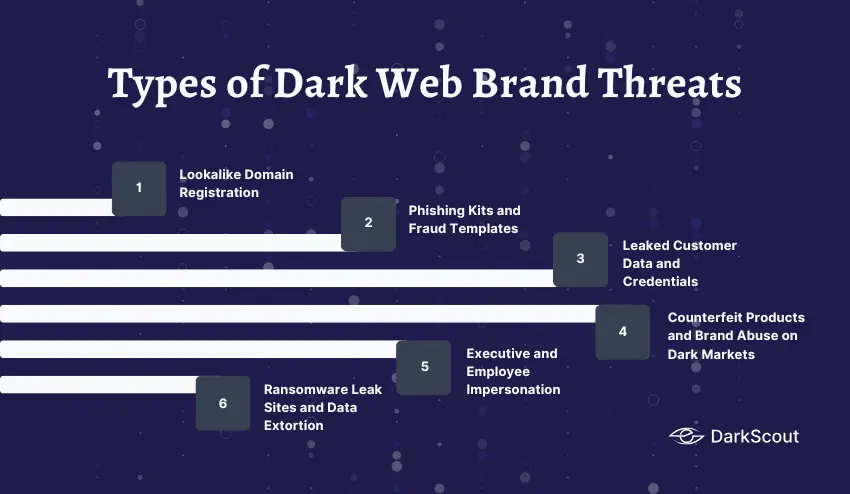
There are a number of different brand threats that arise on or travel through the dark web. Knowing what these are allows you to know what to be looking for and what’s important to you.
1. Lookalike Domain Registration
Criminals register domain names very similar to your legitimate ones and then use them to run phishing pages, send spoofed emails, and act as your customer support.
Examples of domain name mimicry are character substitution (rn as opposed to m, l as opposed to 1), additional word combinations (yourbrand-secure.com or yourbrand-support.net), non-typical top-level domain names (.net, .org, or country-specific extensions rather than .com), and hyphens (your-brand.com). These sites are typically registered in volume using bots, then offered on dark web forums along with the phishing kit used for the impersonation.
Domain shadowing, where cyber criminals compromise a legitimate domain name and create sub-domains to host phishing pages, not an entirely new domain, spiked by 43% year on year in 2025. It can be one of the most dangerous, because the parent domain has a perfectly legitimate history.
2. Phishing Kits and Fraud Templates
As described above, phishing kits are sold on dark web markets specifically targeting well-known brands. Kits targeting financial services brands, Microsoft 365, DocuSign, PayPal, and major e-commerce platforms are among the most common. When your brand appears in a newly listed phishing kit on a dark web market, you have a narrow window to act before the campaign launches at scale.
Dark web forums also trade fraud templates: pre-written scripts for vishing calls impersonating your support team, email templates mimicking your communications style, and social media post templates for fake promotional scams.
3. Leaked Customer Data and Credentials
Breached customer databases, leaked credentials, and stealer log data containing your customers’ or employees’ information circulate on dark web markets continuously. This data is used to craft personalized phishing attacks, execute account takeovers, and conduct synthetic identity fraud using your customers’ real information.
From a brand protection perspective, this matters beyond the immediate security concern. When your customers’ data is used to defraud them through a convincingly branded attack, they blame your organization even if you were not the source of the breach. The reputational damage is real regardless of technical culpability.
4. Counterfeit Products and Brand Abuse on Dark Markets
Some brands, particularly those in consumer goods, pharmaceuticals, and luxury products, face a direct counterfeiting threat on dark web markets. Counterfeit versions of their products, sometimes dangerous, sometimes simply fraudulent, are listed for sale under their brand name.
This causes direct revenue loss, regulatory exposure if counterfeit products cause harm, and reputational damage when customers receive substandard goods believing they are buying from the legitimate brand.
5. Executive and Employee Impersonation
Criminals use dark web forums to research and target specific executives. Dark web intelligence includes leaked contact details, organizational charts derived from social media scraping, and in some cases direct access to compromised email accounts, all of which are used to impersonate executives in business email compromise attacks.
AI-enabled deepfakes are rapidly exacerbating the threat. Deepfakes enabled over 30 percent of high-impact corporate impersonation attacks in 2025, and executive deepfaked voice and video recorded from public speeches can be bought as a service on the dark web. The perpetrators of attacks on Singapore organizations in 2025 used a deepfake-as-a-service offering to impersonate an executive and instruct a corporate employee to send a massive amount of funds to fraudulent accounts.
6. Ransomware Leak Sites and Data Extortion
When the ransomware perpetrators encrypt an organization’s data, they typically steal it and threaten to dump the data on their dark web leak site if the ransom is not paid. These sites can be accessed on the public web in the Tor network and are indexed by threat intelligence services.
An entry on a ransomware group’s dark web leak site identifying an organization by name, along with proprietary documents and customer data, immediately causes severe and irrevocable damage to reputation, with or without ransom payment. Monitoring these sites for your organization will alert you that a ransomware attack has occurred even before you receive any demands from the attacker.
Real Brand Impersonation Attacks and What They Cost
These recorded examples highlight the extent and complexity of brand-based attacks that transit through the dark web.
Microsoft: The World’s Most Impersonated Brand
The world’s most impersonated brand remains Microsoft, whose fake login pages to Microsoft 365 were used in numerous campaigns during Q4 2024/Q1 2025. Brand phishing attacks involving Microsoft made up a quarter of all brand phishing campaigns in Q2 2025. Microsoft’s login pages alone seem to be the basis for some of the most popular tools among hackers trading on dark web markets (known as phishing kits), which were regularly updated.
Not only is the Microsoft brand damaged by all this activity, but each successful corporate credential theft against a Microsoft landing page could provide an attacker with a way into the victim company’s Microsoft 365 tenant, along with their mail, storage and associated third-party applications.
Arup: $25 Million Lost to Deepfake Brand Impersonation
The British engineering giant Arup was financially defrauded of $25 million in 2024 by an employee in finance, who was duped by a video call, featuring convincing likenesses of senior company officials, despite being skeptical of the initial emails. The deepfake, which used known colleagues’ likenesses, eliminated Arup’s defenses after a phishing scam attempt had failed previously.
The attacks involved readily available source recordings for creating the deepfakes, as well as spoofed emails for follow-up and official payment authorization. Arup is the first case where brand and executive impersonation via deepfakes moved beyond being an identified risk and was implemented to produce a financially damaging outcome.
LabHost: 200 Brands Targeted by One Platform
LabHost, which was dismantled by international law enforcement in April 2024, was a phishing-as-a-service that allowed subscribing cybercriminals to use pre-made, copycat tools capable of mimicking around 200 brands. In total, the platform catered to over 2000 cybercriminals, and criminals subscribing to LabHost had access to continuously updated phishing kits, with monthly payment plans.
At its peak, LabHost had harvested over 480,000 card numbers and 64,000 PINs from victims across multiple countries. Every one of the 200 targeted brands suffered impersonation attacks, they had no direct warning about because the platform operated entirely within the dark web ecosystem.
Social Security Administration Impersonation (2025)
The campaign in June 2025 used ClickFix to impersonate the US Social Security Administration through spoofed domains and high-fidelity email templates that included the legitimate SSA social media links at the bottom to make it more believable. The ClickFix campaign used email lists and phishing infrastructure obtained from the dark web and targeted thousands of individuals to install a script onto their computers.
This was an attack combining the ClickFix social engineering style and brand impersonation techniques-it really is important to notice how attack vectors are nested within one another to make them as effective as possible.
SilverTerrier: 50,000 Brands Targeted Across 150 Countries
A Nigerian-based BEC BEC group of more than 400 members called SilverTerrier impersonated 50,000 business brand impersonation in 150 different countries. They used dark web sourced data about existing business relationships, managed to spoof exactly the vendor a business was having payment transactions with. It is an industrial usage of brand impersonation.
How Brand Abuse Starts: The Dark Web Supply Chain
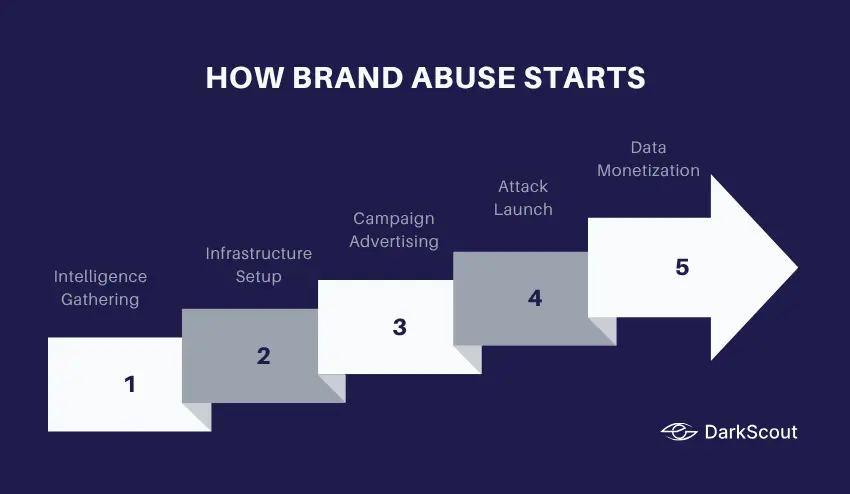
Brand-based attacks do not commence the moment a phishing email lands in your customer’s inbox. They start weeks or months before, in the heart of the dark web system.
Knowledge of the supply chain is crucial in determining where best to place intelligence and monitoring.
Step 1: Intelligence Gathering
Attackers gather information about their targets through open-source research, social media and corporate data traded on dark web sites. They learn the hierarchy within organizations, the nature of the organization’s financial dealings, typical patterns of communication with its customers and where the authority lies within its structure. Uncovered details about any necessary data, that could not be acquired from the internet alone, would be bought on the dark web markets.
Step 2: Infrastructure Setup
Registering look-alike domains (which can be completed in bulk using automated means), procuring or customizing a phish kit suited to the brand name and setting up mail infrastructure using either stolen servers or bullet-proof hosting.
Step 3: Campaign Advertising
On dark web forums, attackers sometimes advertise upcoming campaigns, recruit affiliates to run the distribution, or sell access to the infrastructure they have built. This is the intelligence window that dark web monitoring can exploit. When your brand name appears in forum discussions ahead of a campaign, you have time to prepare.
Step 4: Attack Launch
Phishing emails, malvertising campaigns, SMS lures, and social media scams go live simultaneously, reaching your customers at scale. At this point, reactive defense is the only option. The damage is already in progress.
Step 5: Data Monetization
Stolen credentials and customer data collected by the campaign are packaged and sold back on dark web markets. Stealer logs from drive-by download payloads bundled with the phishing campaign are listed within hours. The cycle feeds itself.
The only place in this chain where proactive detection is possible is steps one and three, before the campaign launches. That requires continuous dark web monitoring, not periodic scanning.
Which Businesses Are Most at Risk?
The reality is any brand with a strong, recognizable name and a customer-facing digital footprint is susceptible to some degree of dark web brand threat. There are a few attributes that put certain brands at particularly high risk:
1. Financial Services
Financial brands face the most phishing attempts as credentials for financial products have instant, tangible monetary value. The financial brands are affected the most as trust is everything, and an email or fake login page can result in fraud, customer turnover, and compliance issues. Phishing kits used to impersonate online banking credentials are among the most commonly traded items on the dark web.
2. E-Commerce and Retail
Retailers appeal due to high transaction volumes, a large customer base, and widespread acceptance of promotional emails. Typical attack vectors include fake promotional campaigns, false product listings, and simulated customer support staff impersonation. Marks and Spencer was affected in a 2025 ransomware event, disabling 1049 stores and causing shares to fall by about 7%, due to a social engineering attack that targeted the brand internally.
3. SaaS and Technology Companies
SaaS brands are targeted because their credentials unlock access to connected systems, customer data, and business processes. Fake Microsoft 365, Salesforce, DocuSign, and Google Workspace login pages are consistently among the most common phishing kit categories traded on dark web markets.
4. Healthcare and Pharmaceuticals
Two distinct threats await healthcare brands, both based on compromised credentialing, patient information, and counterfeiting consumers. The regulatory element introduces another dimension to the fraud and adds cost, and in the health sector, breach of data has further implications related to compliance.
5. Any Organization That Has Experienced a Breach
Once you have been breached and have employee/customer data appearing on the dark web, the likelihood of subsequent impersonation attacks being focused on your brand will skyrocket. Breached data is purchased with a view to improving the believability of future impersonation attempts. The quickest way to see where you’re starting from is to run your domain through a scan to find what data of yours is already appearing on the dark web.
How to Protect Your Brand on the Dark Web
Brand protection on the dark web requires both technical controls and continuous intelligence. Neither alone is sufficient.
1. Monitor the Dark Web Continuously for Brand Mentions
The most crucial element here is visibility; you cannot effectively respond to a threat if you don’t know it’s there.
Continuous dark web monitoring scours forums, marketplaces, leak sites, and criminal networks for mention of your brand, domain, execs’ names, and associated keywords. Whether that’s your brand name listed in a phishing kit, within a forum discussion, appearing in a credential dump, or mentioned in a ransomware leak site, you want to know in real time, not in weeks.
DarkScout’s dark web monitoring provides this visibility continuously, with AI-powered alerts that give context on what was found and what action is needed. Start with a free website scan to see your current exposure across known breach sources.
2. Monitor for Lookalike Domain Registrations
A user will purchase lookalike domains in advance of campaign delivery. By monitoring newly registered domains for similarities with your brand name, you have the ability to take pre-campaign action.
Set up monitoring for common variations: character substitutions, hyphenated versions, keyword additions, and different top-level domains. When a lookalike domain is registered, initiate a takedown request immediately. Most domain registrars respond to well-documented trademark complaints within 24 to 72 hours, often before the attacker has even launched their campaign. DarkScout’s brand protection service covers this monitoring as part of continuous domain and brand intelligence.
3. Implement DMARC at Enforcement Level
DMARC prevents unauthorized parties from sending emails that appear to come from your domain. Without it, any attacker can spoof your exact domain in phishing emails targeting your customers, employees, and partners.
Set your DMARC policy to p=reject to block unauthenticated emails from your domain outright. Combine this with properly configured SPF and DKIM records. Our full guide on email spoofing prevention explains how these three protocols work together. In the US, DMARC enforcement has already contributed to a 65% reduction in unauthenticated email reaching Gmail inboxes. Your customers deserve the same protection.
4. Monitor Your Employees’ Credentials on the Dark Web
Compromised employee credentials are the most common upstream enabler of brand-targeted attacks. When an employee’s login details are sold on a dark web market, attackers can use them to access internal systems, monitor communications, and send emails from legitimate accounts that bypass every authentication check.
Run a free email scan on DarkScout to check whether your organization’s credentials are already exposed. For continuous coverage, DarkScout’s credential monitoring alerts your security team the moment employee credentials surface in breach data or stealer log repositories, giving you the window to reset them before they are used.
5. Monitor Ransomware Leak Sites
If your organization is targeted by a ransomware group, your brand may appear on a dark web leak site before you are even aware of the incident. Threat actors use these sites as leverage, publishing victim names and sample data to pressure organizations into paying.
Monitoring ransomware leak sites for mentions of your organization provides early warning and can inform your incident response timeline. Combined with attack surface management, this monitoring reduces the window between an incident occurring and your team becoming aware of it.
6. Build a Takedown Capability
Detection without action does not serve brand protection; you must have a system to move rapidly to address threats when detected.
For phishing domains: Document your findings, determine the registrar and hosting provider, and send a report. Most registrars have rapid takedown processes in place for clear phishing, but this can be further sped up with legal notices referencing trademark infringement.
For fake social media accounts: Submit a report to the social media site using their formal reporting channel. Escalation to your legal team is necessary if the social media platform does not respond swiftly.
For phishing kits being sold on dark websites: Inform your legal team and law enforcement, such as the FBI, as Europol works vigorously to prosecute impersonation of well-known brands and often will require notification from a brand to begin an investigation.
For customer data breach: Trigger your company’s data breach response plan and quickly notify customers. Transparency will alleviate reputational damage, and laws in various jurisdictions mandate notification within a specific window of time.
7. Train Customer-Facing Teams to Recognize and Report Brand Abuse
Your customer support team is most likely to be the first ones you hear from when your customers encounter fake representations of your brand. Ensure they are trained to collate and escalate any reports they receive of fake sites, phishing emails from your organization, and counterfeits.
Each customer report is an intelligence data point that can help identify active campaigns faster than automated monitoring alone.
8. Protect Your Executive Team
Executives are specifically targeted in dark web intelligence gathering and in subsequent impersonation attacks. Implement executive threat monitoring that watches for mentions of your leadership team on dark web forums and in credential breach data.
For push bombing and account takeover risks, ensure your executives use phishing-resistant MFA on all accounts. Credential theft from executive accounts is frequently the entry point for the most damaging brand impersonation campaigns, as attackers who compromise a real executive account can send instructions from a legitimate address that bypasses every technical control.
Conclusion
Your brand is an asset. It represents the trust your customers place in you, the relationships you have built with partners, and the reputation your team has worked to create.
The dark web has industrialized the exploitation of that trust. Phishing kits sold for a few hundred dollars let any attacker convincingly impersonate your brand in minutes. Stolen customer data makes those impersonations personalized and devastating. And AI-powered deepfakes have made even your executives’ faces and voices a tool that attackers can weaponize.
The organizations that protect their brands effectively are not the ones who react fastest after an attack is launched. They are the ones who see the attack being built before it reaches their customers, and act while there is still time to stop it.
That is what dark web brand protection delivers.