Global account takeover losses are projected to hit 17 billion dollars in 2025, up from 13 billion the year before, according to Sift’s Q3 2025 Digital Trust Index. Akamai separately measured 26 billion credential stuffing attempts against login pages in a single month.
That is not a slow-moving trend. It is a fully industrialized attack category, and it runs almost entirely on infrastructure most companies already have some defense against, just not enough of it in the right places. The Federal Reserve puts reported U.S. losses at 15.6 billion dollars in 2024 alone, up from 12.7 billion the year before, with reports of account takeover rising more than 36 percent year over year.
Here is the part that gets missed in most prevention guides. Attackers increasingly prefer taking over a real, established account over creating a fake one, because a legitimate account already carries the trust signals, purchase history, and saved payment methods that let a takeover clear fraud checks a brand new account never could. Preventing that requires more than a single control at the login page.
This guide covers exactly how account takeover actually happens, what a real layered prevention strategy looks like, where even strong defenses still have gaps, and what to do the moment you suspect an account has already been compromised.
What Account Takeover Actually Means
An account takeover occurs when a bad actor fraudulently gains control over a legitimate user’s account and uses it as if they were the real owner. It’s not a “data breach” as many understand it. No one is hacking a database in a faraway land; rather, the hacker just waltzes right in the front door using someone else’s credentials or session.
Once inside, the system sees a normal, authenticated login. That is what makes account takeover so dangerous. Every transfer, purchase, or settings change made by the attacker looks identical to something the legitimate user could have done themselves, which is exactly why detecting it requires more than just watching who logs in.
How Attackers Actually Take Over Accounts
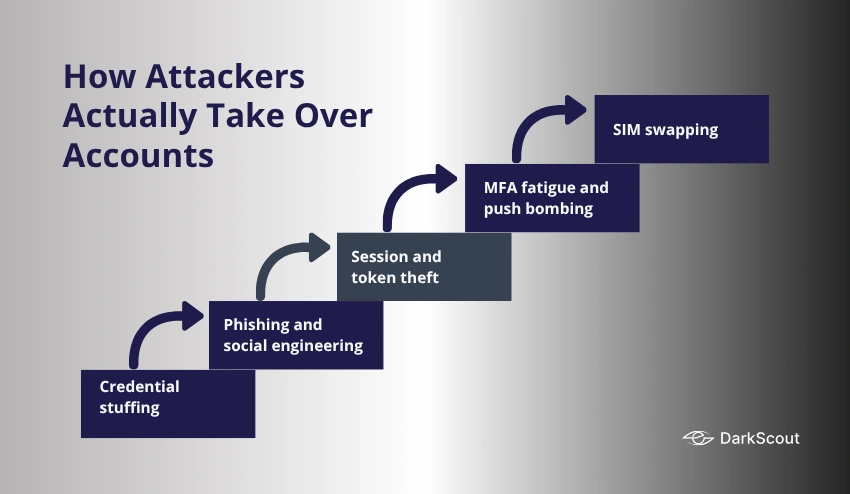
Account takeover rarely starts with a technical break-in. It almost always starts with a credential, a session, or a moment of human error that an attacker turns into access.
1. Credential stuffing
Automated tools test previously leaked username and password combinations against login pages at massive scale, betting on password reuse across different sites. Our full breakdown of credential stuffing covers exactly how this automated attack works and why a single reused password can expose dozens of unrelated accounts at once.
2. Phishing and social engineering
A convincing email, text, or call tricks a user into entering their credentials on a fake login page or approving a fraudulent request directly. This remains one of the most common entry points precisely because it targets the person rather than the system.
3. Session and token theft
Malware built to harvest active session cookies and authentication tokens can let an attacker bypass the login screen entirely, stepping directly into an already-authenticated session without ever needing the password at all. Our explainer on what a stealer log actually contains covers exactly how this kind of session data gets harvested and sold.
4. MFA fatigue and push bombing
Even with multi-factor authentication enabled, attackers with a valid password can bombard a user with repeated approval requests until one gets approved out of frustration or distraction. Our guide to push bombing covers this specific tactic and why sheer volume can defeat an otherwise reasonable MFA setup.
5. SIM swapping
Cybercriminals lure, persuade, or bribe a mobile provider to redirect your phone number to a device that they control, allowing them to hijack your two-factor authentication and gain access to your accounts.
Why Attackers Prefer Real Accounts Over Fake Ones
A takeover is often more valuable to an attacker than building fraud from scratch, and understanding why explains a lot about how these attacks get past standard fraud checks.
Fraud systems are built to scrutinize what is new. A brand new account with no history, an unfamiliar device, and no prior transactions gets flagged constantly, because everything about it looks unproven. An established account flips that dynamic entirely. Nothing about its history looks abnormal on its own, which is exactly why a takeover so often sails straight through the same checks that would stop a fake account cold. Specific trust signals make this possible.
1. Purchase and transaction history
An account with months or years of normal purchases behind it does not read as risky to a fraud model trained to weigh account age and history heavily. An attacker inherits that clean track record the moment they take over the account, instantly bypassing the scrutiny a brand new buyer would face.
2. Saved payment methods
Stored credit cards, linked bank accounts, and saved digital wallets let an attacker transact immediately without needing to supply or verify any new payment details themselves, removing one of the biggest friction points in most fraud attempts.
3. Verified identity and KYC status
Accounts that have already completed identity verification or Know Your Customer checks are especially valuable, since the attacker inherits that completed verification rather than needing to pass it themselves. This is precisely why fraud researchers have flagged a growing pattern of attackers specifically targeting accounts that have already cleared KYC, since it lets them bypass onboarding controls entirely and extract larger sums before anything looks suspicious.
4. Device recognition and trusted logins
Many platforms treat a recognized device or a previously trusted login pattern as a strong positive signal. Once an attacker’s session appears to originate from what looks like a familiar device or location, subsequent actions on the account face far less scrutiny than they would from a genuinely new source.
5. Delegated permissions and internal trust
Within an organization, a particular account has relationships and permissions that were accumulated over time. This might be access to shared drives, permissions to approve things, or a trusted reputation among internal users or vendors. All of that is immediately available to a threat actor – which is far better than starting from scratch.
This is part of why business account takeover so frequently escalates into business email compromise, where a hijacked but trusted email account becomes the launchpad for a much larger fraud attempt. A message sent from a real, previously trusted colleague’s account carries an assumption of legitimacy that a spoofed or unfamiliar sender never could, which is exactly what makes a takeover of that account so much more dangerous than an attacker simply building a convincing fake from scratch.
The Real Cost of an Account Takeover
The damage from a single successful takeover extends well past whatever the attacker directly steals.
- Direct financial loss. Corporate account breaches cost an average of 5 million dollars according to Security.org research, while individual victims lose an average of 180 dollars, with some cases reaching as high as 85,000 dollars.
- Customer trust damage. Around 75 percent of consumers report they stop using a brand after experiencing a cybersecurity issue tied to their account.
- Support overload. A security breach can be expected to create an increase in support tickets from concerned users needing to reset passwords, confirm transactions, or restore access to locked accounts.
- Chargeback and processor costs. As well as repaying the customer whose account was breached, chargebacks and increased payment processor fees contribute to additional costs long after the incident itself has ended.
- Reputational spread. A data breach that gets traction across social media and the press can tarnish the trust that customers have in your brand. And it won’t be immediate either.
Account Takeover Prevention, Layer by Layer
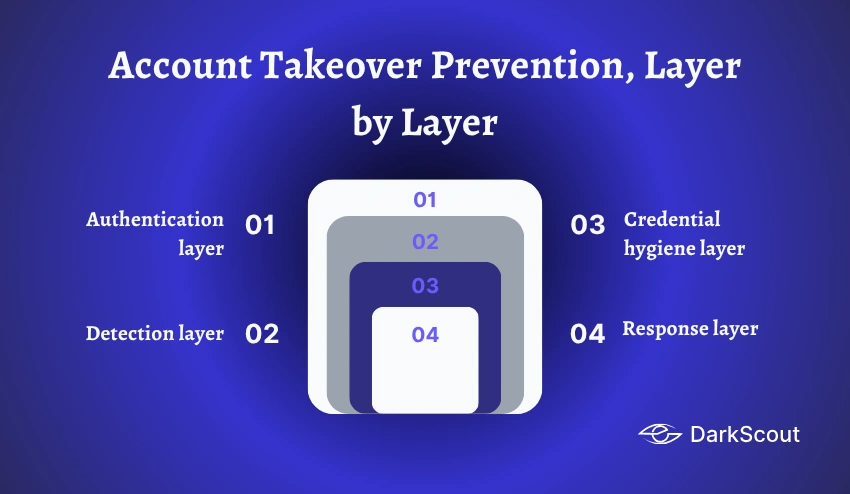
No single control stops account takeover on its own. Effective prevention stacks several layers together, so a failure at one point still gets caught by the next.
1. Authentication layer
Strong authentication removes the easiest paths in, since a large share of takeovers still succeed simply because nothing beyond a password stood in the way.
- Enforce MFA everywhere, without exception, including admin, service, and vendor accounts that often get overlooked in favor of covering employee logins first.
- Prioritize phishing-resistant methods over SMS codes. FIDO2-based passkeys and hardware security keys bind authentication to the specific device and site, making them far harder to intercept or replay, and they remove SIM swapping as a viable attack path entirely.
- Apply zero trust principles to every login, internal or external, rather than automatically trusting logins that originate from inside the network. Our guide to zero trust architecture covers how to structure this properly.
2. Detection layer
Behavioral monitoring catches what authentication alone misses, since a correctly entered password and MFA code do not guarantee the person behind them is legitimate.
- Device fingerprinting flags logins from unrecognized hardware or browser configurations.
- Impossible travel detection catches logins that would require physically traveling faster than possible between two locations in the time elapsed.
- Velocity checks flag an unusual number of login attempts, password changes, or transactions happening in a short window.
This layer matters most for catching an attacker who has already gotten past the front door, since it relies on the behavior around a credential looking wrong rather than the credential itself.
3. Credential hygiene layer
Weak and reused passwords remain the foundation most account takeovers are built on, and this layer is about closing that foundation rather than reacting to what happens on top of it.
- Enforce unique, sufficiently complex passwords across every account, and actively discourage memorable-but-predictable patterns that make credential stuffing effective in the first place.
- Monitor for exposed credentials continuously, not as a one-time check, since the gap between a credential leaking and it being tested against real login pages is often measured in hours, not weeks. Our guide on what makes a password compromised covers exactly why a password can be at risk even without a direct hack on your own systems.
4. Response layer
Fast, automated response limits how much damage a successful takeover can do, and the speed of this layer matters as much as the accuracy of the detection feeding into it.
- A clear, pre-built escalation path for confirmed incidents, including who gets notified and what gets locked down first, removes the delay of figuring out a response process in the middle of an active incident.
- Automatic lockout on confirmed suspicious activity, stopping further action the moment a threshold is crossed without waiting for a human to review an alert queue first.
- Immediate session revocation closes off any access an attacker already gained, even if their session was authenticated correctly at the time.
What Prevention Tools Can’t Guarantee
Honest limitations matter here, since plenty of vendors imply a complete prevention stack makes account takeover impossible. It does not.
No detection system catches every login perfectly on the first attempt. Behavioral and device-based detection reduces false negatives significantly but cannot achieve zero, particularly against a patient attacker using a residential proxy or a device that closely mirrors the legitimate user’s setup.
Human error remains a permanent variable. Even the strongest technical stack cannot fully prevent an employee or customer from being convincingly phished, and no prevention tool can retroactively undo a credential handed over willingly to a well-crafted fake login page.
Legacy systems and third-party integrations often lag behind. Older internal tools and vendor platforms frequently cannot support modern phishing-resistant authentication, which means a portion of any organization’s account surface usually remains protected by weaker methods regardless of how strong the newer systems are.
What to Do If an Account Is Already Compromised
Speed determines how much damage gets contained. Work through this order.
- Terminate active sessions instantly. Active sessions, if closed, disconnect an attacker’s access, even with compromised valid credentials. A fresh login is then forced that your other security measures can catch.
- Reset password and recovery methods. Simply resetting a password may not suffice if session token was also compromised, so the password and session tokens should be treated as one.
- Analyze activity for the recently compromised account. Check for unknown logins, modified settings, and unauthorized transactions to find out the extent of the actual compromise.
- Alert relevant parties as required. This might be a legal requirement depending on what data and funds are involved, or a matter of practice. You can find the entire incident response protocol in our incident response playbook, which also describes how to determine the scope of the compromise.
- Determine the root of entry. Whether you were hacked via credential stuffing, phishing, or via the session being compromised, you should find the way the attack entered because each has different remediation measures.
- Analyze whether your credentials were reused anywhere else. If so, it is extremely rare that your compromised account will be the only compromised entity if you reuse your password across platforms.
Where Continuous Monitoring Fits In
Most account takeover prevention strategies are built to catch an attack in progress. Fewer are built to catch the exposure that makes the attack possible in the first place.
- Exposure surfaces before an attack does. Credentials, session tokens, and account details routinely appear on dark web forums, marketplaces, and stealer log dumps well before they get used in an actual takeover attempt.
- A login-only strategy misses this earlier window entirely. Watching for suspicious activity at the login page only catches the attempt itself, not the exposure that made it possible.
- Continuous monitoring closes that gap. Dark web monitoring tracks exposure directly, flagging compromised credentials the moment they surface rather than waiting for the resulting login attempt to trip a detection system downstream.
- This is the layer most prevention stacks are missing. Authentication, detection, and response all matter, but each one only activates after an attacker already has something to work with.
- Catching exposure early changes the posture entirely. It is the difference between actually getting ahead of the problem and just reacting to it faster once it is already underway.
Conclusion
Account takeover prevention is not a single product or a single control. It is layered authentication, behavioral detection, credential hygiene, and fast response working together, because attackers only need one weak link to get in while defenders need every layer to hold.
The layer most often missing is the earliest one. Exposed credentials and stolen session data usually surface somewhere on the dark web well before an attacker uses them, and that window is exactly where prevention should start rather than end.
If your organization has not checked recently, DarkScout’s email exposure scanner shows whether your accounts already appear in known breach and stealer log data, so exposure gets caught before it turns into an actual takeover.