Email is still the number one initial access vector for cyberattacks. It always has been.
What’s changed is the sophistication. Ransomware groups use email to deliver credential harvesters. BEC attackers spend weeks researching targets before sending a single message. Phishing campaigns now use AI to generate messages indistinguishable from legitimate internal communications. Account takeover attacks pivot from one compromised inbox to every vendor and partner that the employee ever emailed.
Stopping these threats requires more than a spam filter. It requires intelligence: understanding who is targeting your organization through email, what techniques they’re using, where your credentials are already circulating, and what your exposure looks like before any attack reaches your inbox.
That’s what email threat intelligence delivers. And it’s a category that most organizations are significantly underinvesting in.
This guide covers the best email threat intelligence tools and platforms in 2026, what separates genuine intelligence capability from standard email security, and how to build the right stack for your organization.
Email Security vs Email Threat Intelligence: The Critical Distinction
Most tools marketed as email threat intelligence are actually email security gateways.
There’s an important difference.
An email security gateway sits in front of your mail flow and blocks known threats: malicious attachments, known phishing URLs, spam, and messages matching malware signatures. It operates reactively, at the perimeter, against threats it can see.
Email threat intelligence goes further. It provides context about the threat landscape surrounding your email environment: which threat actors are actively running campaigns targeting your industry, what techniques they’re using, where your organization’s email addresses and credentials are circulating in breach databases and dark web markets, and what attack patterns are emerging before they reach your inbox.
The practical difference: a gateway tells you when a malicious email arrives. Intelligence tells you that an attacker has been planning to send it for the last two weeks.
Email security tools and email threat intelligence tools aren’t mutually exclusive. The best programs use both. But organizations that only have a gateway and call it “email threat intelligence” are leaving significant gaps in their visibility.
What Good Email Threat Intelligence Covers
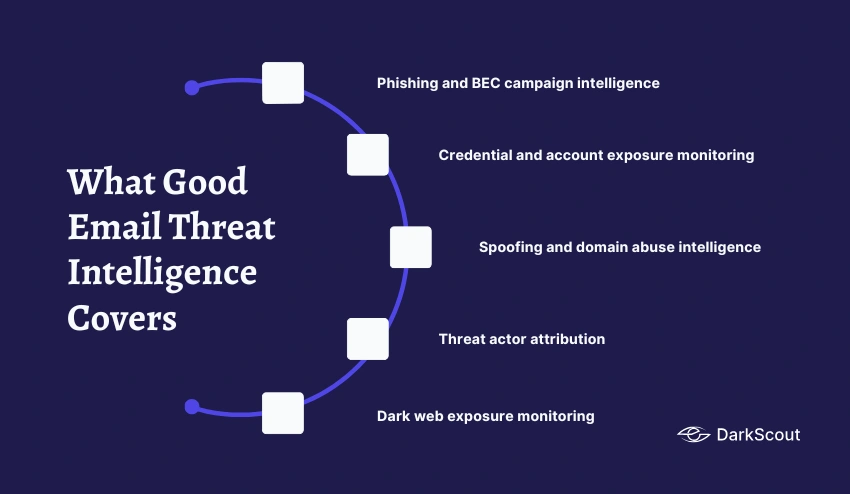
Before evaluating any tool, it helps to understand what email threat intelligence should actually provide.
1. Phishing and BEC campaign intelligence
Active phishing campaigns, business email compromise infrastructure, and lookalike domains are being registered against your brand. This intelligence arrives before campaigns are launched against you, not after.
2. Credential and account exposure monitoring
Your organization’s email addresses appear in breach databases, stealer log markets, and credential dumps being sold on dark web forums. A compromised credential in the wild is a warning sign that an account takeover attempt is likely coming.
3. Spoofing and domain abuse intelligence
Lookalike domains being registered that look like the organization, typosquatting domains being registered, and brand impersonation within phishing infrastructure. This helps protect your customers and partners from such attacks.
4. Threat actor attribution
Which groups are actively targeting the organization via email attacks, the methods they are using for initial access, and how these attacks are developing over time.
5. Dark web exposure monitoring
Employee credentials appearing on underground markets, in a stealer log that also contains a valid email session token, or in dark web forums that have singled out your organization’s email infrastructure for attack.
How We Evaluated These Tools
Every tool on this list was assessed against the same criteria.
Intelligence depth vs gateway depth: Does the platform provide genuine threat intelligence or is it primarily a detection and blocking tool? The best tools on this list do both. Tools that are purely gateways with a thin intelligence layer are not on it.
BEC and account takeover capability: Given that business email compromise is the most financially damaging email threat, how well does the platform specifically address impersonation, account takeover, and social engineering?
Dark web and underground coverage: Does the platform extend visibility into the environments where email-based attacks are planned and credentials are traded?
Behavioral detection: The capability to detect threats without known signatures through behavioral anomaly analysis in emails and account activity.
Integration with existing security stacks: SIEM and SOAR integration are vital to ensure that intelligence is actionable. This can also include endpoint and threat intelligence platform (TIP) integration.
Fit across organization sizes: Solutions requiring dedicated analysis teams to operate are often out of reach for most organizations, irrespective of the platform’s quality.
The Best Email Threat Intelligence Tools in 2026
1. Proofpoint Targeted Attack Protection
Best for: Enterprise organizations needing the most comprehensive email threat intelligence platform with the deepest global threat visibility
Proofpoint processes more email than almost any other security vendor, giving its NexusAI threat intelligence platform a dataset that few competitors can match. That scale translates directly into detection quality: Proofpoint sees emerging threats earlier because they’re more likely to appear in its global sensor network before anywhere else.
Targeted Attack Protection (TAP) goes beyond standard gateway filtering. It provides detailed intelligence on who is attacking your organization, what techniques they’re using, and how your users are responding to threats. The People-Centric Security dashboard identifies your Very Attacked People, the specific employees most targeted in your organization, and provides intelligence on the campaigns directed at them.
What makes it stand out: The intelligence feed behind TAP is genuinely global in scope. Proofpoint’s threat research team continuously tracks active BEC campaigns, credential phishing infrastructure, and malware delivery campaigns, feeding that intelligence into detection in real time. The platform’s threat intelligence reports provide operational context that goes well beyond indicator lists.
Where it falls short: It’s designed for enterprises with big security teams. Deployment is complicated and the volume of intelligence that the platform generates is more than small businesses can operate on. The price also matches its enterprise focus.
Best fit: Large enterprises with dedicated security operations teams, organizations with high-profile email attack risk, financial institutions, and healthcare systems with significant email threat exposure.
2. Abnormal Security
Best for: Organizations that want behavioral AI-driven email threat intelligence without the complexity of traditional gateway deployment
Abnormal takes a fundamentally different approach to email threat intelligence. Instead of relying on known threat signatures and reputation feeds, it builds behavioral baselines for every user, vendor, and partner in your email environment and detects anomalies against those baselines.
This means Abnormal catches threats that have no prior signatures: a first-ever BEC campaign from a brand-new infrastructure, a vendor impersonation using a clean domain, or an account takeover where the attacker is carefully mimicking normal behavior. The intelligence isn’t about what’s been seen before. It’s about what doesn’t match the established pattern.
What makes it stand out: The strongest element of Abnormal’s vendor intelligence is that it builds expected behaviors for all vendors you interact with and recognizes deviation to those patterns, stopping supply chain BEC, which would otherwise slip past signature-only based tools.
The platform includes email account takeover that recognizes compromised mailboxes based on behavioral anomalies as opposed to waiting for email to be sent out.
Where it falls short: Behavioral baselines need to be built over time, and new organizations will have a learning period when detection is not as strong as it can be. Organizations that need coverage immediately may find the ramp-up difficult.
Best fit: Those who have suffered from BEC attacks that signature-based gateway tools failed to catch and organizations that want intelligent detection without extensive maintenance of signature lists. Mid-market and enterprise organizations that operate in Microsoft 365.
3. DarkScout
Best for: Organizations that need dark web email threat intelligence covering the underground layer where email-based attacks are planned and credentials are traded
Most email threat intelligence tools focus on what happens at or after the inbox. DarkScout provides intelligence on what’s happening before attackers ever send a message: in the dark web marketplaces, credential markets, and underground forums where email attacks originate.
This distinction matters significantly for the threat types causing the most damage in 2026.
BEC attacks begin with reconnaissance. Before the first fraudulent email is sent, attackers gather intelligence from compromised accounts, social engineering, and dark web credential sources. When your employees’ email credentials appear in stealer log markets or breach databases being sold on dark web forums, that exposure is the precursor to the account takeover or impersonation attack that follows.
Stealer logs specifically represent one of the most direct email threat intelligence signals available. A stealer log containing an employee’s email credentials and active session tokens gives an attacker direct mailbox access. DarkScout’s Dark Monitoring service continuously scans stealer log markets, breach databases, ransomware leak sites, and dark web forums for exactly these signals, alerting your team when your organization’s email credentials surface underground.
What makes it stand out: DarkScout provides the intelligence layer that gateway tools can’t see. No perimeter security tool monitors the dark web forums where credentials are sold, the Telegram channels where BEC operators share targeting lists, or the underground markets where email access is auctioned. DarkScout’s continuous scanning of these environments gives security teams a pre-attack warning window that no inbox-facing tool can provide.
The Darknet Threat Assessment specifically maps your organization’s current dark web email exposure: which credentials are circulating, what data is available to attackers doing pre-attack reconnaissance, and what the risk posture looks like before any attack is launched.
Where it falls short: DarkScout is a specialist dark web intelligence platform, not a full email security gateway. Organizations need to pair it with an inbox-facing tool for complete coverage. It provides the intelligence on what’s circulating underground; it doesn’t filter email at the perimeter.
Best fit: Organizations that have experienced BEC or account takeover attacks and want to understand their underground exposure. Security teams that recognize credential monitoring as a critical gap in their current email threat program. Any organization where employee email credentials are high-value targets.
Quick check: DarkScout’s free email scan immediately shows whether your organization’s addresses have appeared in known breach data.
4. Mimecast Email Security with Targeted Threat Protection
Best for: Organizations wanting a consolidated email security and intelligence platform with strong impersonation protection
Mimecast combines email gateway security with targeted threat protection in a single platform. Its threat intelligence layer monitors billions of emails globally, feeding real-time detection updates across the customer base as new attack patterns emerge.
The impersonation protection capability is one of Mimecast’s strongest differentiators for email threat intelligence purposes. It monitors for domain similarity attacks, checks sender reputation in real time, and uses machine learning to identify messages that attempt to impersonate internal executives or trusted external contacts.
What makes it stand out: Mimecast’s consolidation approach is genuinely useful for organizations that don’t want to manage multiple point solutions. URL protection, attachment sandboxing, impersonation protection, and threat intelligence all sit in one platform with a single management interface.
The platform integrates with Microsoft 365 and Google Workspace deeply and now connects with over 350 security vendors following its March 2026 update, making it one of the better-integrated platforms in the market.
Where it falls short: Some users report the admin interface has nested settings that slow down troubleshooting. URL protection defaults can be aggressive, occasionally blocking legitimate links. The threat intelligence layer, while solid, doesn’t match the depth of Proofpoint’s global sensor network.
Best fit: Mid-market organizations wanting consolidated email security and intelligence without managing multiple vendor relationships. Organizations on Microsoft 365 looking for a dedicated email security layer beyond native Defender capabilities.
5. Cisco Secure Email Threat Defense
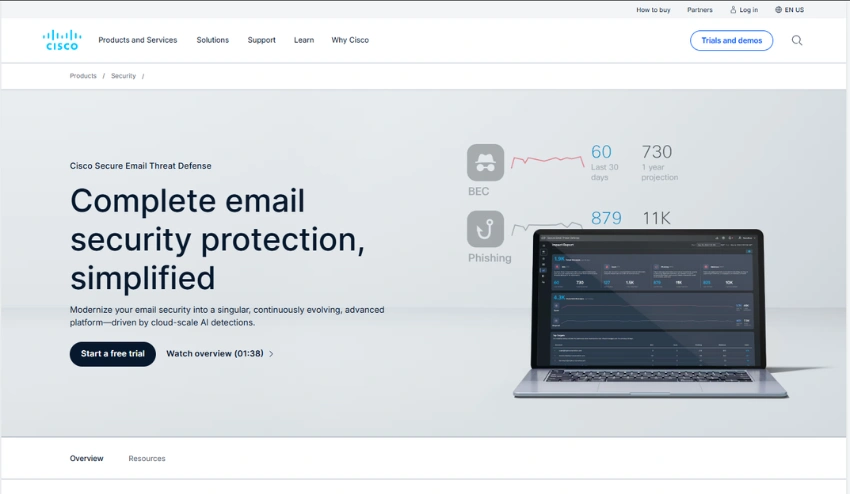
Best for: Organizations already in the Cisco security ecosystem wanting email threat intelligence backed by Talos
Cisco Secure Email Threat Defense is backed by Talos, one of the largest commercial threat intelligence organizations in the industry. Talos processes telemetry from Cisco’s global network of sensors to produce threat intelligence that feeds directly into email detection.
The platform focuses specifically on advanced threat detection: BEC, targeted phishing, and email-based account takeover, going beyond what the standard Cisco Secure Email gateway provides. The threat intelligence layer provides context on detected threats, including attribution information about the campaigns and actors involved.
What makes it stand out: The scale and credibility of Talos are real value adds. The threat intelligence used to inform email detection is provided by one of the largest commercial threat research operations available, allowing for visibility into emerging threats before many are documented.
Where it falls short: The value is highest for Cisco-centric environments. Companies running non-Cisco environments may offset the benefits of intelligence by integration overhead. For non-Cisco users, the system is not as intuitive to those without prior Cisco security experience.
Best fit: Existing Cisco ecosystem users who need increased visibility and intelligence within email compared to the standard secure email gateway. Large companies that leverage Talos threat intelligence but need the application of it targeted at email threat detection.
6. Microsoft Defender for Office 365
Best for: Microsoft 365 organizations wanting native integrated email threat intelligence without additional vendor complexity
Microsoft Defender for Office 365 provides email threat intelligence that’s natively integrated with Microsoft’s broader security ecosystem. For organizations already on Microsoft 365, it provides substantial threat intelligence capability without adding a new vendor or integration layer.
The Threat Explorer and Campaign Views features provide genuine intelligence functionality: visibility into active attack campaigns targeting your organization, detailed analysis of attack techniques in use, and historical trends in the email threats directed at your environment.
What makes it stand out: The integration advantage is real. Defender for Office 365 threat intelligence feeds directly into Microsoft Sentinel (SIEM), Microsoft Defender XDR (endpoint), and Entra ID (identity), creating a correlated threat picture across email, endpoint, and identity in a single ecosystem.
Microsoft’s global scale also provides meaningful threat intelligence: with hundreds of millions of users, Microsoft sees a significant proportion of all email attack activity globally.
Where it falls short: The intelligence depth doesn’t match that of specialist vendors for organizations with sophisticated requirements. Out-of-the-box configuration requires significant tuning to reach its full potential. Organizations with complex email environments sometimes find the platform less flexible than dedicated third-party solutions.
Best fit: Organizations fully committed to the Microsoft 365 ecosystem that want strong native email threat intelligence without third-party complexity. Organizations using Microsoft Sentinel that want email intelligence to feed into their SIEM automatically.
7. Cofense Intelligence
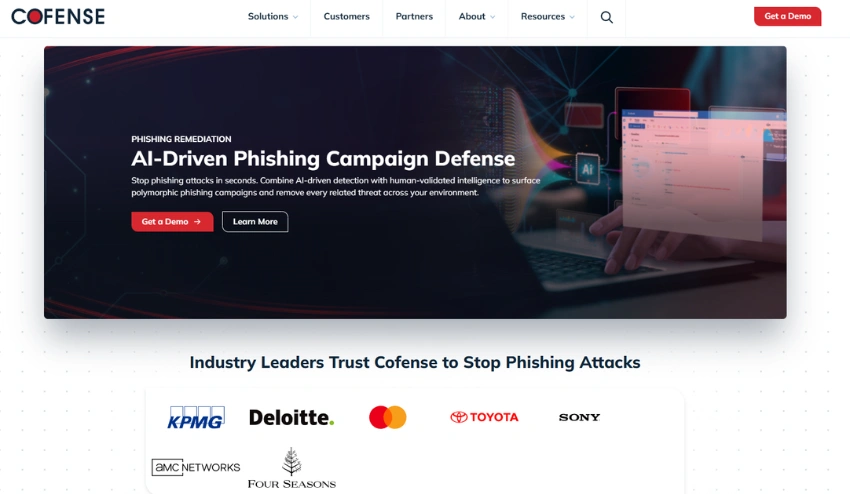
Best for: Organizations that want human-verified phishing threat intelligence from real employee-reported incidents
Cofense takes a unique approach to email threat intelligence. Rather than relying solely on automated analysis, it operates a network of human reporters: employees across thousands of organizations who report suspicious emails they receive. These reports feed a human-vetted intelligence pipeline that produces phishing threat intelligence grounded in real attacks reaching real inboxes.
The Cofense Intelligence platform provides phishing-specific threat intelligence: active campaigns, indicators of compromise from confirmed phishing emails, and trend analysis on phishing techniques currently in active use.
What makes it stand out: Human validation is its only real unique feature. Automated threat intelligence lacks the context that human reports provide. An employee reporting an email and the information it generates from a Cofense analyst covers the reality of phishing far more than just analyzing what automated detection catches.
Where it falls short: Cofense provides only the phishing intelligence aspect. Enterprises that want BEC, account takeover (ATO), and dark web credential monitoring will require supplemental tools.
Best fit: Those whose number one email threat concern is phishing. Security awareness programs seek to have visibility that bridges their training with real-world threat intelligence.
8. SlashNext Email Protection
Best for: Organizations wanting instant AI-driven zero-hour phishing detection in email and collaboration tools, all at once.
SlashNext employs computer vision and NLP to detect phishing attacks in real time-including zero-hour, non-signatured attacks- across email and collaboration tools like Microsoft Teams, Slack, and SMS, as cyber-criminals embrace multi-channel attack vectors.
Its threat intelligence feeds are continuously updated with newly detected phishing campaigns, which allows for nearly real-time protection against novel threats no matter the communication channel used by employees.
What makes it stand out: This is a seriously handy feature, as increasingly attackers are leveraging both email phishing and Teams and Slack messages to get around single gateway solutions. SlashNext’s AI can detect phishing pages while they’ve been live for minutes rather than hours, significantly decreasing the time window for new phishing attacks.
Where it falls short: While excellent for phishing detection, SlashNext falls somewhat short on BEC, dark web intelligence, and other advanced threat intelligence features required by enterprise programs. It works best as part of an email security suite.
Best fit: Companies heavily utilizing Microsoft Teams or Slack who want the protection to extend to other collaboration applications as well as email. Teams are experiencing novel phishing attacks that are bypassing their current email gateway.
How to Choose the Right Tool for Your Organization
The right combination depends on your threat profile, your team’s capacity, and the gaps in your current program.
1. Start with your most pressing threat
BEC and account takeover? Abnormal and DarkScout complement each other well: Abnormal catches behavioral anomalies in your inbox, and DarkScout monitors the dark web for the credential exposure that enables account takeover in the first place.
Phishing at scale? Proofpoint or Mimecast provides deep phishing intelligence with broad coverage. Cofense adds human-verified intelligence on top.
Microsoft 365 environment with a limited security budget? Microsoft Defender for Office 365 provides a strong baseline before adding specialist tools.
2. Match the tool to your team’s capacity
A sophisticated platform that generates intelligence your team can’t act on creates noise rather than protection. Be honest about analyst availability. Platforms that provide actionable, pre-triaged alerts with clear response guidance suit lean security teams better than raw intelligence feeds requiring significant analyst processing.
3. Don’t leave the dark web uncovered
The most common gap in email threat intelligence programs is dark web visibility. Traditional email security tools can’t see the credential markets where your employees’ email passwords are being sold, the underground forums where BEC targeting lists are traded, or the stealer log dumps that give attackers pre-authenticated access to corporate mailboxes.
Understanding how dark web monitoring works makes the value of this coverage layer concrete. Knowing your credentials are circulating underground before they’re used provides a response window that no perimeter tool can deliver.
4. Test with real data
Every vendor demo looks effective with curated examples. Ask for a proof of concept against your actual environment. Real results about your real exposure will always tell you more than a vendor walkthrough.
Building a Complete Email Threat Intelligence Stack
No single tool covers everything. A complete email threat intelligence program typically layers three capabilities.
Layer 1: Inbox-facing intelligence and protection: A platform like Proofpoint, Abnormal, or Mimecast that sits in or alongside your mail flow provides behavioral detection, BEC protection, and real-time threat intelligence applied to incoming email. This layer catches what’s currently being sent to you.
Layer 2: Dark web and credential exposure monitoring: A platform like DarkScout that continuously monitors underground markets and forums for your organization’s credential exposure, domain abuse, and threat actor targeting activity. This layer tells you what’s being prepared before it arrives.
Layer 3: Feed and platform integration: Ensuring that email threat intelligence connects to the broader security stack: threat intelligence feeds flowing into your SIEM, IOCs from email investigations feeding into endpoint detection, and alerts from dark web monitoring triggering credential reset workflows.
Organizations that build all three layers have visibility across the full email attack timeline: the pre-attack planning phase, the active campaign phase, and the post-compromise detection phase. Each layer makes the others more effective.
This three-layer model maps directly to how mature cyber threat intelligence programs are built: coverage across the full threat lifecycle, not just at the point of delivery.
Conclusion
Email is where most attacks begin. It’s also where most threat intelligence programs have their biggest gaps.
The inbox-facing tools on this list provide strong detection and protection against known and behavioral threats at the point of delivery. The dark web monitoring layer provides the intelligence that none of those tools can see: the credential exposure, targeting discussions, and underground activity that precede attacks by days or weeks.
The organizations that consistently stay ahead of email-based threats aren’t the ones that bought the most expensive gateway. They’re the ones that combined smart perimeter detection with underground intelligence, so they knew an attack was coming before it arrived.
Whatever tools you choose, close the dark web gap. It’s the layer that’s most consistently missing and most consistently exploited.
Know your dark web exposure before attackers act on it.
Run a Free Email Scan → Book a Darknet Threat Assessment →