Organizations using AI-powered cybersecurity detect and contain breaches 108 days faster than those without it, saving an average of $1.9 to $2.2 million per incident, according to IBM’s 2025 Cost of a Data Breach Report.
That’s the case for AI in cybersecurity, in one statistic.
Here’s the other half of the picture. By 2026, automated threat actors will reduce the window between initial compromise and data exfiltration to under 15 minutes in many documented cases. The same technology delivering those defensive gains is being used, with equal sophistication, by the people trying to breach your organization.
AI cybersecurity isn’t a single technology or a single side of a fight. It’s the term for an entire shift in how cyber conflict operates: both attackers and defenders now run on machine learning, automation, and increasingly autonomous systems. Understanding AI cybersecurity properly means understanding both halves of that equation, because a security program built around only one half is solving half the problem.
This guide covers the complete picture: what AI cybersecurity actually means, how it evolved, where it’s being used defensively, how attackers are using the same foundations offensively, and how to build a program that accounts for both realities simultaneously.
What Is AI Cybersecurity?
AI cybersecurity refers to the use of artificial intelligence and machine learning technologies across the full cyber conflict landscape: both to protect systems, networks, and data from threats and as the technological foundation attackers increasingly use to execute those threats.
Most explanations of this term focus exclusively on the defensive application: AI-powered tools that detect anomalies, automate security operations, and analyze threat data faster than human teams could manage manually. That’s accurate, but incomplete.
The honest, complete definition has to include the other side. The same categories of AI capability, including natural language generation, behavioral pattern analysis, and autonomous decision-making, are being adopted by threat actors to conduct reconnaissance, generate convincing phishing content, develop adaptive malware, and execute multi-stage intrusions with reduced human involvement.
This is why the cybersecurity industry increasingly describes the current era as an AI arms race rather than an AI solution. Both sides are using the same underlying technological capabilities. The organizations that build resilient security programs in 2026 are the ones that account for this reality explicitly, rather than treating AI purely as a tool they’re deploying against opponents who aren’t using it themselves.
How AI Cybersecurity Evolved
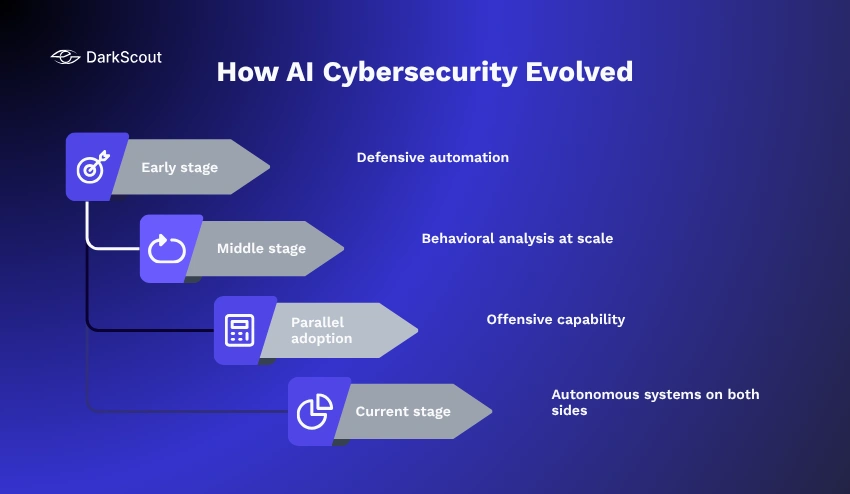
Understanding how AI cyber evolved gives context to why the defensive and offensive tools have developed concurrently, not sequentially.
1. Early stage: Defensive automation
The initial use of AI within cyber was focused solely on defending using automation techniques. Machine learning began to be used to automate tasks such as network traffic anomaly detection, automated log analysis and simple pattern recognition, to take repetitive and labour-intensive tasks away from security analysts. At this point, AI was simply seen as an efficiency tool used in conjunction with existing security infrastructure.
2. Middle stage: Behavioral analysis at scale
Advanced machine learning techniques enabled defensive AI systems to go beyond automation into genuine behavioral analysis. AI systems started to build a baseline of what was considered to be normal activity within a network and flag meaningful deviations that indicated an attack, and were capable of identifying threats never encountered before. This was not a mere addition of an efficiency tool, but rather an architecture shift for defense.
3. Parallel adoption: Offensive capability
Threat actors observed the defensive capabilities being developed and adopted equivalent approaches for offensive purposes. Reconnaissance automation, AI-generated phishing content, and adaptive malware development followed close behind their defensive equivalents, often using the same underlying open-source models and techniques that defenders were using.
4. Current stage: Autonomous systems on both sides
In 2026, AI is no longer a supplementary tool on either side of the conflict. Defensive platforms increasingly operate with meaningful autonomy in triage and initial response. Offensive operations increasingly use AI agents capable of executing significant portions of an intrusion with minimal human direction. Both sides have moved from AI-assisted to AI-native operations within the same multi-year window.
This parallel evolution is the key context missing from most explanations of AI cybersecurity. It didn’t develop as a defensive innovation that attackers eventually caught up to. It developed as a dual-use technological shift that both sides adopted at a similar pace.
The Defensive Side: How AI Strengthens Security Operations
On the defensive side, AI cybersecurity delivers genuine, measurable improvements across several specific functions.
1. Faster, more accurate threat detection
AI threat detection moves security operations beyond signature-based matching, which can only catch threats that have been previously documented, toward behavioral analysis capable of identifying genuinely novel attacks. Modern detection models can identify malware variants with accuracy exceeding 99% in controlled testing, including samples the model has never directly encountered. The full mechanics behind this shift, along with its genuine limitations, are covered in detail in our AI threat detection guide.
2. Reduced alert fatigue through intelligent triage
Security operations centers receiving thousands of alerts daily can’t investigate them all manually. AI-powered triage reduces false positive rates significantly, allowing analysts to focus on high-confidence incidents rather than chasing noise. This shift from manual to AI-assisted and increasingly autonomous triage is reshaping how security operations centers function day to day, a transformation explored fully in our AI SOC automation guide.
3. Faster breach containment
The IBM statistic at the top of this guide, 108 days faster detection and containment with AI-powered tools, translates directly into reduced breach costs and reduced operational disruption. Faster detection limits how far an attacker can move laterally before being identified and contained.
4. Threat intelligence processing at scale
AI-powered natural language processing allows security teams to extract structured intelligence from unstructured sources, including dark web forum discussions, threat reports, and security advisories, far faster than manual analyst review allows. This capability is foundational to modern cyber threat intelligence programs that need to process growing volumes of threat data without proportionally growing analyst headcount.
5. Vulnerability and exposure analysis
AI can provide insights into the most likely to be actively exploited vulnerabilities by using patterns in threat actor behavior, attack surface information and past exploitation, enabling teams to prioritize patch application better than solely relying on CVSS.
The Offensive Side: How Attackers Use the Same AI Foundations
The honest complement to the defensive picture: the offense is leveraging equivalent AI capabilities to make all phases of attack faster, more realistic, and less discoverable.
1. Automated reconnaissance and target profiling
AI tools rapidly scrape and synthesize open-source intelligence of a target organization, enabling rapid construction of detailed organizational, technological, and communication target profiles.
2. AI-generated phishing and social engineering
Generative AI produces phishing content that is grammatically flawless, contextually accurate, and stylistically matched to the person being impersonated. The detection signals that security awareness training relied on for years, poor grammar and unusual phrasing, are no longer reliable indicators.
3. Adaptive, polymorphic malware
AI-assisted malware development produces code that rewrites itself with each execution, generating functionally identical but structurally unique variants that evade signature-based detection entirely. Some malware now queries AI models mid-execution to adapt its behavior based on the specific security environment it encounters.
4. Faster exploitation and reduced response windows
The compression of attacker timelines is one of the most consequential developments in the current threat landscape. Industry data places the average breakout time, the gap between initial access and lateral movement, at under 30 minutes, with some documented cases occurring in under a minute. Our AI cyber attacks guide covers the full attack chain transformation, including real, named threat actor groups documented using AI across active operations.
5. Autonomous and semi-autonomous attack execution
The most advanced documented cases involve AI agents executing the majority of an intrusion’s technical steps with minimal human direction: reconnaissance, exploitation, and exfiltration all handled by AI systems operating with defined objectives rather than constant human instruction.
Why This Is an Arms Race, Not a Solved Problem
It’s tempting to frame AI cybersecurity purely as a defensive upgrade: deploy the technology, improve your detection, problem addressed. That framing misses the structural reality.
Both sides have access to broadly similar underlying technology. The large language models, machine learning frameworks, and automation tooling powering defensive AI platforms are largely the same categories of technology available to threat actors, sometimes through the exact same commercial products.
This creates a genuine arms race dynamic rather than a one-sided improvement. As defensive AI gets better at identifying behavioral anomalies, attackers develop adversarial techniques specifically designed to stay within the boundaries the defensive model has learned to consider normal. As defenders deploy AI to detect AI-generated phishing, attackers refine their generation techniques to defeat that detection.
This dynamic has a practical implication for how organizations should think about AI cybersecurity investment. Deploying AI defensive tools isn’t a destination. It’s an ongoing capability that requires continuous tuning, monitoring, and adaptation as the threat side of the equation evolves in parallel. Organizations that deploy AI detection once and consider the problem solved consistently find their detection accuracy degrading as attackers adapt around the specific model they’re facing.
Core Components of AI Cybersecurity
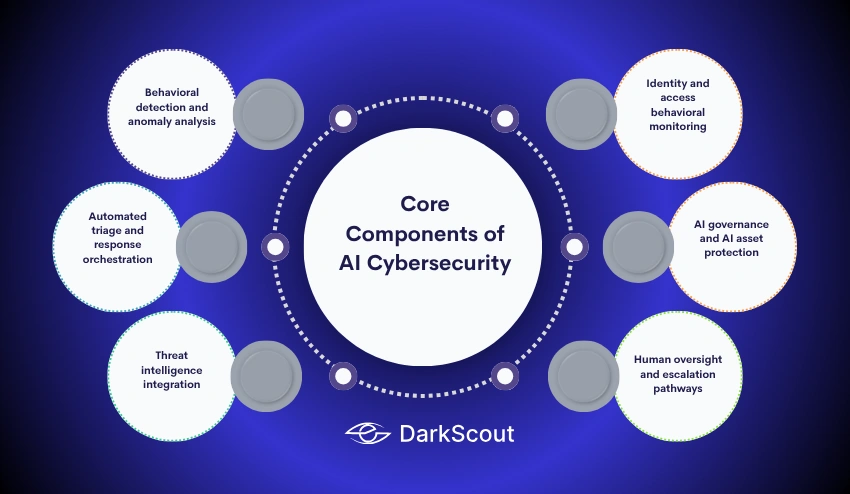
A complete AI cybersecurity program, addressing both the defensive opportunity and the offensive reality, typically includes these core components working together.
1. Behavioral detection and anomaly analysis
The foundational defensive capability: establishing baselines of normal activity across network, endpoint, identity, and cloud environments, and flagging meaningful deviations regardless of whether the specific threat has a known signature.
2. Automated triage and response orchestration
Reducing the manual burden of investigating high-volume, well-defined alert categories, freeing analyst capacity for the complex, ambiguous cases that genuinely require human judgment.
3. Threat intelligence integration
Feeding behavioral detection systems with external context, including active threat actor campaigns, known indicators, and credential exposure data, so that anomaly scoring reflects real-world threat relevance rather than purely statistical unusualness.
4. Identity and access behavioral monitoring
The expansion of behavior analytics into user and entity behavior exclusively, allowing us to address account take-over and insider threat conditions which cannot be prevented by access controls alone.
5. AI governance and AI asset protection
Recognizing that AI systems deployed inside the organization, including the security tools themselves, represent both a capability and a potential attack surface requiring deliberate protection and oversight.
6. Human oversight and escalation pathways
Defining explicitly which decisions and response actions are appropriate for automation, and which require human judgment given business context, risk tolerance, and the consequences of getting a decision wrong.
How to Tell AI-Native From AI-Washed
The cybersecurity vendor space in 2026 has products touting AI capabilities that fill the market. Not just accept this on face value; ask particular questions to get an answer of whether the platform is truly AI-native or it is just a rebranded heuristic engine under a fancy UI.
Ask what specific technique is being used. “AI-powered” can mean supervised learning, unsupervised anomaly detection, deep learning, natural language processing, or simple rule-based heuristics relabeled for marketing purposes. A vendor that can’t specify which technique their platform uses for a given capability likely isn’t using a meaningfully sophisticated approach.
Ask how the model handles novel threats it hasn’t seen before. Genuine behavioral AI detection should demonstrate capability against threats with no prior signature. If the platform’s detection capability degrades significantly against genuinely novel attack patterns, the underlying approach may be closer to signature matching with an AI label attached.
Ask about the baseline and tuning process. Legitimate behavioral AI requires an observation period to establish what normal looks like for a specific environment and ongoing tuning to maintain accuracy as the environment changes. A vendor claiming instant, zero-configuration accuracy across any environment is making a claim that doesn’t match how this technology genuinely works.
Request clear and evidence-based performance measures. “Time to detect, false positive rates, and the circumstances under which those measures were gathered”. Reassurance is meaningless if not tied to evidence.
Inquire about how human oversight is incorporated. AI systems claiming to be a substitute for rather than an enhancement of the capabilities of a security analyst are making overly optimistic statements about the state of the art.
The Dark Web’s Role in the AI Cybersecurity Equation
The dark web plays a specific and significant role on both sides of the AI cybersecurity equation that most discussions of this topic overlook entirely.
On the offensive side, AI has transformed how quickly the underground economy processes and monetizes stolen data. Following major breaches, threat actors now use AI tools to categorize, validate, and list stolen credentials for sale within hours rather than the weeks or months manual processing previously required. AI-driven credential validation, automated target intelligence gathering shared across criminal forums, and AI-assisted dark web ransomware operations have all accelerated the pace at which stolen data becomes an active threat.
On the defensive side, this same underground activity represents one of the most valuable and underutilized intelligence sources available to security teams. When an organization’s credentials appear in a stealer log market or a breach database, that exposure is frequently a precursor signal that precedes the internal behavioral anomaly a detection system would eventually catch, sometimes by hours or days.
This is the connecting thread between AI cybersecurity’s defensive and offensive realities: dark web intelligence gives defenders visibility into the same underground processes that AI is accelerating on the attacker side. A security program with strong internal AI threat detection but no visibility into dark web activity is missing the earliest, most actionable warning signal available for credential-based threats specifically.
AI Governance: Securing the AI You Deploy
As organizations adopt AI tools internally, both for security operations and across the broader business, those tools introduce a category of risk that AI cybersecurity programs need to address explicitly: the AI systems themselves becoming attack surfaces.
AI agents with access to internal documents, business systems, and decision-making authority represent a new category of identity inside the organization, one capable of taking autonomous action. Prompt injection attacks, where malicious instructions embedded in an AI system’s input cause it to execute attacker-directed commands, have already been documented affecting dozens of organizations using legitimate enterprise AI tools.
Effective AI governance for cybersecurity purposes includes maintaining an inventory of AI tools in use across the organization, including unsanctioned shadow AI deployed by individual teams without formal approval. It includes applying the same access control rigor to AI infrastructure that applies to other sensitive systems: monitoring AI model APIs, auditing training data pipelines, and limiting what internal systems and data a given AI tool can access.
It also includes extending behavioral monitoring to AI agents themselves, treating their activity patterns as a category of identity behavior worth establishing a baseline for, the same way security teams monitor human user behavior for anomalies.
Organizations that deploy AI broadly without this governance layer are expanding their attack surface in ways that traditional security architecture wasn’t designed to account for.
Building an AI-Aware Security Program
Bringing the defensive opportunity and offensive reality together into a coherent security program requires specific, deliberate steps.
1. Audit your current detection architecture for AI maturity
Understand whether your existing security tools genuinely use behavioral AI detection or are relying primarily on signature matching with AI marketing applied. This audit determines where your most significant detection gaps likely exist.
2. Build human-in-the-loop governance deliberately
Define explicitly which security decisions and response actions are appropriate for automation, and which require human review given their consequences. Document this architecture rather than letting it develop implicitly over time.
3. Integrate threat intelligence, including dark web sources, into detection workflows
Behavioral detection operating purely on internal telemetry is working with an incomplete picture. Connecting external intelligence, particularly dark web credential exposure signals, materially improves both detection accuracy and response urgency.
4. Train your team to operate alongside AI tools, not just deploy them
Security professionals need to understand how to interpret AI-generated outputs, recognize when a model’s assessment is likely wrong, and act on the insights surfaced rather than treating AI output as an automatic, unquestionable verdict.
5. Apply governance to your own AI deployments
Inventory the AI tools in use across your organization, apply access controls to AI infrastructure consistent with other sensitive systems, and extend behavioral monitoring to AI agents operating with meaningful autonomy inside your environment.
6. Treat this as an ongoing capability, not a completed project
Given the arms race dynamic between offensive and defensive AI, plan for continuous tuning, monitoring, and adaptation rather than treating AI cybersecurity deployment as a one-time implementation.
Organizations without the internal capacity to build and maintain this level of AI-aware security operations increasingly turn to specialized providers. DarkScout’s AI-powered cybersecurity platform combines continuous dark web intelligence with the threat detection and monitoring capability that closes the gap between what’s happening in the underground economy and what internal security tools can see on their own.
Conclusion
AI cybersecurity is not a single tool, a single vendor category, or a problem that gets solved once and stays solved. It’s the term for an ongoing, two-sided technological shift where the same fundamental capabilities, behavioral analysis, automation, and increasingly autonomous decision-making are being adopted in parallel by defenders and attackers alike.
The defensive gains are real and measurable: faster detection, reduced alert fatigue, faster containment, and intelligence processing at a scale manual analysis can’t match. The offensive reality is equally real: faster reconnaissance, more convincing social engineering, adaptive malware, and compressed attack timelines that leave less room for manual response.
Building a security program for this reality means investing in genuine behavioral detection rather than AI-washed signature matching, governing the AI tools you deploy as carefully as any other sensitive system, and extending your intelligence sources to cover the dark web activity where the offensive side of this equation is most active and least visible to internally-focused tools.
The organizations that get this right aren’t the ones with the most AI vendors in their stack. They’re the ones who understand both halves of the picture and built their program around that complete understanding.
👉 Book a demo and see DarkScout in action