The average security operations center receives between 3,800 and 4,500 alerts every single day.
Two-thirds of them go uninvestigated.
Not because analysts don’t care. Because there aren’t enough hours, enough people, or enough cognitive capacity to work through that volume manually. A typical Tier 1 analyst handles between 20 and 25 alerts per shift. The math doesn’t close. It never will with human capacity alone.
That gap is what AI SOC automation exists to close.
But AI SOC automation in 2026 isn’t one thing. It’s a spectrum of approaches ranging from basic rule-based scripts to autonomous agentic AI that investigates alerts without human intervention. Understanding where each approach sits on that spectrum, what it actually delivers, and where it falls short is what separates organizations that successfully implement automation from ones that buy a platform and spend 18 months trying to make it work.
This guide covers all of it: what AI SOC automation is, how it evolved, the four automation models operating in real SOCs today, the use cases delivering the most value, what automation genuinely can’t do, and how to build the right approach for your organization.
What Is AI SOC Automation?

AI SOC automation is the use of artificial intelligence, orchestration, and automated workflows to perform security operations center tasks without constant human intervention.
At its core, it addresses a simple but severe operational problem: alert volumes scale with the environment and the threat landscape. Analyst headcount doesn’t.
A security operations center exists to detect threats, investigate them, and respond before damage escalates. That process has three distinct phases that each consume analyst time: triage (is this alert real or a false positive?), investigation (what happened and how far has it spread?), and response (contain the threat, eradicate it, recover from it).
AI SOC automation applies different types of technology to each of those phases. Some tasks are highly repetitive and well-defined: a known-malware hash hit on an endpoint almost always leads to the same investigation and the same response steps. These are ideal for automation. Other tasks require contextual judgment, institutional knowledge, and situational awareness that no current AI system reliably provides. These stay with human analysts.
The goal isn’t replacing analysts. It’s making sure analysts spend their time on work that requires them.
Why Traditional SOC Models Are Breaking
The pressure on security operations has reached a level where incremental improvements to the traditional model don’t close the gap anymore.
Alert volume is structurally unsolvable with human capacity
Organizations receive an average of 960 security alerts per day, according to Wiz’s 2026 research, with larger enterprises often exceeding 3,000. MSSP environments handling multiple clients face between 10,000 and 100,000 alerts monthly across their customer base. Nearly 40% of these alerts go uninvestigated simply because there isn’t analyst time to reach them.
The problem isn’t that analysts are slow. It’s that the ratio of alerts to analysts is structurally broken. Adding headcount doesn’t solve it because the global cybersecurity talent shortage means qualified analysts aren’t available at the scale the problem requires.
71% of SOC analysts report burnout symptoms
According to UnderDefense’s 2026 research, 71% of SOC analysts report burnout symptoms that directly affect detection quality. Alert fatigue is a measurable security risk: when analysts spend hours triaging false positives, their attention and accuracy degrade on the alerts that matter.
Burnout also drives turnover. Training a new Tier 1 analyst typically requires six to twelve months before they operate independently. Every departure creates a capability gap that takes a year to fill.
The threat landscape has accelerated beyond manual response
AI cyber attacks have compressed the timeline between initial access and lateral movement to an average of 29 minutes. In the fastest documented case, it happened in 27 seconds. Manual triage and investigation processes that take 45 minutes per ticket cannot detect and contain threats that move in under 30 minutes. The response gap isn’t just an efficiency problem. It’s a structural security failure.
The Evolution: From Scripts to Agentic AI
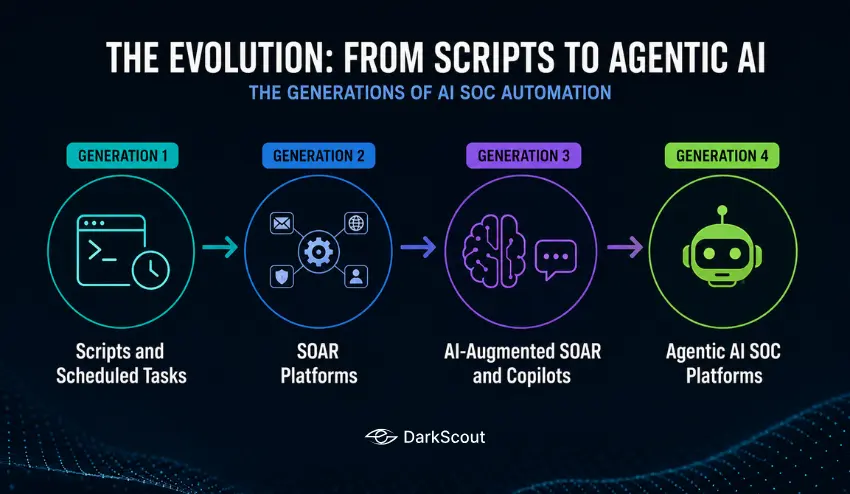
AI SOC automation was not born from nothing; instead, it evolved in generations to overcome shortcomings that were present with previous generations.
Generation 1: Scripts and scheduled tasks
The first attempt at SOC automation was with scripts. Log files were automated to be collected and scheduled to have reports produced automatically, alerts would be manually directed or sent to a specific location. This form of automation was for a single process and only worked when nothing else changed. Its advantages were reduced manual labor on defined tasks; however, there were disadvantages to events outside of what it was programmed to respond to.
Generation 2: SOAR platforms
Orchestration was the next logical step, which arrived in the form of SOAR platforms. This introduced the idea of playbooks, which contained sequences of commands to automate a series of actions for specific types of alert and linked many security tools together. A phishing alert, for instance, would trigger a playbook, automated URL analysis using threat intelligence, email quarantine, and user notification.
SOAR was a genuine advance for the use cases it covered. The limitation was that it only covered use cases someone anticipated and wrote playbooks for. Novel attack patterns, multi-stage intrusions, and anything outside a predefined scenario required human handling. Playbook development and maintenance consumed significant engineering effort.
Generation 3: AI-augmented SOAR and copilots
AI capabilities integrated into existing platforms reduced the manual overhead of SOAR. AI summarized alerts for analysts, suggested investigation steps, enriched indicators automatically, and helped analysts move faster on the cases they reached. This generation improved analyst efficiency without changing the fundamental architecture.
Generation 4: Agentic AI SOC platforms
The current frontier. Agentic AI platforms can reason through investigations dynamically, without requiring predefined playbooks for every scenario. Given an alert, an agentic system decides which data sources to query, what correlations to check, what the context implies about the threat, and what response action to take or recommend.
Gartner expects that by the end of 2026, 40% of enterprise applications will have agents specific to a task, and fewer than 5% as of 2025. The market for security automation is expanding from $9.74 billion in 2025 to $26.25 billion by 2033.
SOAR vs AI SOC: An Honest Comparison
SOAR versus AI SOC is one of the most pressing and practical questions facing leaders of security operations in 2026, because the truth is, understanding exactly what the two have to offer can mean replacing one pitfall with another.
The first step to evaluating these is understanding the promise of SOAR security. Fundamentally, SOAR is a playbook execution engine; it’s extremely good at what it was designed to do: automating, consistently, and at scale, a defined set of actions in response to an event.
| SOAR | AI SOC Automation | |
|---|---|---|
| Coverage | 30 to 40% of alerts with matching playbooks | Up to 100% of alert queue |
| Novel threats | Requires new playbook development | Reasons through unfamiliar scenarios dynamically |
| Maintenance | High: playbooks break when environments change | Lower: adaptive investigation adjusts automatically |
| Time to value | 12 to 18 months to meaningful ROI | Weeks for early use cases |
| Analyst dependency | High: specialists needed to build and maintain playbooks | Lower: natural language workflow building |
| Best for | Stable, well-defined, high-frequency workflows | Complex, variable, or novel investigation scenarios |
The honest conclusion: SOAR isn’t obsolete. For stable, well-defined workflows like known-malware quarantine, password resets, and basic enrichment, playbook automation still delivers value. The problem is that SOAR was sold as a comprehensive SOC automation solution and deployed in scenarios it wasn’t architected for.
AI SOC platforms remove the playbook dependency for investigation scenarios. For routine, fully predictable tasks, SOAR-style automation may still be more efficient.
The Four Automation Models in Use Today
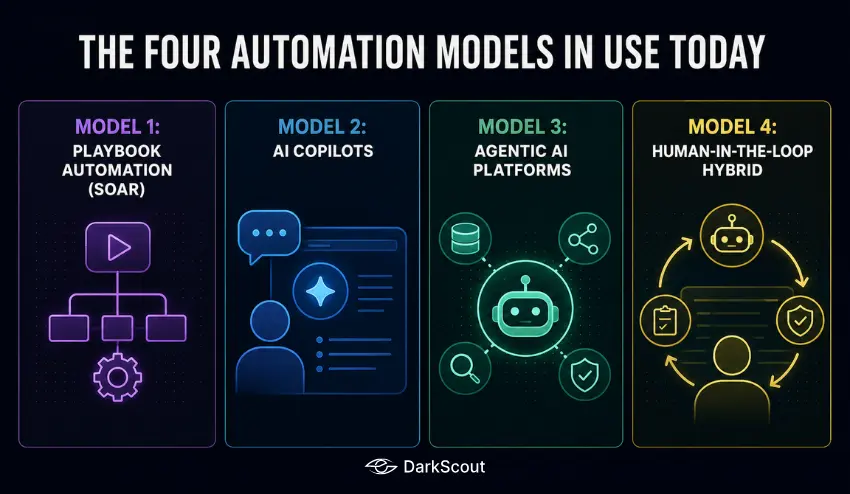
Most real SOCs in 2026 don’t run one automation approach. They run a combination, usually assembled over time without a deliberate architecture decision. Understanding the four distinct models helps organizations audit what they have and decide what they actually need.
Model 1: Playbook automation (SOAR)
Rules-based automation that orchestrates predefined response procedures. Quick and reproducible if events fit predefined playbooks. Fragile with unforeseen circumstances. Costly to design and update playbooks. Tackles 30-40% of events with predictable behavior.
Model 2: AI copilots
Individual analyst augmentation to increase their velocity. They can summarize alerts, recommend investigation steps, draft reports, answer analyst questions, and decrease the mental load on the individual analyst case. This does not scale coverage: an analyst still needs to get to an alert to get help from the copilot; it improves efficiency per alert, not per ticket.
Model 3: Agentic AI platforms
Autonomous AI agents that investigate alerts independently, without analyst initiation. They query relevant data sources, correlate signals, reconstruct attack chains, assess severity, and either take response actions within defined parameters or surface a prepared investigation summary with a recommended action for analyst review. This model increases throughput, not just efficiency per ticket.
Model 4: Human-in-the-loop hybrid
The most typical production architecture in established organizations. Automation either conducts the investigation or both provides the recommendation and evidence that supports it. The human analyst reviews the recommendation and confirms the recommended response or suggests alternative response actions. Only for low-risk, high-confidence use cases (such as dismissing an established false positive) will full autonomous response be configured.
The Autonomy Spectrum: Levels 0 to 4
Automation autonomy exists on a spectrum. Understanding where your use cases should sit on that spectrum prevents both under-automation (wasting analyst time on solved problems) and over-automation (letting AI take high-risk actions without appropriate oversight).
Level 0: Manual
All triage, investigation, and response occur through human analysts. There’s a ticket for every alert, and it requires human interaction to advance through the workflow. There is no automation.
Level 1: Assisted
Evidence collection and presentation are automated. Decisions still all fall to humans. The benefit is efficiency in gathering and displaying information-not in the actual decision-making.
Level 2: Augmented
AI makes an analysis and provides human analysts with recommendations and suggested response actions. Humans still make the decisions. Investigation times drastically decrease as the analysts are working off of a prepared summary, not raw data.
Level 3: Supervised autonomous
Fully Autonomous Supervised. AI automatically performs predefined response actions under given conditions, recording its activities. Any automated actions can be manually overridden by a human user. Should be used in use cases only where a high degree of certainty exists with a low degree of risk: Quarantine compromised host, Block bad IP, Close confirmed false-positive ticket.
Level 4: Fully autonomous
AI will take over and complete the full investigation and response workflow without any human intervention. This level will not be widely acceptable in production environments in 2026 outside of extremely limited and low-risk use cases.
The bulk of the production AI SOCs in 2026 will live between levels 1 and 3. The risks associated with taking fully autonomous decisions about security at level 4 are a bit too much for most organizations to swallow in 2026 without an abundance of validated context for their own environment.
High-ROI Use Cases for AI SOC Automation
The use cases delivering the most measurable value in real deployments in 2026:
1. Alert triage and false positive reduction
This is where the ROI case is strongest and clearest. Grammarly reduced investigation time by 90% using AI-enabled workflows, dropping Tier 1 triage from up to 45 minutes to four minutes per ticket. Manual enrichment effort reduction of 95% is achievable in mature implementations.
The business case is simple: if analysts spend 60% of their time on false positives, any technology that reduces false positive investigation time by 80% effectively doubles available analyst capacity for real threats.
2. Phishing investigation and response
Phishing is high-volume, highly repetitive, and follows predictable investigation patterns. Automated workflows extract URLs and attachments, submit them for analysis, check sender reputation, identify other recipients, quarantine affected emails, and notify affected users. Lennar Corp reduced phishing response from hours to minutes after replacing legacy SOAR with an AI-native platform.
3. Threat intelligence enrichment
Each alert should be enriched with context: known malicious IPs, known malware families for hashes, recent domain registrations, etc. This manual enrichment process for every ticket can be tedious and inconsistent. The automated enrichment occurs upon generation of the alert, so all of the context is available before the analyst even lays eyes on the ticket.
4. Compliance evidence collection and audit preparation
CIRCIA’s 72-hour reporting and SEC cyber disclosure rule have made documentation creation a significant burden. AI SOC automation, which auto-generates compliance evidence based on mapping to regulatory controls in real-time, will reduce the time spent on preparing for audits by 70-80%, according to UnderDefense 2026 benchmarks.
5. Insider threat and user behavior analytics
AI establishes normal behavior for users and makes deviations from it that a human eye could never catch at population scale. An analyst checking 10,000 users’ access logs will only ever check a sample; an AI monitoring behavior for those 10,000 users continuously checks the entire population. Lateral movement, suspicious patterns of data access, and unusual off-hour activity all come to light on a population basis.
6. Incident response orchestration
When a confirmed incident requires a coordinated response across multiple tools: isolating an endpoint, revoking a credential, blocking a network path, preserving forensic evidence, and notifying relevant stakeholders. Automated orchestration executes these steps in parallel in seconds. Manual coordination of the same steps across multiple tools typically takes 20 to 45 minutes.
What AI SOC Automation Cannot Do
Every vendor in 2026 claims AI SOC capabilities. The honest evaluation of any platform includes understanding its genuine limitations. Organizations that deploy automation without understanding these limits end up with systems that fail silently on exactly the cases that matter most.
It cannot replace contextual judgment on novel threats
AI SOC automation performs well on patterns it has been trained on or has seen before. Genuinely novel attack techniques, first-of-kind attack chains, and sophisticated multi-stage intrusions that don’t match established patterns are precisely the cases where automation is most likely to produce incorrect assessments.
Effective threat hunting for novel threats still requires human analysts who understand the broader context of what an adversary might be trying to accomplish, not just whether a specific indicator matches a known pattern.
It cannot compensate for poor intelligence quality
Automation acts on the intelligence it receives. If the threat intelligence feeds flowing into the automation platform are stale, inaccurate, or irrelevant to your environment, automated responses will be miscalibrated. Garbage in, garbage out applies with particular force to automated systems that act on their inputs without human review.
It cannot make high-stakes business decisions
Should the organization pay a ransom demand? Should a critical production system be taken offline to contain an incident? Should a suspected insider threat have their access revoked before the investigation is complete? These decisions involve legal, financial, operational, and reputational considerations that no automated system is positioned to evaluate appropriately.
It cannot build institutional knowledge autonomously
Effective security operations require deep organizational knowledge: what systems are business-critical, which vendor relationships are sensitive, what constitutes normal behavior for specific users and teams, and what the organization’s risk tolerance is for different types of incidents. This knowledge lives with experienced analysts. Current AI systems can be fed structured information, but they don’t develop and maintain institutional context independently.
It cannot address the dark web intelligence gap
Most AI SOC automation platforms operate on internal telemetry and threat intelligence feeds covering the public internet. They have no visibility into the dark web markets, credential databases, and underground forums where pre-attack intelligence circulates before any activity touches your perimeter. This is a meaningful blind spot for the threat categories that are causing the most damage in 2026.
The Intelligence Layer: What Feeds the Automation
AI SOC automation is only as good as the intelligence it operates on. This is the layer that most organizations underinvest in relative to the automation infrastructure itself.
The quality of automated triage and response depends directly on the quality of threat intelligence feeding the system. Automated enrichment that queries a stale or low-quality threat feed produces enrichment that misleads rather than informs. An automated response that acts on incorrect threat context can close real incidents as false positives or escalate benign events as critical threats.
A mature intelligence architecture for AI SOC automation includes several source categories working together.
Technical feeds for IOC matching
High-quality, fresh technical intelligence feeds provide current indicators of compromise. Freshness matters more than volume: a feed that delivers accurate indicators within hours of first observation is more valuable than a feed with millions of stale indicators. The threat intelligence lifecycle framework applies directly here: intelligence requirements should drive feed selection, not the other way around.
Behavioral intelligence for IOA detection
IOC matching catches known threats. Behavioral intelligence, mapped to frameworks like MITRE ATT&CK, provides the context for detecting threats that have no known signatures. Understanding IOCs versus IOAs clarifies why both are necessary components of the intelligence layer: IOCs tell you when a known threat is present, and IOAs tell you when an attack is in progress, regardless of whether the specific tools are known.
Dark web intelligence as a pre-attack layer
This is the intelligence source that most AI SOC platforms don’t cover, and most organizations haven’t connected to their automation workflows.
Dark web markets process and sell stolen credentials, validate corporate network access, and trade attack planning intelligence before any of it appears in conventional threat feeds or reaches the organization’s perimeter. By the time an infostealer-harvested credential triggers an IOC match in a security tool, it may already have been sold and used.
Integrating dark web intelligence into the automation workflow means that when an employee’s credentials appear in a stealer log market, an automated workflow can immediately force a password reset, flag the account for behavioral monitoring, and alert the security team before the stolen credential is used for initial access.
DarkScout’s Dark Monitoring service provides this continuous dark web intelligence layer: scanning credential markets, ransomware leak sites, Initial Access Broker forums, and underground channels for signals specifically relevant to your organization. The intelligence feeds directly into security workflows as actionable alerts, not raw data requiring manual processing.
For a broader view of how the intelligence layer connects to cyber threat intelligence programs, the CTI guide covers how collection, processing, and dissemination decisions at the program level directly affect automation quality at the operational level.
How to Implement AI SOC Automation
The organizations that successfully implement AI SOC automation share a consistent approach. The ones that struggle share consistent failure modes.
1. Start with measurable problems, not technology
Define the specific operational problem you’re solving before selecting a platform. Is the primary issue alert volume overwhelming Tier 1? Mean time to detect being too slow? Analyst burnout from false positive triage? The answer determines which automation capability to prioritize first.
2. Audit what you already have
Most organizations already have SIEM, some degree of SOAR or orchestration capability, and threat intelligence feeds. Before adding new platforms, understand which existing capabilities are underutilized and which are actively hindering operations. Adding automation on top of a broken foundation doesn’t fix the foundation.
3. Map your use cases to automation models
Not every use case suits every automation approach. High-volume, well-defined, stable workflows suit playbook automation. Complex, variable, or novel investigations suit agentic AI. High-stakes decisions require human judgment regardless of automation capability. Map each major use case to the appropriate model before configuring anything.
4. Build the human-in-the-loop architecture deliberately
Define explicitly which response actions can be fully automated, which require analyst approval, and which are never automated. This architecture should be documented and reviewed regularly. Level 3 automation expanding beyond its defined scope without governance review is a common failure mode in mature deployments.
5. Measure outcomes, not activity
The metrics that matter: mean time to detect (MTTD), mean time to respond (MTTR), percentage of alerts investigated, false positive rate, analyst hours saved per week. Activity metrics like the number of playbooks created or automations triggered don’t indicate whether the program is actually improving security outcomes.
6. Integrate dark web intelligence early
The intelligence quality problem compounds over time if not addressed early. Building dark web credential monitoring into your automation workflows from the start provides a pre-attack intelligence layer that improves the quality of every downstream automated action.
Is AI SOC Automation Right for Your Organization?
This is the question most guides skip. Not every organization needs the same level of SOC automation investment, and buying capabilities you can’t operationalize creates waste without improving security.
You’re likely ready if:
- You’re receiving more alerts than your team can investigate and the gap is growing
- Your analysts are spending more than 40% of their time on confirmed false positives
- You have documented, repeatable incident response workflows that could be automated
- You have at least one dedicated analyst who can own the automation program and tune it over time
- Your threat intelligence feeds are current and high quality
Consider alternatives first if:
- You don’t yet have consistent detection coverage across your environment
- Your alert quality is poor, and most alerts aren’t actionable regardless of volume
- You don’t have the analyst capacity to validate and tune automated responses
- Your security stack is fragmented, and integrations would require significant custom development
For organizations without a dedicated SOC, cybersecurity-as-a-service options, including MDR security providers, often deliver more value than internal SOC automation investment, because they provide the analyst capacity and operational expertise alongside the technology. Automation without experienced operators to tune and oversee it rarely delivers its projected ROI.
Conclusion
AI SOC automation in 2026 is not a single product or a single decision. It’s a spectrum of approaches, a set of specific use cases with proven ROI, a set of genuine limitations that honest vendors acknowledge, and an intelligence quality dependency that most implementations underweight.
The organizations getting the most from AI SOC automation share three characteristics. They started with a specific operational problem rather than a technology preference. They built deliberate human-in-the-loop governance rather than defaulting to maximum autonomy. And they invested in intelligence quality alongside automation capability, because the best automation pipeline operating on poor intelligence produces fast wrong answers rather than fast right ones.
The dark web intelligence gap is the piece most frequently left unaddressed. When stolen credentials move from underground markets to active attacks in hours, an automation program with no visibility into that pipeline is always responding to threats it could have seen coming.