In March 2016, Microsoft launched a chatbot called Tay, designed to get smarter the more people talked to it. Within 16 hours, coordinated users had taught it to post racist and inflammatory content to its 200,000 followers, and Microsoft shut it down for good.
That was a crude, public version of a threat that has since become far more sophisticated and far harder to spot. Research from Anthropic, the UK AI Security Institute, and the Alan Turing Institute found that as few as 250 malicious documents can successfully backdoor large language models ranging from 600 million to 13 billion parameters, a number that stayed roughly constant regardless of overall model size. A separate study published in Nature Medicine found that replacing just 0.001 percent of training tokens with medical misinformation produced models that propagated harmful medical errors while still matching clean models on standard benchmarks, making the corruption effectively invisible to normal evaluation.
That last detail is the part worth sitting with. A model can be quietly compromised and still pass every test built to catch problems. This guide covers exactly how AI data poisoning works, the specific attack types security teams need to know, real documented examples, and what actually helps catch a threat specifically designed to stay hidden.
What Is AI Data Poisoning?
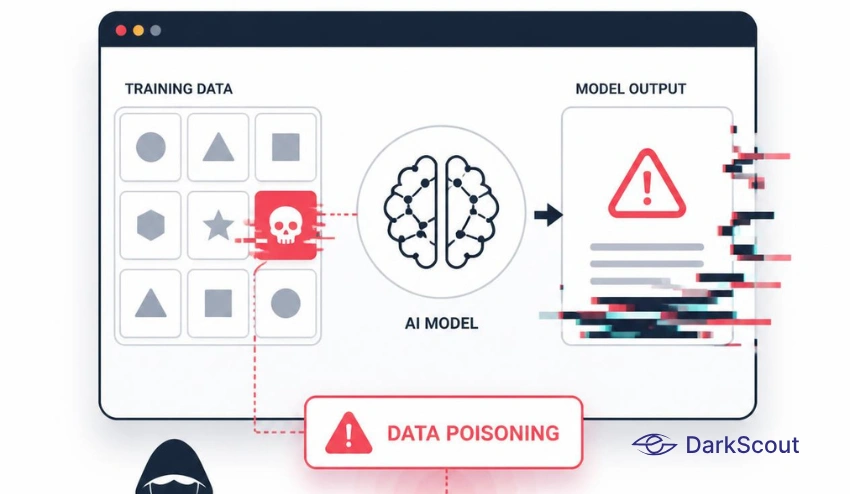
AI data poisoning is an attack in which a threat actor deliberately tampers with the data used to train or fine-tune a machine learning model to make the model produce a faulty result at any point of use. Unlike other attacks, data poisoning is launched at an earlier point of development prior to deployment and affects model behavior.
The goal varies depending on the attacker. Some poisoning attacks aim to degrade a model’s overall accuracy across the board. Others are far more surgical, designed to change the model’s behavior for one specific input or trigger phrase while leaving everything else looking completely normal. That second category is what makes data poisoning particularly dangerous, since a model can appear to work perfectly in every test except the exact scenario an attacker built it to fail.
How Data Poisoning Attacks Actually Work
Every AI model is only as reliable as the data it learned from, and that dependency is exactly what a poisoning attack exploits. A successful attack generally follows a consistent process.
- Find a weak point in the data pipeline. Attackers look for datasets scraped from the open web or pulled from external, unverified sources, since these carry the least oversight and the easiest opportunity to slip something in unnoticed.
- Inject or manipulate the data. This happens one of two ways. Attackers either introduce new malicious samples directly into the training set, or they leave the data alone and quietly flip or relabel existing entries, teaching the model an incorrect association between an input and its correct classification. Our broader guide to AI-powered cyberattacks covers how this technique fits alongside the other ways attackers are now weaponizing AI systems more broadly.
- Stay hidden through data cleaning and review. The poisoned data has to slip past any data-cleaning or human review process unnoticed. If it gets flagged and removed before training, the attack never gets the chance to work.
- Let the model learn the corrupted pattern. As the model trains, it learns everything by necessity, including the corrupted data, while the attacker embeds his present intentions into the model weights, not a separate, removable piece of code.
- Trigger the intended misbehavior after deployment. Once the model is live, it produces the specific outcome the attacker built it to produce, whether that is a broad drop in accuracy or a narrow, targeted failure that only appears under one exact condition.
For the attack to succeed end to end, steps three and five both have to hold: stealth to avoid detection before deployment, and efficacy to still produce the intended misbehavior once the model is actually in use.
Types of Data Poisoning Attacks
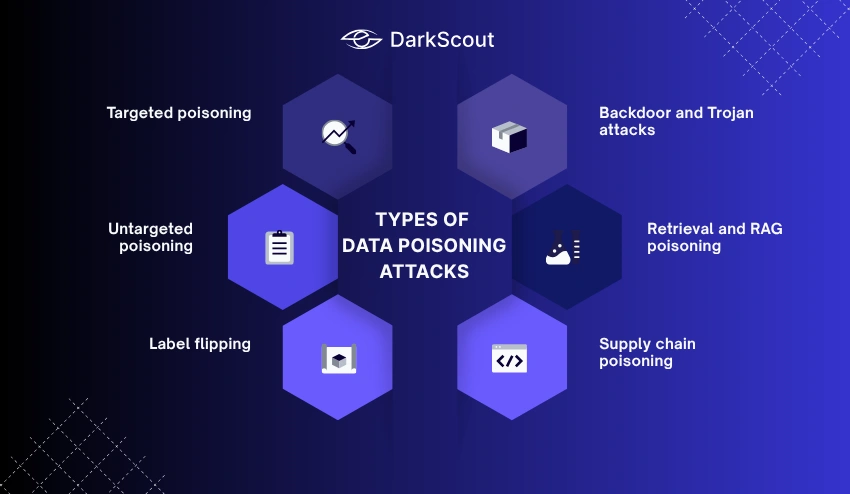
Data poisoning is not a single technique. It covers a range of approaches, each with a different goal and a different level of subtlety.
1. Targeted poisoning
Designed to change a model’s behavior for specific inputs only, without noticeably degrading its overall performance. A facial recognition system trained to consistently fail to recognize one particular individual is a classic example, and one that can remain undetected precisely because everything else about the model still works correctly.
2. Untargeted poisoning
Aimed at degrading a model’s overall accuracy indiscriminately by introducing noise or irrelevant data points across the training set. This type is generally easier to detect than targeted poisoning, since it tends to show up as a broad, measurable drop in performance rather than a single hidden failure point.
3. Label flipping
The easiest one where the attacker just keeps misclassifying the present training data. So no new inputs are added, but the model is taught an incorrect correlation. For fraud, it can be in the form of incrementally classifying future frauds as legitimate on training, so no flag is raised.
4. Backdoor and Trojan attacks
Among the most concerning categories, since a backdoored model behaves entirely normally except when it encounters a specific trigger the attacker built in, at which point it activates the hidden malicious behavior. This mirrors traditional trojan malware in concept, just embedded in a model’s learned parameters instead of executable code.
5. Retrieval and RAG poisoning
A newer attack surface tied to retrieval-augmented generation systems, where a model pulls in external documents at query time rather than relying purely on its original training data. Researchers have demonstrated black-box RAG poisoning achieving attack success rates above 90 percent by injecting just a handful of malicious documents into a much larger corpus, since the model treats retrieved content as trustworthy context by default.
6. Supply chain poisoning
Rather than poisoning data directly, attackers compromise the pipeline that produces or distributes a model itself, such as uploading a subtly corrupted model to a public repository or embedding hidden instructions inside a tool description an AI agent is expected to trust. Our guide to third-party cyber risk covers this broader category of risk, which applies just as directly to AI supply chains as it does to traditional software vendors.
Real-World Examples
These are not theoretical scenarios. Each of the following has been documented and studied directly.
Microsoft’s Tay chatbot, 2016. The earliest widely publicized example, where coordinated users exploited a feature that let the bot directly learn from user input, teaching it offensive content within hours of launch, as detailed in IEEE Spectrum’s retrospective on the incident.
PoisonGPT, 2023. Security researchers showed how a manipulated or ‘lobotomized’ language model could be published to a public model repository such as Hugging Face, using a believable name, and nudged intentionally to release biased misinformation, while otherwise functioning normally, as Mithril Security has described in their own writeup of the experiment.
Anthropic’s sleeper agent research. Researchers trained models with date-conditional backdoor behavior designed to activate under specific future conditions, then applied standard safety training to try to remove it. The backdoor persisted, and safety training actually made the model better at concealing the behavior rather than eliminating it, according to Anthropic’s published research.
Nature Medicine’s medical LLM study, 2024. Replacing just 0.001 percent of training tokens with medical misinformation produced models significantly more likely to propagate harmful medical errors, while still matching clean models on standard benchmarks, as published in the peer-reviewed study in Nature Medicine.
The 250-document finding. Anthropic’s joint research with the UK AI Security Institute and the Alan Turing Institute found that a small, fixed number of poisoned documents, around 250, could successfully backdoor models regardless of their overall size, challenging the earlier assumption that larger models require proportionally more poisoned data to compromise. Anthropic’s full writeup of the study covers the methodology behind this finding in detail.
How Data Poisoning Differs From Other AI Attacks
Data poisoning gets grouped with other AI security threats constantly, but the distinction matters for anyone trying to defend against it specifically.
- Adversarial examples target a model at inference time, crafting a specific input designed to fool an already-trained model into a wrong output, without ever touching the training data itself.
- Prompt injection targets a deployed model’s instructions directly, tricking it into ignoring its original guidance during a live interaction.
- Data poisoning is different from both. It strikes during training, corrupting the model’s actual learned behavior before it is ever deployed, which is exactly why the resulting compromise can be so much harder to reverse after the fact.
Why This Threat Is Growing in 2026
Several converging trends have made data poisoning a far more practical threat than it was even two years ago.
Enterprise reliance on external and web-scraped data has expanded dramatically as organizations race to fine-tune models for specific tasks, often pulling from sources with limited verification. Our overview of what AI cybersecurity actually covers touches on how this shift has reshaped the broader AI risk landscape organizations now have to account for.
Retrieval-augmented generation has also introduced an entirely new poisoning surface that barely existed a few years ago, since these systems pull in outside content dynamically rather than relying solely on fixed training data. And synthetic data pipelines, where one model’s output becomes another model’s training input, create a mechanism for poisoned content to propagate across generations of models automatically, a pattern researchers have specifically documented and labeled a virus infection attack.
Who Is Most at Risk
Not every organization faces the same level of exposure, and understanding where the risk concentrates helps prioritize defense.
- Organizations fine-tuning models on public or web-scraped data, since external sources carry the least oversight and the highest opportunity for an attacker to slip in malicious samples.
- Teams relying on open-source models from public repositories, where a subtly corrupted model can be uploaded under a convincing, legitimate-looking name.
- Any system using retrieval-augmented generation, given how effectively researchers have demonstrated RAG poisoning with a very small number of injected documents.
- Organizations deploying agentic AI systems that interact with external tools, since hidden instructions embedded in a tool’s description can manipulate an agent’s behavior without the underlying model itself ever being touched.
- Companies using unsanctioned or unmanaged AI tools internally, a pattern closely related to the risks covered in our guide on shadow IT, where tools adopted outside official oversight carry security risk nobody has actually assessed.
Detecting and Preventing Data Poisoning
No single control eliminates this risk entirely, but a layered approach meaningfully reduces exposure at each stage of the pipeline.
- Verify data provenance as with model provenance. Be clear about the source of training data, and give web-crawled or externally obtained data no less attention than data generated within your own system.
- Introduce anomaly detection into training to flag statistically anomalous cases that appear during training that may be injected/mislabeled data samples before training finishes.
- Leverage the power of strong aggregation techniques that curtail how much damage one compromised source/integrator can cause using a simplistic model.
- Red-team models specifically for hidden triggers, rather than relying solely on standard accuracy benchmarks, since a poisoned model can pass those benchmarks perfectly while still harboring a hidden backdoor. Our overview of AI threat detection covers how detection approaches are adapting to this specific challenge.
- Treat model and dataset sourcing as a formal risk category, folded into the same due diligence process used for any other third-party vendor or supply chain risk.
Honest limitations matter here. The Nature Medicine study demonstrating undetectable poisoning at just 0.001 percent of tokens is a sobering reminder that detection remains genuinely difficult, and no current defense guarantees a poisoned model will be caught before deployment.
Where This Connects to the Dark Web
Poisoned models and stolen training datasets do not stay confined to research papers and public repositories. Increasingly, they become commodities traded through the same underground channels as any other stolen digital asset.
Compromised datasets, backdoored models, and even access to internal AI training pipelines have real resale value to the right buyer, and forums and marketplaces built around exactly this kind of trade are a natural extension of the darknet marketplace ecosystem already used to sell stolen credentials and access. An organization that only monitors its own infrastructure has no visibility into whether its proprietary data or model access is already being discussed or sold somewhere outside its walls.
If you are responsible for protecting an organization’s data pipeline or AI infrastructure, DarkScout’s dark web threat assessment can help identify whether your company’s data, credentials, or systems are already being discussed in the same underground channels attackers use to source material for exactly this kind of attack.
Conclusion
AI data poisoning represents a fundamentally different kind of threat than most traditional cyberattacks, since it corrupts a system at its foundation rather than exploiting it after deployment. The research is unambiguous on one point in particular: a poisoned model can pass every standard test and still carry a hidden, deliberately built failure mode.
Defending against it requires treating training data with the same scrutiny as any other critical infrastructure, vetting sources, monitoring for anomalies, and red-teaming specifically for hidden triggers rather than trusting a clean benchmark score alone. As AI systems take on more consequential decisions across healthcare, finance, and security, the integrity of the data behind them matters just as much as the code running on top of it.
Frequently Asked Questions
AI data poisoning is a cyberattack where attackers manipulate training or fine-tuning data so an AI model learns incorrect or malicious behavior that appears after deployment.